

When I was working as a senior editor at HuffPost in New York, the HR department launched a poster campaign with the bold headline “Bring all of yourself to work.”
On seeing it, I joked to a colleague that if anyone actually took their heart into their hands and followed this HR missive, they would be escorted off the premises holding a box of their belongings.
That is because the last thing our owner Verizon Media wanted was for any one of us, never mind all of us, to bring our messy complexity into the office; they just wanted us to work hard to meet their short-term profit goals and leave our inner world at home.
It’s not that the senior leaders of Verizon Media were uncaring as individuals but that the system in which we were operating limited them to expressing only a small slice of their humanity.
I suspect many of us have our own version of this. The pressures of daily life leave few spaces where we feel safe enough to show up fully as we are or to accept others as they are. Often this comes down to a fear that we are not enough, or that if we are truly seen, we may be rejected or unloved. Sometimes, it’s even a matter of physical or psychological safety.
My own pattern began in childhood. I often felt lonely and excluded and spent much of my energy on a chameleon-like search for places where I could fit in.
My teacher, the Zen monk Thich Nhat Hanh, known to his students as Thay, created a calligraphy that reads, “Be Beautiful, Be Yourself.” But during that period of my life, I felt anything but beautiful. I wanted only to be someone else, and that belief echoed through my twenties and early thirties.
Sometimes our suffering feels so immense that, out of guilt, shame, or embarrassment, we’re unable to share it, even with those closest to us. It took more than a year of Jungian therapy at the age of twenty-nine before I felt safe enough to share my deepest secret with my psychoanalyst, something I had withheld from everyone else. My therapist was not surprised and responded: “People always bring me their second worst problem first.”
But over the years, I have progressively been able to more deeply embody Thay’s gentle guidance to accept and love myself as I am.
He taught that when we build a home within ourselves, we begin to feel a sense of peace, warmth, and joy. Others can sense it too, not because we’ve become someone else, but because we’re finally at ease in who we already are.
This is not an instant fix but a journey, perhaps even a lifelong one. Aside from time, it also takes diligence and practice. Like a farmer preparing the land before planting crops, we need to create the conditions that allow vulnerability to emerge.
The first step is to begin befriending our pain, recognizing that we are more than our emotions or beliefs. Thay offered a simple but profound practice: When suffering arises, we say hello to it.
A senior monk from Plum Village once shared how, when he first arrived at the monastery in the southwest of France, he expected to be shown a whole cosmology explaining the meaning of life. Instead, he heard Thay speak about simply saying hello to our suffering. Convinced there must be some deeper, hidden meaning, he spent months trying to decipher it, until eventually he let go of the intellectual search and realized that Thay meant exactly what he said.
Just say hello.
I’ve come to understand that this simple act does two things. First, it allows us to welcome our suffering into awareness rather than denying or repressing it. Second, it reveals that there is a part of us that is not subject to the pain but can observe it with tenderness and without being consumed by it.
When my leadership coaching clients feel unable to meet the depth of their suffering, I sometimes ask them to imagine a wise part of themselves hovering above their situation, able to see clearly without being caught in the emotional drama. Almost without exception, they immediately can see the forest for the trees and find a more compassionate and intelligent response. Another way of asking this is: What advice would you give to a close friend in the same situation? The answer is often far kinder than the way we treat ourselves.
I often use the metaphor of entering a dark room and being confronted by the shadow of what appears to be a giant monster cast on the wall. Our instinct is to run. But if we turn toward the source, we discover it’s just a small mouse standing in front of a lamp. Our pain is often like this—intimidating at first glance but less overwhelming when we face it directly.
As we learn to be present with what arises, we begin to see how both our struggles and our successes have shaped us. Rather than something to be exorcised, our suffering becomes something we can learn to accept. I often ask people I coach to name the qualities they’ve developed through their suffering, and they can usually and quickly come up with a list. The answers range from greater empathy and deeper listening to increased resilience in the face of life’s ups and downs.
As we make peace with the parts of ourselves we once rejected and acknowledge how they have shaped us, we become more able to live in the present moment rather than being pulled into the past or future. We begin to forgive ourselves for anything we feel we may have done that has contributed to the situation we are in, and we see more clearly that beneath everything there is a fundamental capacity for connection and love.
We discover that being beautiful and being ourselves is not just a personal practice but one that deepens through the recognition that we are a small part of a glorious whole; there is what Thay called interbeing.
What can motivate us is that this process of healing is not only for our own benefit; it’s in service to the collective consciousness. When we begin to heal and show up more authentically, we create space for others to do the same. By taking off our protective armor and revealing our scars, we give others permission to be real. Something new can emerge between us, a deeper connection that wasn’t there before.
I often think of it like a tuning fork: When one begins to vibrate, it can cause another identical fork to resonate and “sing” in response.
There is a saying that we can only truly understand someone else’s suffering to the extent that we have been able to look at our own. As Thay said, “the more we have suffered in the past, the stronger a healer we can become. We can learn to transform our suffering into the kind of insight that will help our friends and society.” Doesn’t that, on some level, resonate with everyone’s deepest aspiration?
Many people ask how I protect myself in my coaching work, given that others normally come to me with their problems rather than their joys. My answer is that because I have gone into my own hell realms and not been obliterated in the process, I can sit with others in their dark places without either avoiding the depths of their suffering or being overwhelmed by it. I can metaphorically hold their hand and sit with them so that they know they are not alone.
Like assembling the pieces of a puzzle, as we integrate the different parts of ourselves, we begin to see the whole picture of our lives more clearly. In doing so, we can start to relax.
We begin to realize that we’re already enough. Trying to be someone else only takes us further from our center. This, to me, is the very definition of what it means to feel at peace. When we cultivate peace within, we see more peace in the world around us. When we feel at peace, we no longer have to cover up our fear, anger, and despair through distraction or overconsumption.
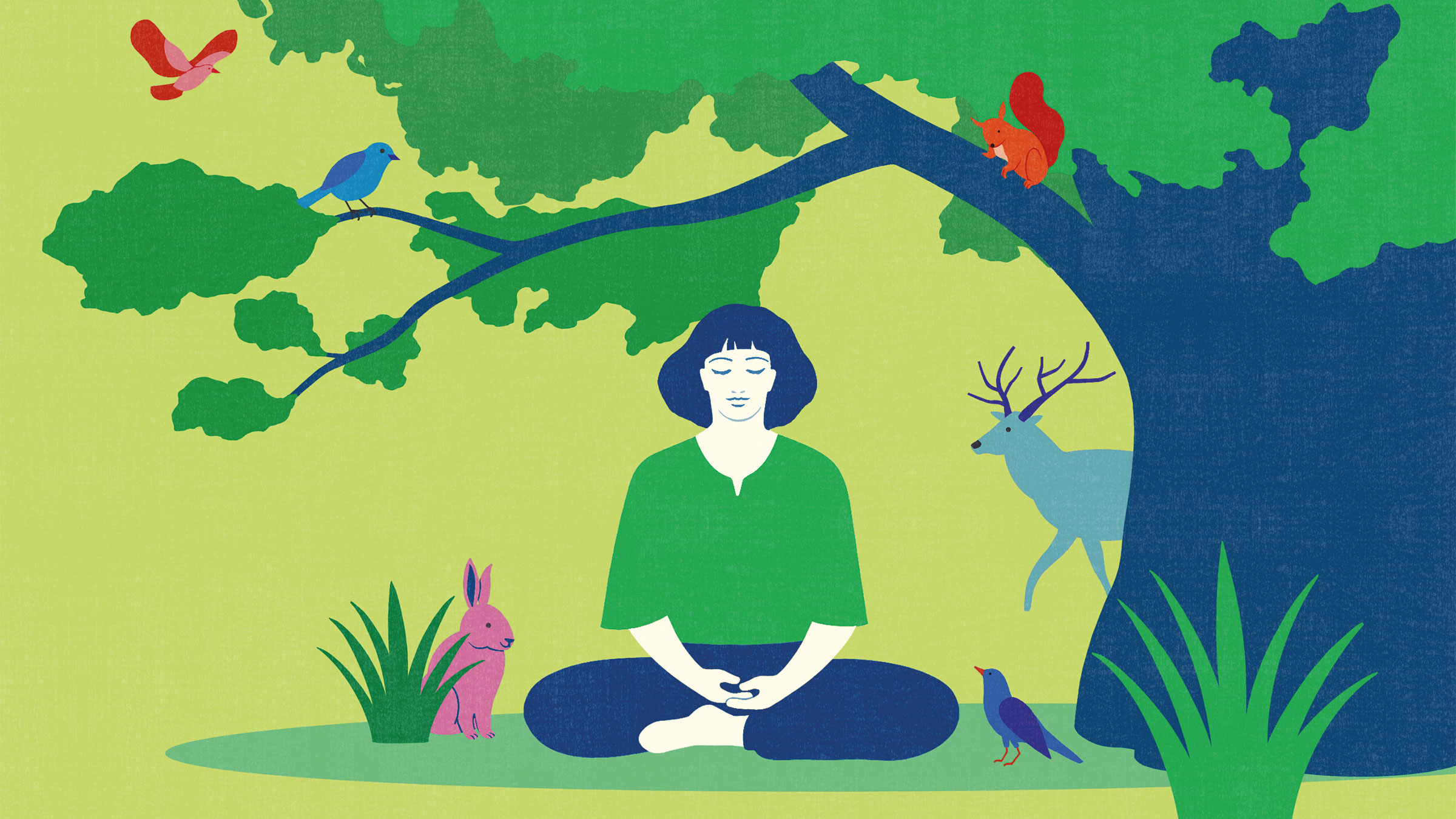
What gave me such faith in Thay as a spiritual teacher was his presence. There was no gap between what he said and how he lived. Because of that, I was able to completely trust him, and as a result, his teachings were able to penetrate me more deeply. His presence was a refuge, just like a great oak tree offers a home for many different species.
This was not accidental. He had lived through the Vietnam War, witnessed immense suffering, lost friends and fellow monks in the conflict, and been exiled from his homeland for refusing to take a side. Yet rather than turning to hatred or despair, he embodied compassion and understanding.
A similar insight appears in Man’s Search for Meaning by psychiatrist, neurologist, and philosopher Viktor Frankl, who was a Holocaust survivor. He observed that despite the extreme suffering, some prisoners in the Nazi concentration camps maintained the capacity to comfort others and find refuge in their inner dignity.
When we strip everything back, our deepest aspiration is not fame, wealth, or the fulfilment of desire, but something far simpler and more profound: to love and be loved, to know where home is. There are many ways of expressing this, but they all point to the same truth.
“It’s so simple,” said Thay. “To love is to be there. It’s so obvious. If you are not there, how can you love? But so many of us are so busy, we cannot be there and when we are there, we are not pleasant, we are not peaceful, we are not compassionate, we are full of stress and irritation.” Love begins with offering your true presence. This in itself is a practice.