

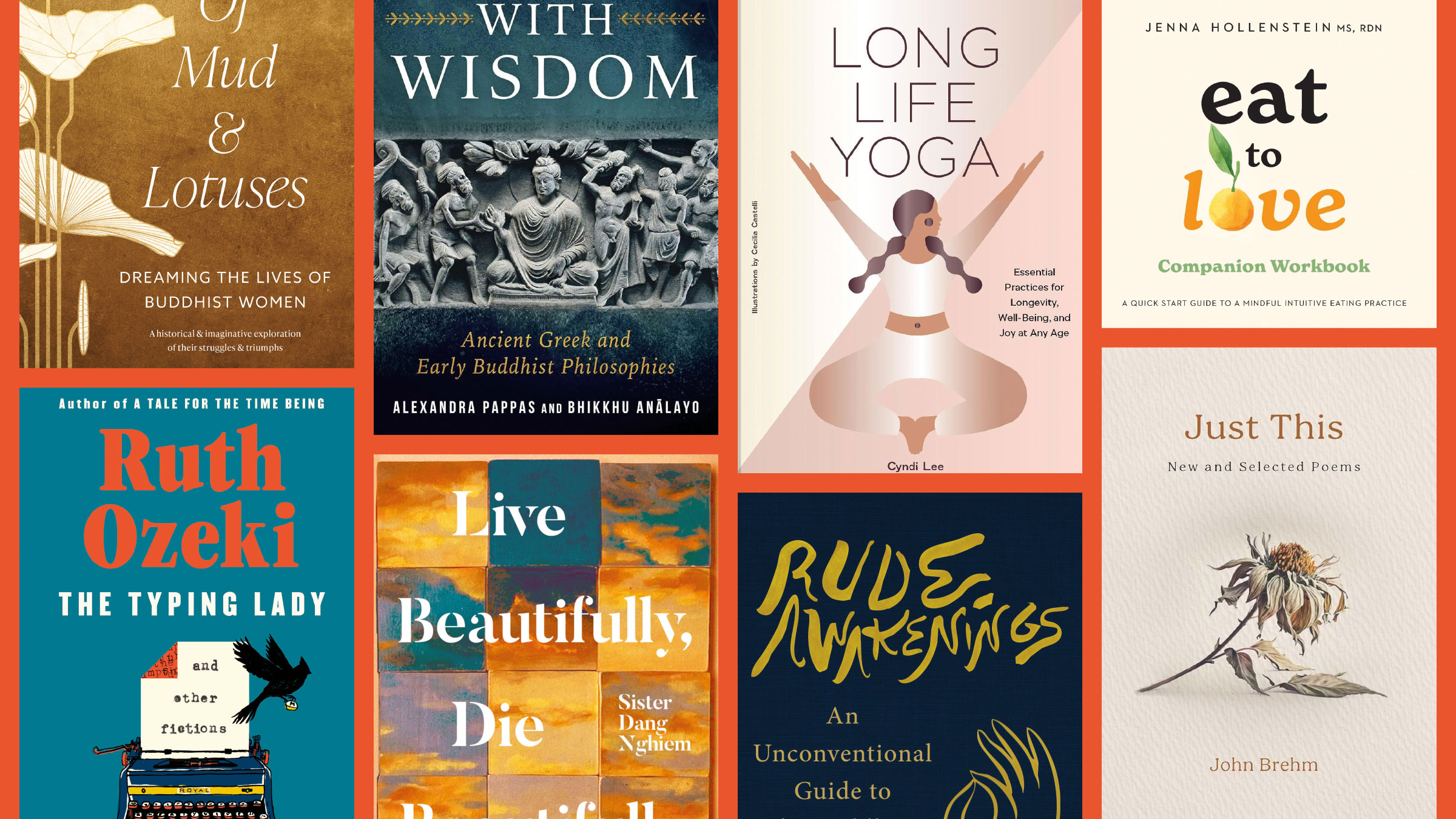
Paula Arai explores what it means to be a Buddhist woman in her new book Of Mud & Lotuses: Dreaming the Lives of Buddhist Women (Shambhala Publications). Part One is a collection of imagined accounts of women’s lives throughout Buddhist history. Examples include a fictitious exchange of letters between Siddhartha and his stepmother Mahaprajapati, and a story about a fifteenth-century Japanese woman who smuggled her hair into a monastery hidden inside a statue she donated. Where the history of Buddhist women has frequently been left unrecorded, Arai uses creative narrative to illuminate what might have been. Part Two consists of nonfiction vignettes based on interviews she conducted with contemporary North American Buddhist women and deals with deeply personal issues, including abortion and addiction. In both sections, Arai, a Japanese American scholar who specializes in the role of women in Buddhism, explores both the disenfranchisement and hidden power of Buddhist women.
The Typing Lady: And Other Fictions (Viking) is a book of short stories by renowned novelist and Zen priest Ruth Ozeki. The stories in this collection are imbued with Zen wisdom and philosophy. In the story “Feelings,” she writes about two high school girls who are assigned a “compassion project” and explore their own selfishness. In “Dead Beat Poet,” the main character, who works in the publishing industry, is visited by the ghost of a Beat poet who advises her to get in touch with her authentic self and not run away from bad feelings. In the ghost poet’s words: “Well, you don’t have to feel shitty about feeling shitty. You don’t have to feel meta-shitty.” Ozeki says she finds that writing is similar to her Zen practice because it is a kind of meditation on the world around us.
What are the similarities and differences between ancient Greek philosophy and early Buddhist thought? That’s the question addressed in In Love with Wisdom: Ancient Greek and Early Buddhist Philosophies (Wisdom Publications). The first half of this comparative study is written by Alexandra Pappas, a specialist in ancient Greek philosophy, and the second by the German Buddhist monk and early Buddhism expert Bhikkhu Analayo. The book compares how these two traditions deal with topics like impermanence, the middle path, the four elements, and the practice of mindfulness, in particular when approaching death. Diving into these ancient philosophies, one Western, one Eastern, may help us better understand how Buddhism can be integrated into the Western world today.
“When we remember that death is certain, we begin to value each breath more deeply,” writes Sister Dang Nghiem, MD, in her new book Live Beautifully, Die Beautifully: Field Notes from the Edge of Impermanence (Parallax Press). Sister Dang Nghiem left her medical career to join Thich Nhat Hanh’s monastic order after her boyfriend died in an accident. She writes, “In the following pages, I offer my life as a kaleidoscope.…My deepest wish is that, as you turn this kaleidoscope, you will also see the colors and patterns of your own life and discover how much beauty is already there.” Dang Nghiem frames her book around the five remembrances, teachings that remind us we are of the nature to age, fall ill, and die; that everything we love is subject to change; and that our actions are our only true belongings. These remembrances are a cornerstone of Buddhist practice, guiding us on our passage from life to death and inviting us to live more fully while we’re alive.
Well-known yoga teacher and Buddhist chaplain Cyndi Lee writes about the value of yoga throughout every stage of life in Long Life Yoga: Essential Practices for Longevity, Well-Being, and Joy at Any Age (Chronicle Books). She explains that as we grow older, our relationship to yoga postures evolves naturally, but we never have to feel like yoga is too difficult for us or that we are too old for yoga. Lee’s new book teaches us sequences of gentle postures that, while challenging, should not lead to injury at any age. Cecilia Castelli’s illustrations are clear and inviting, and the overall presentation is warm and welcoming. The book is divided into two sections: Section One discusses the yamas (the “don’ts”) and the niyamas (the “do’s”), which are yoga’s ethical guidelines for cultivating a balanced and harmonious life. Section Two teaches asanas appropriate for older practitioners. Lee discusses restorative yoga and what she calls “anti-inflamm-aging” postures. Finally, she ends with relaxation.
The founder of Shambhala Publications, Samuel Bercholz, writes with humor and alacrity about practicing the dharma in Rude Awakenings: An Unconventional Guide to the Buddhist Path (Shambhala Publications). The book covers the foundations of Buddhism, Mahayana teachings, worldly wisdom, and the Shambhala tradition of Tibet. He also writes about what it means to lead an artistic life and how to find and communicate with a good Buddhist teacher. Bercholz studied with famed Tibetan guru Chögyam Trungpa Rinpoche for seventeen years and with Thinley Norbu Rinpoche for twenty-one years. The book is infused with his teachers’ wisdom and tells fascinating stories about Bercholz’s encounters with them. Two appendices discuss the time and teachings of Trungpa Rinpoche and inspirational Shambhala warrior slogans.
Nutrition therapist and mindfulness teacher Jenna Hollenstein has written a workbook to accompany her 2019 book Eat to Love: A Mindful Guide to Transforming Your Relationship with Food, Body, and Life. Eat to Love Companion Workbook: A Quick Start Guide to Intuitive Eating Practice (Cambium Editions) is an easily accessible collection of exercises, journal prompts, self-compassion practices, and practical tools to help the reader move away from diet culture and food policing and toward a more attuned, gentle way of relating to food. She has divided the workbook into chapters entitled Earth, Sun, Rain, Trunk, Branches, and Air. Each chapter explores an element of personal growth. For example, the earth is our foundation, so this chapter discusses foundational needs such as self-regulation and healthy sleep habits. If you want to readjust your relationship to food and eating, this book will help you find your way back to your body’s natural wisdom and live in accordance with your values. Hollenstein is a regularLion’s Roar contributor. Her article “Nourish Yourself” is on page 15, and she is our resident teacher for September.
“Now I long / to see and say something / beautiful, something that would / redeem this suffering, sanctify it, / or at least make it more bearable,” writes John Brehm in his new poetry collection Just This: New and Selected Poems (Wisdom Publications). Faced with a difficult diagnosis, Brehm has created a collection of wise, unflinching, humorous, and redemptive poetry. The first part of the book is dedicated to new poems, which largely deal with themes of illness, pain, and mortality. The second brings together selected poems from his previous collections, allowing us to get a sense of Brehm’s evolution as a poet. Author of four books of original poetry and a book of essays, Brehm edited the best-selling anthology The Poetry of Impermanence, Mindfulness, and Joy, also published by Wisdom. With his wife, Alice Boyd, he leads mindfulness retreats that incorporate poetry.