
Until recently, Buddhism was the only major tradition in American higher education without a national campus ministry organization. As a Buddhist campus chaplain, I saw the need firsthand. I had served on several college campuses, and could see that we Buddhist campus chaplains were under-resourced. Christian chaplains were funded by sending organizations, such as Newman Ministry and InterVarsity Christian Fellowship. The Jewish campus organization, Hillel, was able to advocate for the spiritual needs of its students and provide dedicated worship space. Muslim and Hindu chaplain organizations, while newer than their Christian and Jewish counterparts, have national conferences and student networks.
But Buddhist chaplains and student organizations, by contrast, often lack access to the institutional memory or resources that would help the bodhi seeds to grow in this new field. As Venerable Priya Rakkhit Sraman, the Buddhist chaplain at Emory University, put it at our first meeting of Buddhist campus chaplains in 2023, “We need a Buddhist Hillel.”
That first meeting, held on Zoom on a Saturday during winter session, made it clear that individual chaplains have found skillful ways to adapt the dharma to campus ministry. By sharing those techniques, we could increase our collective resiliency.
Out of that conversation grew Maitreya Association, a national peer network of Buddhist campus chaplains, which I helped to found and now serve as president. Its name references Thich Nhat Hanh’s teaching that the future Buddha may take the form of a sangha. While our organizations continue to be light on material resources, we have discovered that the primary infrastructure — which transmits the light of the Buddha’s teaching seamlessly — is kalyanamitta, spiritual friendship.
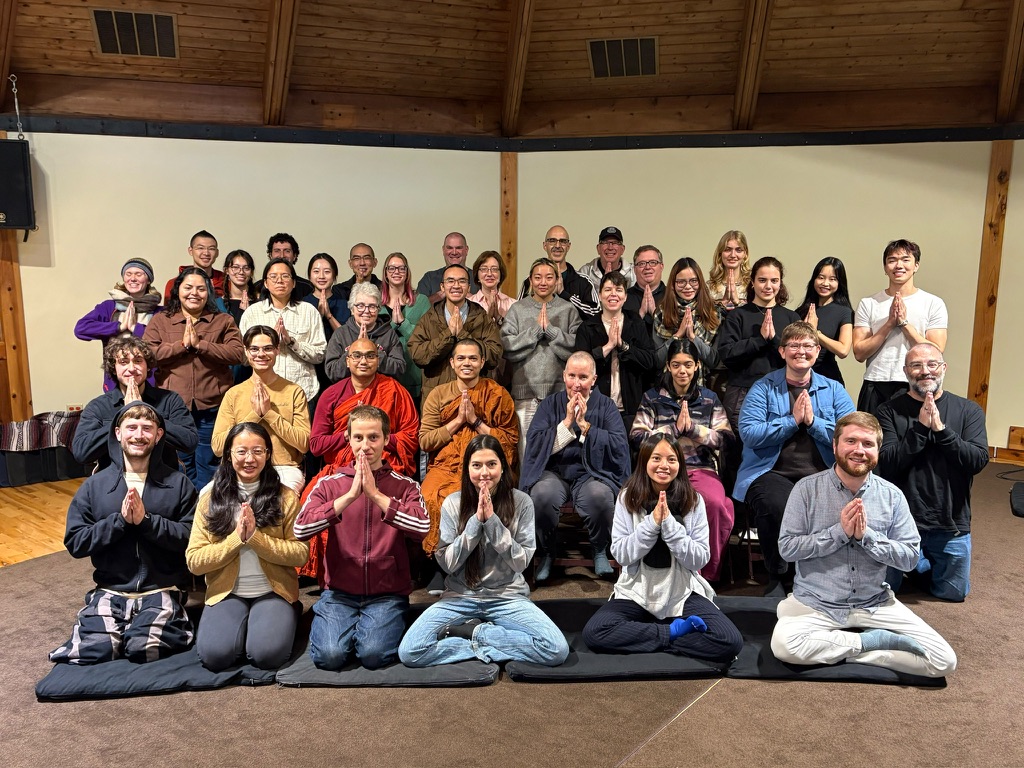
This October, forty-two chaplains and student leaders from nineteen institutions responded to Maitreya Association’s invitation to gather at Omega Institute in Rhinebeck, New York, for our second annual conference. We came together for three days to deepen that friendship across lineages and campuses, to strengthen our skills as chaplains, and, for the first time, to bring Buddhist student leaders into the circle.
Around the Fire
On an autumn evening in the Hudson River Valley, we gathered around a bonfire. Jonathan Makransky of Harvard Divinity School began by introducing a Tibetan sang (smoke) offering, reciting it in Tibetan and then in English translation. The sang offering is a gesture of ultimate generosity: incense and resinous wood are given to the fire, and all beings in the six realms are invited to receive nourishment.
We followed this with traditional Korean Son Kwanseumbosal kido chanting, a recitation practice accompanied by moktak percussion. Our voices found a new rhythm together, while at the periphery of our senses we enjoyed a sacred “time outside of time” supported by the natural elements: the firelight, and an autumn wind infused with the coolness of the nearby pond.
In the stillness that followed the chanting, the fire illuminated robes, malas, hoodies with college names. Students and chaplains offered poems, gathas, songs, and pranayama that arose from the creativity of their own encounter with the dharma. Forty-year practitioners sat beside students who’d first joined a “Buddhist club” last spring. I was reminded of the Lotus Sutra passage:
plants, bushes, medicinal herbs
trees large and small
a hundred grains, rice seedlings
sugar cane, grape vines
The rain moistens them all,
none fails to receive its full share.
Just as many diverse plants and trees share a forest, it is the diversity of the forest that nourishes its full, vibrant expression of life. Buddhist life on American campuses is awakening to that same potential, through moments like these in which we connect at the root.
Throughout the conference, we emphasized relationship-building. We encouraged chaplains and students to make new friends, to reach across lineages and campuses. In this way, the shared meals, kayaking, and other “integration time” we planned for the event did the foundational work of establishing dharma friendship. We could see friendships developing across picnic tables and along the meandering forest trails.
This was the first event since Maitreya’s inception to include Buddhist student leaders, and the students’ conversations continue online today. A student representative gives feedback to Maitreya Association on what students need to grow their own network. This year, Maitreya Association offered seed grants to support three student group initiatives: these were made possible through the generosity of Buddhism.net, an organization founded by Chade-Meng Tan. Maitreya Association also notes the generosity of Hemera Association, which, together with Buddhism.net, funded this conference.
Unity in Diversity
Early in the planning, the Maitreya Board decided to anchor this conference in the act of taking refuge together. We had first taken refuge together in a ceremony at our inaugural conference one year ago, and many had found that to be a powerful experience.
The practice of taking refuge is one all Buddhists share, and can be traced to the time of the historical Buddha. Taking refuge together affirms the deeply rooted connection we share and the ethical commitments we together vow as a sangha. Our gathering thus can be felt as a mahasangha, a reunion of different branches of the original bodhi tree and whose flowers and fruits are visible through the contributions of recitations and teaching words from culturally diverse lineages.
My approach to such ceremonies has been shaped by many years of work with Victor Kazanjian, who served as Dean of Religious Life at Wellesley College. Rather than reducing campus services to only what every tradition holds in common, he encouraged each community to contribute something distinctively its own. As a preface to such ceremonies, he encouraged those present to find “moments of connection through that which was familiar, and moments of inspiration from that which is new.”
We made that understanding of pluralism explicit in the introduction to our refuge ceremony. While we foregrounded the Three Refuges chanted in Pali, we also included contributions from individual participants to represent the diversity of lineages, such as The Four Dharmas of Gampopa and the Heart Sutra in Chinese. We also centered a recitation of the Five Mindfulness Trainings as articulated by Thich Nhat Hanh and his Order of Interbeing.
The day before the ceremony, Buddhist chaplain Jess Benjamin told us that they wished to take precepts at this ceremony. So we all renewed our own commitments to the path. Thus our pan-lineage refuge ceremony included teachers and students from several lineages saying the refuges aloud, representing the unity-within-diversity of the global Buddhist sangha.
What the ceremony offered us is what we hope to offer our students: to be met in the particularity of one’s own culture and practice lineage. Yet most of us, even graduates of Buddhist MDiv programs, have little training in the teachings and ceremonies of Buddhist traditions other than our own. To close that gap, Maitreya Association is compiling resources from sanghas across the United States into a digital library, so that a chaplain will be able to respond to a careseeker with the liturgy or ritual that honors that person’s path.
A Path of Service Coming of Age
As we gathered this year, we were very aware that this is a precipitous time for higher education: necessary infrastructure such as the Department of Education is being dismantled, student loan access is curtailed and academic freedom has been under siege (both individually, through the arrest of international students for First Amendment exercise and institutionally, through the threatening of universities’ tax-exempt status). At a time when universities’ foundations are shaken, it is particularly important to keep strengthening Buddhist campus chaplaincy as a profession, with shared ethical standards and ongoing training, so that we work with students in effective and integral ways.
Ven. Priya and Buddhist chaplain Ivan Kusa Mayerhofer co-hosted a workshop on ethics, in which we centered the themes of confidentiality, dual roles, power and boundaries. This spring, Maitreya Association launched a course on Buddhist ethics (designed by Nathan Michon), and it hosts ongoing ethics peer groups. In addition, Maitreya Association now has a new Ethics Committee, charged with drafting a Buddhist chaplain code of ethics. Maitreya is also planning to launch additional web-based resources for continuing education this year. These initiatives, spread across four committees (Governance, Education, Ethics, Fundraising), are helping us to actualize our aspiration toward structured, robust organization across campuses. The professional structure is a way of tending to social sustainability — helping chaplains connect to themselves and others in nourishing ways, so as to tend to all beings without burning out.
On Sunday morning at dawn we practiced sky-gazing as the sun rose over the lake. We then spent an hour in small groups, reflecting on our aspirations for the community. Spiritual friendship was one, along with infrastructure, a robust network, and digital training resources. So much is still in process — but our network of spiritual friends has begun, and as the Buddha told his attendant, Ananda, spiritual friendship is the path.
Although Maitreya Association is grounded in campus chaplaincy, we are now opening our doors to chaplain members from other sectors of chaplaincy — whether healthcare, prison, military, first responder or another sector. We hope that every chaplain will be supported and sustained by a sangha of peers, and that every careseeker will find a well-cultivated Buddhist chaplain. Perhaps you too, dear reader, will be moved to reach out toward this forest of chaplain-practitioners, to be nourished by the timeless mercy of dharma rain. We welcome inquiries at https://www.maitreya-association.org/
The author acknowledges with gratitude the Maitreya Association Board: Jonathan Makransky, Venerable Priya Rakkhit Sraman, Victor Gabriel, Dan Storey and Mark Miller.