


For the first time in history, Buddhist college chaplains — previously working in isolation across campuses — have united to create sustainable spiritual care infrastructure for young adults. In recognition that, as Thich Nhat Hanh said, “the future Buddha is Sangha,” this collective is named the Maitreya Association.
In the Association, twenty-four chaplains from all the Theravada, Mahayana, and Vajrayana traditions have co-created and conducted a historic pan-lineage “Taking Refuge” ceremony, demonstrating that sectarian boundaries can dissolve while maintaining lineage integrity. The organization, which I co-founded and for which I serve as president, is also hosting monthly professional development sessions for Buddhist chaplains, and recently gave a webinar through the Chaplaincy Innovation Lab, to raise awareness regarding the spiritual needs of the next generation.
Teaching college students is different from teaching non-college adults. The attention span is different, we agreed, and the readiness of college students for long periods of formal meditation is different, too. Skillful means are needed to help students integrate practice into their lives, and establish a network of spiritual friends.
Twenty of us were gathered together on Zoom, eager to build connections. It was mid-January 2023. What is it, to do dharma work specifically as a chaplain rather than as a dharma teacher, working within and on behalf of a lineage? The university charges us to support the spiritual life of all Buddhist students — while working with students whose cultural and lineage diversity is a veritable United Nations of Buddhism: how do we do that? What resources can we find within our own lineages that support honoring the views of other lineages, and how can those become part of a shared Buddhist campus culture?
Every other major world religion has a campus chaplaincy organization which does advocacy, training and fundraising. What would it take? Could we indeed form such an organization, so as to make possible a sustainable future for Buddha’s way in the West? In order to do this well, truly as Sangha, we would need to meet in person.
We physically gathered for the first time at Tufts University’s Multifaith Center in June 2023, studying together using case studies, practicing together, and engaging in conversation around next steps. Trust and momentum had built. We were now ready to write grant proposals together to bring this organization into being.
Chaplain Kotatsu John Bailes, the Wellesley College Buddhist chaplain, kindly offered space for our next planning session, in June 2024. We elected officers for an organization we named Maitreya Association — which holds as its mission giving birth to the future Buddha. We created timelines: within one year, we would form a 501(c)3, and create a website which would hold a database of the pan-sangha materials that Buddhist chaplains need. We set out to work on this by building relationships with each other, with colleagues in related fields, and with philanthropists. By January 2025, we received the initial gift which seeded the nonprofit process and website build-out. We were then able to plan for an inaugural conference, graciously hosted again by Wellesley and Bailes.
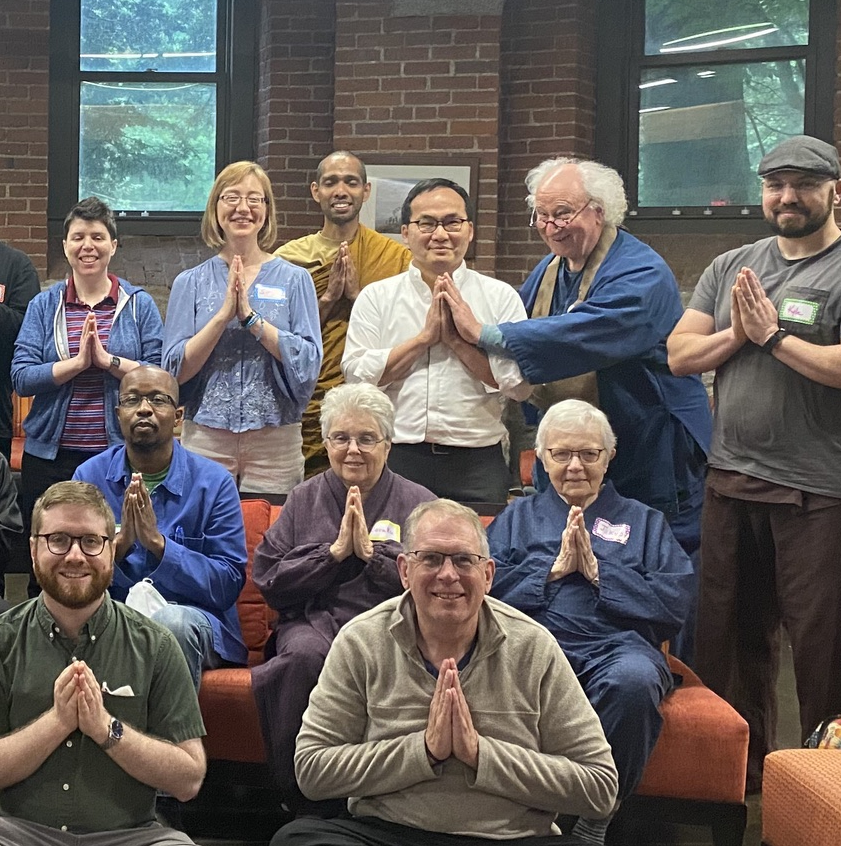
The Inaugural Conference of the Maitreya Association took place in the spring of 2025, drawing twenty-four Buddhist chaplains from every geographic region of the United States, plus one colleague from Canada. For many of those present, it was the first time they had ever been in a room with so many peers doing the same work, facing the same questions, and carrying the same aspiration: to make the dharma genuinely available to young people at one of the most formative and vulnerable time of their lives.
The students arriving on college campuses today inhabit a world of extraordinary complexity: ecological crisis, social fragmentation, the psychological weight of digital life, and a spiritual hunger that secular frameworks often struggle to address. They are also, many of them, genuinely curious about the dharma. They arrive having heard something — in a wellness app, from a therapist, in a book — and they want to know if there is more. The Buddhist chaplain may be the person who shows them that, indeed, there is.
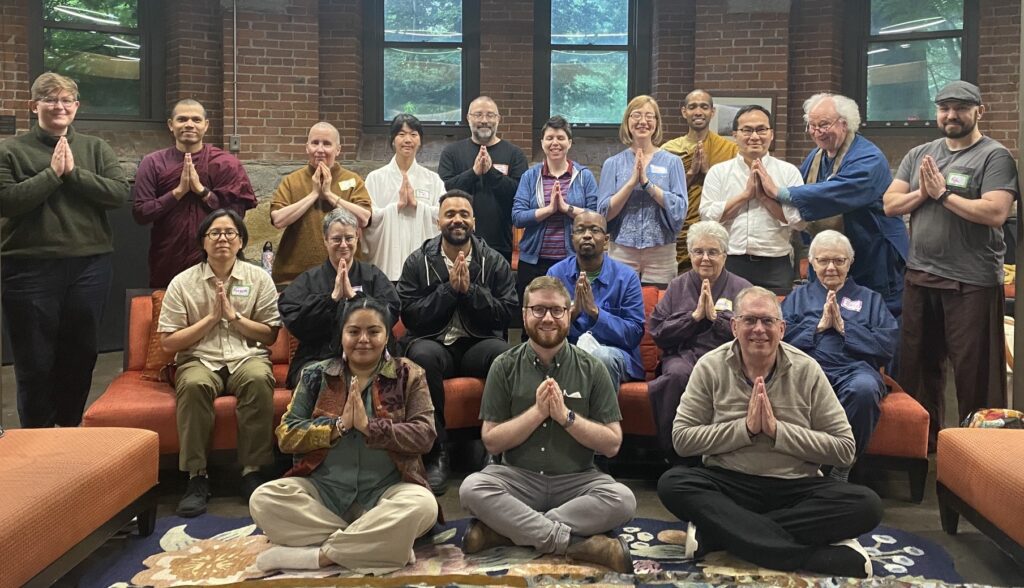
Chaplains’ availability for gatherings falls almost entirely outside the academic year, which is precisely when their undergraduate students are away. This meant that, however much we longed to bring chaplains and their campus sanghas together in one historic pan-lineage ceremony, wisdom and practicality demanded we proceed in stages. The inaugural conference would be for the chaplains themselves — a chance to keep building the trust, the shared language, and the relational ground that any authentic pan-lineage practice requires. The students would come later.
The heart of the conference became a moving pan-lineage Taking Refuge ceremony. We chanted the traditional refuge verses together, undertook shared practices of purification including mantra recitation and prostrations, and received the blessing of refuge. The preceptors present came from different lineages; the graduate students and chaplains assembled carried different practices, different teachers, different cosmologies in some respects. And yet the three jewels of Buddha, dharma, and sangha held us all. To take refuge together was not to erase the particularities of lineage but to remember our kinship within the great lineage tree of the historical Buddha.
Beyond the ceremony, chaplains gathered in small groups and larger conversations to share what they were actually doing on their campuses — what was working, what remained difficult, and what they needed. The practical and the contemplative were woven together throughout the days. Committees began to form organically, as chaplains volunteered to lead professional development initiatives and networking efforts.
From those conversations emerged concrete priorities for the year ahead. Maitreya Association has a research project in which it is gathering liturgies from all Buddhist lineages. (Maitreya Association invites anyone to send us texts of the chants and rituals their sanghas use.) The project’s completion will help all those in our sanghas who sometimes find themselves in a hospital or another transitional place, in need of spiritual care.
Chaplains also discussed their own professional development needs. Chaplaincy is a bit different from dharma teaching. It has its own professional standards. Maitreya Association has gone about supporting professional development in two ways: 1) through group membership in the Chaplaincy Innovation Lab, a national organization that supports spiritual care professionals across traditions. And, 2) through monthly seminars every Saturday focused on professional development, with sessions facilitated by various Maitreya Association members and publicized through the Chaplaincy Innovation Lab’s networks. Together, these offerings are building what one chaplain has called “a rhythm of sangha” — a regularity of connection that mirrors the kind of spiritual continuity we wish to offer our students.
The Maitreya Association has also begun building partnerships beyond its own membership. A developing relationship with Dharma Gates has already yielded a retreat partnership between Dharma Gates and Emory University, and discussions are underway about future retreats in collaboration with the Maitreya Association. The idea taking shape is a pan-lineage retreat that would bring chaplains and undergraduate students together — finally realizing the hope that was seeded at that very first Zoom call in January 2023. That retreat, which will take place at Omega Institute in October 2026, will require the kind of careful preparation that comes from the relational groundwork being laid now.
Through the discussions and hybrid practices that take place in these campus sanghas, these students will grow up in the dharma, understanding — through their own direct experience — the kinship that exists across lineages.
The Maitreya Association exists to ensure that their chaplains will not be working alone, that they have colleagues who understand their particular vocation, resources tailored to their context, and a shared sense of purpose that can sustain them through the long, unglamorous work of planting seeds — even if these seeds don’t bloom until a student has graduated and the chaplain who first offered them a cushion has long moved on. This is the nature of this path of kalyana-mitta, spiritual friendship.
Thich Nhat Hanh’s statement that the future Buddha is sangha is a heart instruction which the Maitreya Association is taking as a charge. Buddhist chaplains are, in their day-to-day work, weaving together the psycho-spiritual trainings of modern chaplaincy and the ancient wisdom of the Eightfold Path. Through this skillful means, we can help the lotus bloom in the muddy waters of twenty-first century campus life, as students encounter the dharma for the very first time — and their lives begin to change.
The author acknowledges with gratitude the Maitreya Association Board: Jonathan Makransky, Venerable Priya Rakkhit Sraman, Rebecca Nie, Dan Storey and Mark Miller.