


I recently attended the grand opening of Tergar Osel Ling Monastery in Kathmandu. It was splendid by any measure. And it revealed something profound: a new way of being that sits at the confluence of three Buddhist cultures.
On the first morning, Vajradhara Chamgon Kenting Tai Situpa spoke directly to his disciple, Mingyur Rinpoche. Tai Situpa is the last living member of the circle of four teachers who shaped Mingyur Rinpoche’s training. Mingyur Rinpoche’s father, Tulku Urgyen Rinpoche, gave him his earliest instruction. Nyoshul Khen Rinpoche served as his primary Dzogchen teacher. Saljay Rinpoche guided him through his first three-year retreat. Those three have passed. Tai Situpa, alone, remains.
Tai Situpa spoke eloquently about the power of building an epicenter of Buddhist thought and practice. And then he turned to his disciple. Despite his efforts, he said, he struggled to relate to the contemporary mind — but Mingyur Rinpoche clearly could. It would be Mingyur Rinpoche, he said, who would lead the modernization of the Tibetan dharma, and he would do so while upholding the authenticity of the transmission. A teacher of Tai Situpa’s renown and seniority publicly acknowledging the limits of his own understanding is rare; acknowledging his student’s role in this way is rarer still. His words landed on me, a disciple of Mingyur Rinpoche, with particular force.
I do not mean “devotion” as one practice among others, ranked beside study, meditation, and so on. Instead, I mean it in a larger sense: the love and trust that animates all our practice.
The ceremony itself was an extravaganza. There were dance performances and theatre, song, formal descriptions of the monasteries and projects under Mingyur Rinpoche’s care, profound teachings, and empowerments. One evening, in a quiet moment with his senior leadership, Mingyur Rinpoche shared that his dream had come true: When he’d returned from his four-and-a-half years of wandering retreat in 2015, he found the monastery in ruins, devastated by the massive earthquake that had struck Nepal that spring. He committed then to rebuilding it more glorious than before. A decade later, there we were, sitting inside the fulfillment of that commitment.
But the week stayed with me less for its grandeur than for a question Tai Situpa’s words set in motion: If Mingyur Rinpoche is to lead the modernization of the dharma, what exactly must be modernized, and what must be carried forward intact?
The grand opening itself offered a kind of answer. Those who gathered for it had come from across the world. Some were students of Tai Situpa, others devotees of Mingyur Rinpoche. In theory, what unified them was lineage: historically, the entire Tergar enterprise has been housed under, and overseen by, Tai Situpa’s Palpung monastic seat.
Within this single dharma family, however, there were critical differences in how people related to what was unfolding. And one particularly useful way to consider these differences is what I would call orientations toward devotion.
I should be clear about how I am using this word, devotion. I do not mean it as one practice among others, ranked beside study, meditation, and so on. Instead, I mean it in a larger sense: the love and trust that animates all our practice.
There are many ways this love and trust expresses itself. Here I will focus on three examples, and, with some hesitation, attach each to a specific culture: the analytical frame of the modern West, the open-handed generosity of the Chinese-speaking Buddhist world, and the embodied reverence of the Tibetan and Himalayan world.
I recognize that this kind of cultural essentialism is dangerous. These labels are not descriptions of the essences of peoples. They are offered together, as an organizing structure that will, I hope, help people navigate gatherings like this one. In my experience, frameworks like this have had a beneficial impact. Moreover, every practitioner holds all three orientations in some proportion; I have all three at war in myself. Cultures do not own these tendencies so much as amplify them, and the tradition’s own teachers speak this way, naming the tendencies in order to work with them. The Tibetan world I will call embodied is also the world that built the great debating colleges, where monks sharpen logic for decades. I am pointing to where each orientation grows loudest, not where it lives alone.
In a certain way, Tai Situpa was identifying the task that falls to Mingyur Rinpoche and other leaders: to ensure that all three have room to flourish, and coexist. To my mind, the symbiosis of the three is of critical importance if the lineage is to thrive.
The West: Devotion Under Suspicion
In the modern West, there is often a quiet resistance to devotion, as if it were a practice for those not yet ready for philosophical reflection and meditative contemplation. Bowing, offering, and supplicating can strike the Western practitioner as cultural residue, to be politely tolerated in public and quietly set aside at home.
Part of this is the story we tell about ourselves, in which the West is a thought leader in technology, medicine, business. The same is said of global Buddhism. Entire academic departments are dedicated to investigating Buddhist philosophy and contemplative science. Western practitioners read and scrutinize the teachings. These are genuine strengths, and the modern tradition has been enriched by them.
The critical method was nurtured through my training as a graduate student in Religious Studies, reading loads of postmodern and deconstructionist theory. This training worked. To this day, I catch myself turning cynical toward faith and devotion, holding both at a distance. And yet, on the occasions when I can access devotion more deeply, it feels so right. Embodied devotion lives on in me. The assumption that analysis somehow sits above devotion would have puzzled the tradition’s greatest exemplars. Milarepa, Tibet’s most beloved yogi, taught that the hermit meditating in his cave and the sponsor who feeds him are bound by a connection that can carry both to buddhahood, and that the heart of that connection is the dedication of merit. The benefactor and the hermit ascend together. Devotion, in this view, is not a remedial practice for those who cannot philosophize, but a core component of the path.
The Western mode takes itself too seriously. We approach devotion the way we approach so much in life, analytically and formulaically. We treat the prostration as a technique to be evaluated rather than a gesture to be inhabited. And in doing so, we keep devotion at arm’s length, studying the water while refusing to get wet.
The Chinese-Speaking World: Devotion as Offering
Before Mingyur Rinpoche disappeared into his wandering retreat, I attended his farewell teaching in Hong Kong. I had been ordained as a monk under him about six months earlier. (I would remain in robes for three and a half years.) None of us knew that he would slip out of his monastery in the middle of the night. We only knew that he would soon be unreachable for four years or more. My role at the retreat was to support the English-speaking community in attendance.
Even after eight or nine years of practice and considerable time in Asian Buddhist countries, I was still naive. Among the attendees was an older Chinese man who took a liking to me. He was sweet but spoke no English. I spoke no Chinese. He would say hello, we would bow, and that was the whole of our friendship. It was enough.
As the retreat went on, he began approaching me, mostly in gestures, asking whether he could meet with Rinpoche. I would politely indicate that this was not my decision and steer him toward the Chinese-speaking retreat managers. Then, with a couple of days left, he approached me again. This time he was holding a paper bag. He handed it to me. It was full of cash. He gestured toward Mingyur Rinpoche.
I was surprised, to say the least. I went to find my Chinese counterpart and asked her how to handle it. She didn’t skip a beat. She accepted the offering on Rinpoche’s behalf, found the man, and escorted him in to see his teacher.
At first, I was pained. It felt like a dharma-for-money transaction. Maybe, in some way, it was. But for the rest of the retreat, the man was visibly changed. I have no idea what he asked Rinpoche, or what was shared, but the encounter clearly moved him. Our friendship stayed exactly as it was. He smiled, we bowed. To this day, when we see each other, the affection between us remains.
What I could not see then, and have come to understand since, is that there is a natural symbiosis between the dharma and its supporters. This is not unique to Tibetan Buddhism. It is true in every religion and across charitable causes of every kind. Money is necessary to get the work done. And when you offer, you gain access. In Chinese-speaking Buddhist communities, this understanding sits close to the surface. Devotion is treated as a valuable state of mind, something to be cultivated and expressed, not explained away, and practitioners are often moved to offer considerable time and money in the service of the teachers and institutions they hold dear.
The scale of this generosity is difficult to miss. Monasteries throughout India and Nepal, as well as in Tibet itself, are often funded primarily by Chinese-speaking students, from the mainland and from the broad diaspora of Chinese-speaking Buddhist communities across Asia. Without this river of generosity, much of the institutional dharma as we know it today simply would not exist. Tergar Osel Ling itself rose from rubble in large part thanks to such generosity.
At its best, this approach expresses a genuine symbiosis between monastery and benefactor. The scholar Sam van Schaik and others have described this as the priest-patron dynamic, a relationship with deep roots in Asian Buddhist history. The patron sustains the conditions for practice and teaching. The monastery, in turn, offers the dharma, ritual care, and a field of merit. Each party gives what the other cannot supply for itself. It is a circle, not a transaction. The man with the paper bag was not buying anything. He was stepping into a relationship far older than either of us.
Yet this is precisely where the approach can fall short. In traditional teachings, the essence of generosity is said to be the mind of letting go, and material generosity unfolds through relinquishing our wealth. When the circle hardens into a ledger, when offering becomes purchase and blessing becomes product, the relationship goes astray. The gift is given, but there is no true letting go.
The Tibetan World: Embodied Devotion
For Tibetans, and Himalayan people more broadly, devotion is embodied. There is no deliberation, no cost-benefit analysis, no preliminary literature review. It simply moves through them. This is what I mean by embodied: a form of being that requires no interpreter.
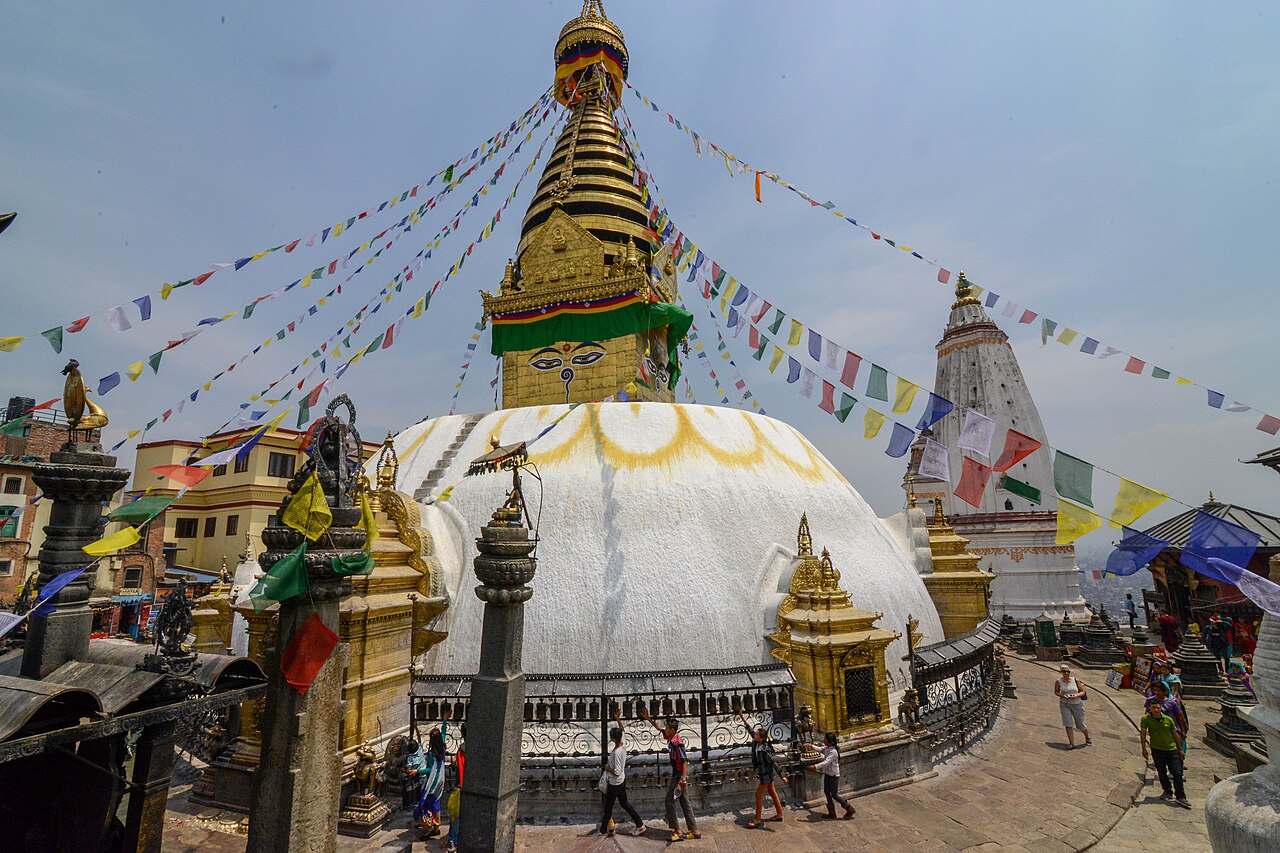
Anyone who has spent a morning at the great stupas of Boudha and Swayambhu in Nepal has seen it. Practitioners circumambulating, prostrating, rendering their bodies entirely prone, rising, stepping forward, and going down again, circling the stupa one body-length at a time. This expression is ancient and entirely expected. No local stops to stare, and no devotee is performing for an audience. For the initiated, the sight is profoundly ordinary.
The same instinct appears in teaching settings. When a lama or tulku enters a space, Tibetans rise. Not out of obligation or social habit, but as an expression of the desire to awaken, seeing the teacher as an embodiment of this profound intention. The body answers before the mind has formed an opinion.
There is a great deal to learn here. Tibetans, the primary holders of the lineage, understand enormous portions of the tradition in a way carried in posture and gesture and song, much of which has never been written down because it never needed to be. The modern student can read a hundred books on guru yoga and still not know what a Tibetan grandmother knows in her aging body.
I know such a grandmother, who lives near Tergar Osel Ling. When my family stays at the monastery, my wife and our two sons and I go to drink tea and visit. Her life is simple. She is an embodiment of what Tsoknyi Rinpoche calls “essence love,” a fundamental form of love that is unshakable.
To my eye, she is equally an embodiment of the devotion I am describing here. I spotted her at the grand opening, her eyes closed, resting in what looked like wordless absorption. She wasn’t tracking the content of the teaching, but nothing about her was absent. When her eyes opened and found me, she reached for my hand, smiling in a way that felt transcendent, like a mother to her child. In that moment, she invited me into a non-conceptual, embodied form of being — a way of being seen that had nothing to do with words.
Both Mingyur Rinpoche and Tsoknyi Rinpoche point to this kind of seeing as essential, and easily overlooked by those of us who came to the path from outside the Himalayan world. Without it, practice can grow dry and merely intellectual. With it, study and analysis come alive, turning us from people who quietly armor over our own goodness, and the goodness of others, into people who can let that goodness move.
And when devotion is entirely expected, it can calcify into routine. After years living in the Himalayas, I watched my own prostrations go automatic, the body folding while the mind wandered off somewhere else entirely. Familiarity is the risk wherever devotion is most at home. The forms becoming so familiar they no longer ask anything of the one performing them.
Three Orientations in One Courtyard
All three of these orientations were on display at the grand opening, sometimes in the same row of seats.
By my estimate, between thirty and thirty-five percent of the attendees were Chinese speakers. Another ten to fifteen percent had come from Europe and the Americas. The remainder were Tibetan and Himalayan, monastics and laypeople, locals and pilgrims.
You could almost read the three orientations in their demeanors. The Western students were analytical and contemplative, attentive to the teachings, taking notes, and parsing their experience. The Chinese-speaking students were eager and engaged, present for every session, generous at every opportunity. The Tibetans and Himalayans were jovial and light-hearted, treating the whole affair with the easy festivity of people for whom a monastery opening is not an exotic event but a homecoming. These are impressions, of course, and they frayed each time I looked at an actual person: the Western nun lost in wordless devotion, the Tibetan scholar bent over his notes.
Each of these postures is a genuine expression of devotion filtered through a culture. The analytical posture honors the dharma as truth to be understood. The generous posture honors it as a field of merit to be served. The embodied posture honors it as a way of life to be lived.
The problem is never the posture itself. The problem is what each posture becomes when it loses contact with the others. The modern West can go wrong by taking it all too seriously, being too formulaic, insisting that devotion justify itself in the language of psychology or philosophy before it will be practiced. The Chinese-speaking world can go wrong when the priest-patron circle collapses into transaction, when the experience of the dharma is implicitly framed as something exchanged for support. And the Himalayan world can go wrong through apathy, when forms performed since childhood are performed in childhood’s absence of reflection, the body present but the heart elsewhere.
“The Dharma Will Not Be Sold”
Tai Situpa, it turns out, was watching the same confluence, and he did not leave its dangers unnamed.
Throughout the week, he declared that the dharma cannot, should not, and will not, at least in his presence, be sold. He said it often. He wanted it heard.
The comments sent waves through the attendees. Those of us who design paid courses hesitated. Those who had made offerings toward the monastery rebuild paused for a moment. The statement implicated everyone in the courtyard, each in a different way, and that seems to have been the point. No single culture or individual could hear it as a rebuke of another.
What made this declaration so piercing is that it does not resolve neatly. The dharma has always required material support. The robes, the temples, the texts, the butter lamps: none of it appears out of thin air. Tai Situpa was not condemning the river of generosity that had just rebuilt the very monastery he was sitting in. He was guarding the spring it flows from. The difference between an offering and a price is invisible from the outside. It lives in the mind of letting go.
There is a way of holding both truths, that the dharma should not be sold and that the dharma requires resources to thrive, without letting the two cancel each other out. Finding this way forward requires open-hearted listening to the broader range of Buddhist experiences in today’s world.
I feel both privileged and obligated to be honest about where I stand, because I stand in the middle of it. I design paid-for courses. My training is first as a disciple and monk, then in Religious Studies and curriculum development, and now as a leader of organizations. With that ground, my colleagues and I are continually wrestling to find a middle path in the relationship between money and the dharma. We want the dharma to last, and that kind of durability requires resources and a commitment to stewardship.
We are also aware that we approach the problem from inside our own culture, one in which we pay for nearly everything, including much that was once given freely: childcare, schooling, elder care, community. From this vantage, paying for the dharma can feel natural. Those of us who work on these projects feel the tension in our own lives, too. We want to devote ourselves fully to the dharma, and need a sustainable path forward.
The Tergar Osel Ling grand opening showed us a way of holding both truths, that the dharma should not be sold and that the dharma requires resources to thrive, without letting the two cancel each other out. Finding this way forward requires open-hearted listening to the broader range of Buddhist experiences in today’s world.
Finding the Way Forward
When we step back and look at these three orientations alongside one another, something quite profound appears. A symbiosis arises through the relationship among them. Each one’s weakness is answered by another’s strength.
Western over-thinking is dissolved by Tibetan embodiment. Tibetan apathy is awakened by the eager engagement of the Chinese-speaking sangha. Transactional habits are checked by the Western insistence on scrutinizing the motivation behind ceremonial generosity. The three orientations are not merely cohabiting with one another. They offer each other an invitation to go deeper. They are, whether they know it or not, correcting one another.
This suggests a possible new way forward: a form of devotion that sits at the confluence of these three orientations.
My hunch is that the outcome will prove more resilient than expressions rooted in a single culture. For this to take shape, we need leaders like Mingyur Rinpoche, so attuned to the modern mind, to help navigate the hangups and challenges, of which there will be plenty. Their guidance will help us to be reflective without getting caught in over-analysis, generous without being transactional, and embodied without being automatic.
My sense is that this multicultural, pluralistic form of Buddhist devotion may also be the only ground on which Tai Situpa’s charge can be honored: a way of sustaining the dharma without ever selling it.
The Disciple at the Center
If such a confluence sounds abstract, the grand opening offered a living example of it. He was sitting at the front of the courtyard.
It would be easy to assume that Mingyur Rinpoche would have spent the week as the guest of honor, receiving the celebration of his fulfilled dream. What I saw was nearly the opposite. For five days, in the presence of Tai Situpa, Mingyur Rinpoche was primarily a disciple. You could see it in his body. Whenever he was near his teacher he bowed, and kept bowing, his frame inclined in a continuous physical expression of devotion. The man whom thousands had traveled across the world to see spent his week folded toward the one teacher he has left. Here was the Tibetan way of being, fully intact: devotion carried in the body, unselfconscious and complete.
But Mingyur Rinpoche is also profoundly generous, directing resources and attention through his various social impact projects, embodying the benefactor’s stream of devotion-as-offering. And he is, by any measure, a serious meditator and scholar, one whose presentations of awareness, compassion, and wisdom have reached precisely the contemporary minds Tai Situpa confessed he could not understand. The analytical stream, the generous stream, and the embodied stream run together in him without contradiction.
This is what a teacher is for. Not a marvel to be admired from a distance, but a mirror, showing us, in a single body, what the rest of us are reaching toward in pieces.
The truth is that everyone in that courtyard was wrestling with these three orientations, mostly unconsciously, leaning on whichever one comes most naturally to the neglect of the others. As we grow more aware, we begin to strengthen what we lack: the analyst learns to bow, the devotee learns to question, the giver learns to truly let go. A teacher like Mingyur Rinpoche is perpetually aware, and so the three hold together in him with apparent ease. The rest of us are still assembling them. What I witnessed at the grand opening, I think, was that assembly happening in real time mostly without anyone noticing.
Perhaps this is what Tai Situpa was really pointing to in his keynote. The modernization of the dharma will not be accomplished by choosing among the three cultures now gathered under its roof, elevating one and politely managing the others. It will be accomplished by people in whom the cultures have already met. The authenticity of the transmission and its adaptation to the contemporary mind are not in tension. They meet in a single gesture, the way they met all week in a single image:
A teacher who has rebuilt a monastery from rubble, who leads a global community, whose dream has just come true in stone and gold and painted timber, bowing, and bowing, and bowing to his guru.