

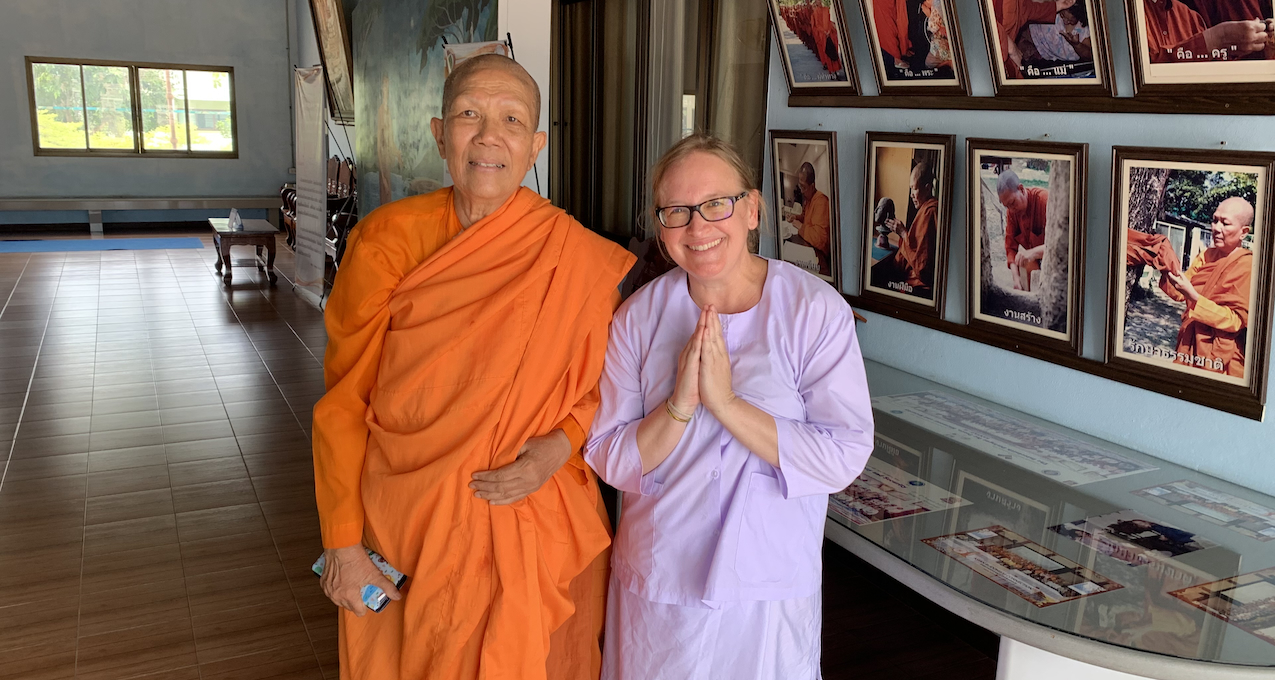

Every evening after our dhamma class, most of the lay people and one or two monastics gathered for cold drinks and chats. I mainly listened and gestured as a means to communicate with other residents of Thailand’s Songdhammakalyani Monastery. My language gaps heightened my own body awareness, visceral senses, and physical cues of those around me.
One particular embodied experience was my second time going on alms rounds (pindapatta), a practice the bhikkhunis (fully ordained nuns) and samaneris (novice nuns) do every Sunday as well as every new and full moon. Going on alms rounds helped me better understand the term for requirements, nissaya, in a physical way. Nissaya is actually only for fully ordained monastics and the reliance on the ordination preceptress and/or a teacher. It has numerous translations from requirements, to support, to dependence, to apprenticeship.
I received a brief glimpse of nissaya or the necessary dependent relationship through Dhammananda, the monastery’s abbess and her community. As a scholar of Tibetan Buddhism and gender and sexuality studies, I wanted to better understand models of care that sustain Buddhist women and monastic practices outside of India and Nepal. I did short-term fieldwork in Summer of 2024 with Dhammananda and her community. Even as a lay saṇgha member, I relied on the monastery for food, white clothes, a place to stay, and medicine (mainly mosquito repellant). I sought to learn from Dhammananda and her community. This openness and aspiration is essential in ethnographic work because it requires the participant observer to be receptive and vulnerable; and, as anthropologist and writer Ruth Behar reminds ethnographers, “What happens within the observer must be made known.” Let me make a little bit of my experience known.
On my second time joining alms rounds, I had mastered tying my white skirt and taking short steps in a 4-4 rhythm. I had learned that casual swinging of my arms in my everyday manner of walking was too loose. It was not until I saw a fellow layperson clasp her hands in front of her body that I remembered to walk more formally, poised, and with control.
As we began our procession, I took note of the different gates and lush foliage surrounding the houses, met the gaze of two cats, and wished to smell the white plumeria flowers in bloom. I realized, however, that the bhikkhuni and samaneri in front of me were only looking forward and slightly downward. I adjusted my gaze. We walked until we met donors; the bhikkhuni and samaneri received the offerings, and I and the other laity would take these offerings and place them in the cart that Nut, one of the other lay retreatants, pushed along behind us. We held our hands in prayer while the monastics recited blessings for the donors who kneeled before them. I loved this part because as the donors bowed, and we stood behind the monastics with our hands in prayer and slightly bowed, it felt like we all had something completely in common: a shared wish for something better for this life or a next life for loved ones and strangers around us (seen and unseen).
I realized this was why Dhammananda had created a community of women practitioners, so that they could be the examples that others need.
As we veered back toward the monastery, I noticed a man balancing a motorbike between his legs and waving a long stick as a barking dog dragging a chain came toward him. My fight or flight response generated a feeling that we should stop and let the man deal with this barking dog that had unleashed himself. How quickly my love and compassion changed to fear. I was only thinking about myself. I was willing to let this man on the motorbike deal with this frightening dog.
The bhikkhuni and samaneri, however, kept our rhythm — never flinching, pausing, or changing the pace. As we were getting closer and closer to this dog, several scenarios went through my head: the sixty-year-old bhikkhuni was going to sacrifice herself like the Buddha did to a hungry tigress, the samaeri was going to protect the bhikkhuni by tossing rice out of her alms bowl to the dog, or I would crouch like a coward as the dog ravished us all. I wondered how I would get all the blood out of the white clothes the monastery. While these thoughts flew through my head, a woman walked out and picked up the chain that the dog had somehow managed to drag with him out of the gate, and the motorbike drove off.
The procession continued as if I had imagined the whole scenario. I locked eyes with the dog as he was led onto the other side of the gate. I wondered if he had been scared too. We both redirected our gaze toward our different processions. My body relaxed as he receded. Maybe his did too. I had experienced a secondary sort of nissaya. I had been silently instructed for our two kilometers of alms rounds. I depended on the monastics’ comportment, ease, continuity, and consistency. I tried to mimic these in the aftermath of the dog-gone-loose incident.
I realized this was why Dhammananda had created a community of women practitioners, so that they could be the examples that others need. This was the second time on this hour of alms rounds where I had watched the monastics keep their steady rhythm. Earlier, without missing a beat in the 4-4 walking pace, the lead bhikkhuni swept down and picked up a snail who had lost its way on the pavement. She scooped it up and put it back down in some lush grass out of harm’s way. Throughout my stay at Songdhammakalyani, I felt like this snail — quickly being resettled, instructed, and guided for my own benefit and in the service of others.
About Dhammanda and Songdhammakalyani
Luang Mae (Venerable Mother), known as Bhikkhuni Dhammananda Mahatheri (hereafter Dhammananda), trains samaneris, bhikkhunis, and lay practitioners in an inclusive manner to sustain and extend Buddhasasana, (the teachings of the Buddha). Dhammananda’s biography helps set the context for examining her care, collaborative effort, and inclusive practices. Her life is characterized by wonder and dependence on learning, which she then reflects back to her students. For defining care, I draw from professor Maria Puig de la Bellacasa, who defines care as “everything that we do to maintain, continue and repair ‘our world’ so that we can live in it as well as possible.”
Dhammananda’s biography captures her role as an educator: After receiving her Ph.D. in Buddhist Studies, she taught Buddhism at Thammasat University for 27 years. She authored and translated more than 200 books, received higher ordination from Sri Lanka in 2003, and became the first fully ordained Theravada bhikkhuni in Thailand. She gave ordination to more than 1000 samaneris as of April 6, 2023. Dhammananda extends her commitment to her own education as care to the community of vow holders — monastic and lay.
Since 2015, Dhammananda holds International Monastic Training programs annually during Vassa (three-month rains retreat) at Songdhammakalyani, her monastery in Nakhon Pathom, Thailand. She also extends Buddhasasana through her online Vinaya courses, “Application of Buddhist Vinaya in the Contemporary World,” which run collaboratively through the United Theravada Bhikkhuni Sangha International (hereafter UTBSI) and the Maha Bodhi Society of India (hereafter MBSI). I argue that these training programs provide insight into how she extends nissaya, to narrow the distance between practitioners and the preceptress or teacher, and bridges Buddhist worlds for all practitioners so that they may be a support for one another. How does she do it?
Nissaya and Care
Dhammananda describes nissaya as the four requirements for bhikkhus and bhikkhunis. Speaking of nissaya in the context of alms rounds (pindapatta), she emphasizes that food is the first of the four nissayas; bhikkhunis receive food as alms to inspire faith in donors and afford them an opportunity to make merit.
The second requirement is the necessity of robes, which were originally made from the scraps of cloth that wrapped the deceased. Bhikkhus sewed these pieces of fabric together in patches. The third requirement is shelter, which the Buddha kindly required for bhikkhunis, a distinguishing feature of their practice that Dhammananda highlights. The fourth is medicine.
During her July 6 Dhamma talk, Dhammananda asked the others in attendance why she had taught the nissayas that evening. While they had myriad answers about ordination, learning Vinaya, and knowing their requirements, she told them that she had taught them so that I could better understand the significance of alms rounds, and that they were only thinking of themselves by not recognizing this. I was taken aback because while grateful, I didn’t want to feel like the center of attention. I had only experienced these women as thinking of me and tending to me in ways I did not entirely know how to reciprocate.
First is food: they warned me about the spicy dishes, even though I relish spicy food. They also included me in drinking cold drinks after our evening dhamma talks. It was a refreshing way to stave off hunger and enjoy their friendship. Second is robes: they made sure I had the proper fitting white clothes for the monastery. Third is shelter: they made sure my room was comfortable and that I was clear on the daily temple schedule. Fourth is medicine: during walking meditation, they shared mosquito repellant; they also shared salted candies to help manage hydration. While these nissayas are ultimately about the relational and reciprocal support between the bhikkhuni and teacher and/or preceptress and the sangha, Dhammananda created a trickle-down effect of care and dependence that extends down to include all the laity in her monastery.
Bhikkhu Thanissaro clarifies how the nissayas also indicate dependance:
“The Dhamma and Vinaya impinge in such detail on so many areas of one’s life that no new bhikkhu can be expected to master them in a short time. For this reason, the Buddha arranged for a period of apprenticeship — called nissaya, or dependence — in which every newly ordained bhikkhu must train under the guidance of an experienced bhikkhu for at least five years before he can be considered competent to look after himself.”
Dhammananda makes nissaya possible at Songdhammakalyani and then extends nissaya, or dependence, so that bhikkhunis can continue their training when living close to the preceptress or instructor is not feasible.
She cultivates and revisions a closeness to the newly ordained in two regards: in-person training and online programs. She develops the way Buddhist monasticisms stipulate a dependence for the newly ordained by making the proximity of students elastic and extendable.
Case Study: International Monastic Training (IMT)
My stay at Songdhammakalyani coincided with that of three of ten laywomen who planned to stay for the samaneri training. As Lom, one of the them, told me, “Whenever you think of Thailand, you will think of me.”
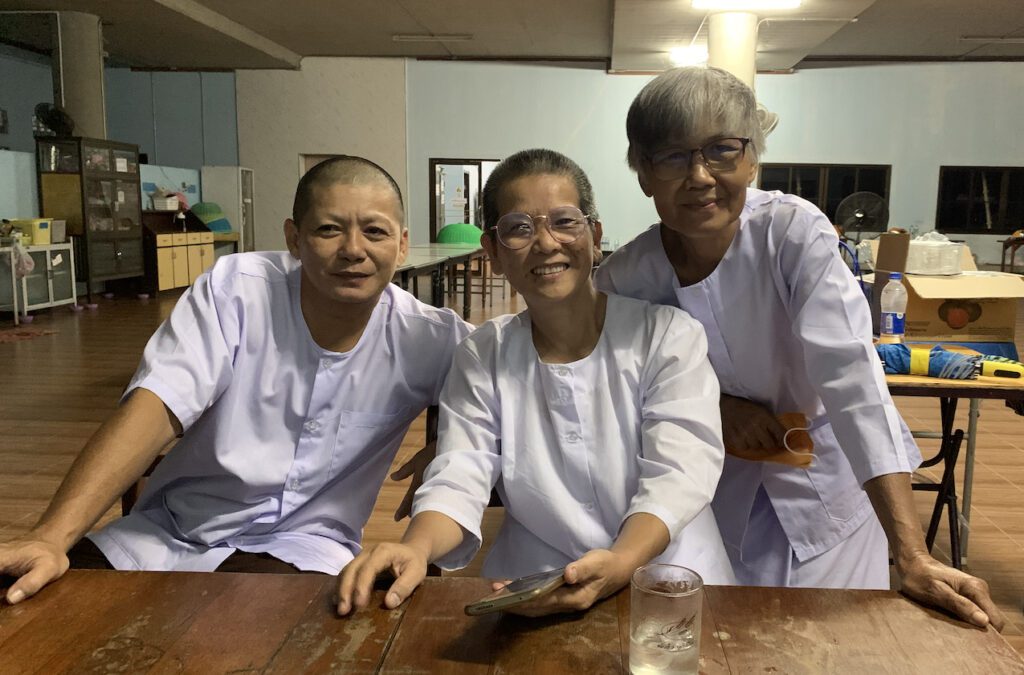
It is true, the laity’s welcoming impact on me has been unforgettable. Lom, a former housekeeper, intends to eventually ordain as a bhikkhuni. Gope, a former nurse, intends to take samaneri vows only for the period of Vassa on behalf on her recently deceased mother. This practice mirrors the temporary ordinations afforded to samaṇeras in Thailand.
After our morning meditation, they gather and practice the prayers they will need after their samaneri ordination.
International Monastic Training (IMT) is described as an intervention on the Songdhammakalayni website:
“Sometimes, even newly ordained monastics who have made a full commitment do not really know how to continue life in their new role and thus have difficulty being an effective member of the a sangha. International Monastic Training (IMT) will endeavor to remedy the situation by offering a training course which consists of intensive academic studies alongside daily practice, particularly in the following areas: History of Buddhism with emphasis on women and Buddhism, history of Thai Buddhism, the Vinaya, Patimokkha reciting and training (for ordained members), spiritual training, chanting and socially engaged Buddhism. In addition, IMT wishes to open this training program to women intending to be ordained as well as serious laywomen who wish to go more deeply into the Buddhist way of life.”
While IMT is formally held annually during Vassa, its effects were in place beforehand. The IMT program extends the notion of nissaya by giving the necessary requirements to bhikkhunis and offering this also to samaneris and laity. The IMT program and the availability to practice around these times is completely inclusive and welcoming of all practitioners.
Sunday dhamma talks are more formal and open to the community as a way for local neighbors to make merit. In one talk, Dhammananda gave different examples of how service must be paired with wisdom. She concluded her July 7 talk by drawing parallels with the bodhisattva vow in the Mahayana tradition. The talk’s closing line was poignant: “We, as Buddhists, must be kind, wholesome, and inclusive.”
Inclusivity characterizes Dhammananda’s approach to teaching. I was curious about the beautiful Tibetan Buddhist-style images in her monastery. She said to me, “There is no Theravada, Mahayana, or Tibetan Buddhism, it is all the teachings of the Buddha.” This comes through in her own devotion to the Medicine Buddha. She bridges Buddhist worlds in IMT and introduces other practitioners to deities not typically paired with Theravada practices.
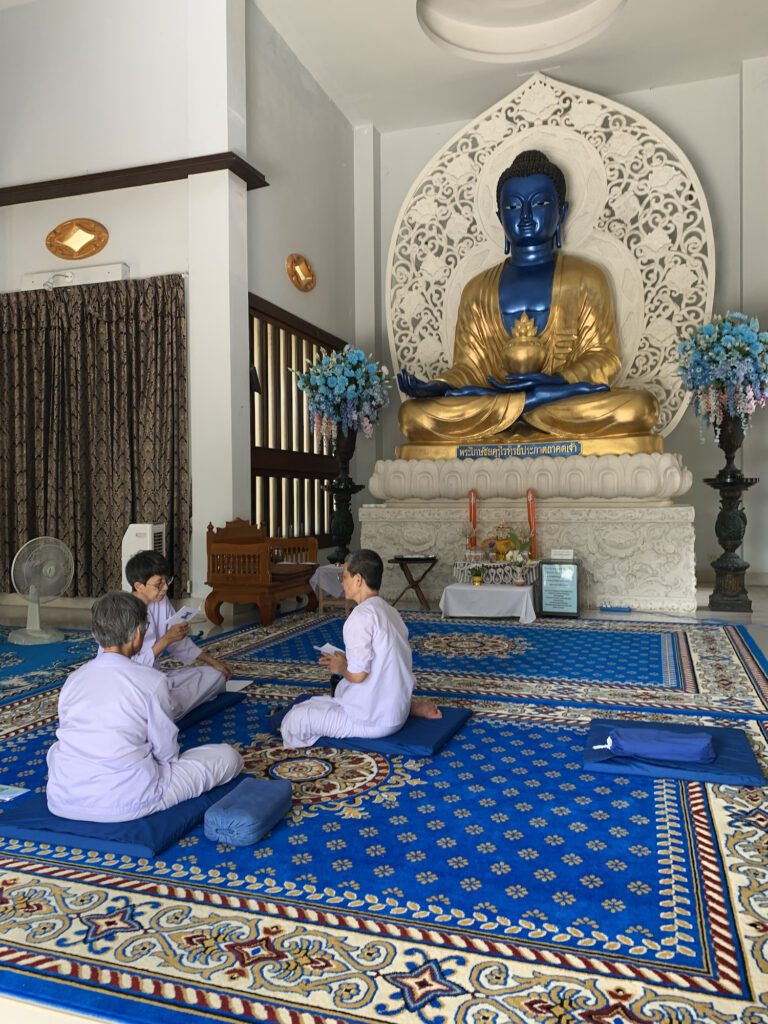
This type of training and practice also goes beyond IMT because every new and full moon at her monastery ends with chanting the mantra for the Medicine Buddha. Dhammananda had a vision of this buddha while in meditation. Now her vision has been transformed into the central image in the temple, and the clay-cast Medicine Buddha presides over practitioners on these auspicious days. Every new and full moon culminates with chanting the mantra 108 times.
Case Study: Application of the Vinaya in the Contemporary World
In her “Application of the Vinaya in the Contemporary World” courses, Dhammananda extends the practice of nissaya, as dependence, to accommodate distance and bridge the worlds of other practitioners. These courses began as part of the bhikkhuni ordination held in Bodhgaya in November 2022.
In collaboration with MBSI and UTBSI, Dhammananda has offered monthly Vinaya courses. These mitigate the distance between teacher and student when being onsite is not possible. These courses are meant for the ordained, but lay members also join via Zoom. The videos remain online and accessible for monastics who hope to enrich their understanding of Vinaya and make it applicable for their daily lives. As Dhammananda notes in the course, “We need to understand the spirit, not the rules. If we only follow the words, we are being tied down to rules from 2600 years ago. We need to practice according to the spirit of it, not the specific words.”
She bridges Buddhist worlds through these trainings, extending nissaya and making the Vinaya applicable and realistic for today’s practitioners. This includes, for example, clarifying rules about discarding medicine after seven days. She notes that this rule is impractical in today’s world when medicine has a clear expiration date on its packaging. Once, she was critiqued for traveling alone after her bhikkhuni ordination. She sees this interpretation as misguided because she was not alone in the sense that the Vinaya proscribed. Laughingly describing flying on an airplane with over two-hundred people, she asked, “How could this be considered traveling alone?”
These anecdotes and experiences make the Vinaya real for the communities of bhikkhunis. These online courses provide a new type of nissaya when being proximate to the teacher becomes impossible, and they beckon the saṇgha to come together in service and care to collaborate and include one another on the Dhamma path.
Conclusion
Dhammananda and her community of samaneris and bhikkhunis actively collaborate to train monastic women. As she says, “It shouldn’t be just meditating together; you have to work together to build a sangha.”
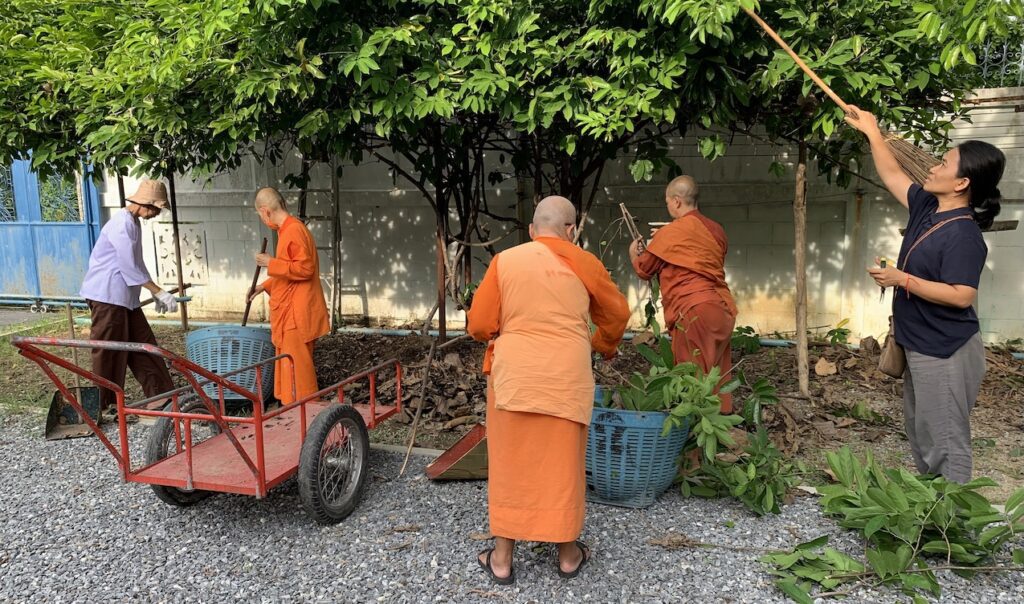
My last night at Songdhammakalayni fit Dhammananda’s vision. After the dhamma talk, Gope grabbed my arm and said, “Cold drinks?” I nodded happily and we walked together arm-in-arm to the kitchen. After drinks, we washed dishes together before walking meditation. She and Luang Phi, the samaneri, brought out mosquito repellent — medicine, the fourth nissaya. I had experienced all the nissayas in the ripple effect of this community.
As we went downstairs for walking meditation, the samaneri practiced her English as she repeated Dhammananda’s words from her earlier talk: “Love yourself.” Dhammananda had discussed the five precepts as central for loving oneself and others. These precepts, she argues, are the gateway for meditation.
We later ended the evening with a water offering at the base of a nearby tree, “to remember Bhumi who witnessed the Buddha’s enlightenment and to share our merit with others,” the samaneri instructed. These monastics and lay women felt compelled to include and instruct any visitors who pass through the gates and offer prayers for all sentient beings outside the gates. Their comportment mirrors their teacher, and they share it whole-heartedly.
Dhammananda has been acting as teacher (pavattini) in charge of preparing candidates for samaneri and bhikkhuni ordinations for ten years. As she reminded us, meditation should change you so that you can be a “change-agent” wherever you go. You should change your love and compassion to share it with your family and those around you. Dhammananda is a change-agent who extends the idea of nissaya through her innovative care, collaborative efforts, and inclusive practices. And these are passed down not only to her bhikkhunis, but also to anyone who comes to practice at Songdhammakalyani.
More recently, in 2025, Amnuaypond Kidpromma and Cindy Rasicot reported on how Dhammananda’s efforts continue outside of Songdhammakalyani. She convened the country’s first Thai Bhikkhuni Seminar on “Intergeneration and Sustainability.” More than one hundred bhikkhunis and samaneris focused on what they can offer to those in need.
Training bhikkhunis and samneris as change agents is also ongoing in India. In March 2026, the World Bhikkhuni Sangha Assembly assembled at the Maha Bodhi Society of India, bringing together the global community of bhikkhunis, samaneris, scholars, and supporters. Senior Bhikkhuni Venerable Lieu Phap Mahatheri of Vietnam remarked that this event was a testament to “a historic movement within the Buddhist world: the ongoing flourishing of the bhikkhuni sangha and the renewed commitment to the education, training, and empowerment of women monastics.”
This work among Dhammananda and others like Venerable Lieu Phap reflects a broader sense of nissaya — the remarkable efforts among senior bhikkhunis to provide the requirements for bhikkhunis and samaneris as they create and sustain global communities of change with deep care.