


When the push of a button can launch thousands of nuclear weapons, nationalistic and ethnic tribalism are more dangerous than ever. An economic system that must keep growing in order to avoid collapse is irreconcilable with a biosphere that does not, and neoliberalism’s penchant for producing billionaires while billions of other people struggle to get by is incompatible with a just or harmonious global civilization.
The Axial Age is a term coined by Karl Jaspers to describe a pivotal period that began in the middle of the first millennium BCE, when “the spiritual foundations of humanity were laid simultaneously and independently in China, India, Persia, Judea, and Greece.” Religious revolutionaries such as Lao-tzu, Gautama Buddha, the Hebrew prophets, Jesus, and Muhammad were not official priests but marginal figures, responding to a widespread sense of social and moral failure by offering innovative conceptions of cosmic order that juxtaposed this mundane (and unsatisfactory) world with an idealized transcendent realm (heaven, nirvana). This was accompanied by a new emphasis on one’s own relationship with that higher reality, shifting the focus from temple rituals to personal morality. Salvation became radically individualized: no longer a destiny restricted to elites but a possibility for each of us, according to how we live. The basic religious teachings we usually take for granted today — individual morality and salvation, with compassion for everyone — were Axial Age developments.
These ideals are so important to our spiritual traditions today — which does not mean we actually follow them, of course — that it is difficult to appreciate how radical they were when first proclaimed. Nonetheless, most Axial Age teachings have two serious flaws that limit their relevance to our difficult situation today: cosmological dualism and individual salvation.
Belief in another and better postmortem reality was important for liberating the individual from what had become tight embeddedness in a hierarchical social structure, but cosmological dualism tends to devalue this world. In Christian terms, the earth is merely a backdrop to the human drama of sin and salvation. Why worry about what’s happening here and now if our eternal bliss is elsewhere? This implied another dualism that has become especially problematic for us today, between humanity and the rest of the biosphere. Lynn White Jr. has (controversially) traced the ecological crisis back to “the Christian axiom that nature has no reason for existence save to serve man. . . . Despite Darwin, we are not, in our hearts, part of the natural process. We are superior to nature, contemptuous of it, willing to use it for our slightest whim.”
Individual salvation means that my well-being is ultimately separate from yours. Sure, I hope you will make it to heaven too, or attain nirvana, but in either case my own spiritual destiny will be unaffected. Replacing self-centered evolutionary selection — preoccupied with reproducing one’s own genes — with self-centered afterlife selection — preoccupied with personally qualifying for heaven and so on — was not necessarily a big improvement.
Historically, the Axial Age failed. The revolutionary personal and social transformations implied by its teachings — attempting to address the tensions inherent in our evolutionary psychology — were aborted as the new religions became reappropriated by despotic rulers and institutionalized into their empires. With the Roman Emperor Constantine’s conversion, Christianity became Christendom. Later European kings ruled by divine right, and their Asian equivalents (who must have extraordinarily good karma from past lifetimes!) sometimes declared themselves to be bodhisattvas or buddhas. A good example is the way that Christian teachings have been used to rationalize the forceful conversion of pagans, the persecution of Jews and heretics, the subordination of women, crusades against Muslims, and the establishment of brutal empires. What is now known as Christian nationalism, in particular, is an oxymoron — it has almost nothing to do with the teachings of Jesus — but it is not new. More generally, nationalism has been described by Arnold Toynbee as “ninety percent of the religion of ninety percent of the people of the Western world and of the rest of the world as well.” A sacralized social order continues to sanctify our overgrown tribalism.
We too are manifestations of this earth, not exiled spirits that should be preoccupied with qualifying for eternal bliss somewhere else. Nor do we need such an otherworldly reward. The challenge is not to transcend the world but to transcend our usual ways of experiencing it.
The good news is that the Axial Age teachings have survived, and they have served an important role in the development of democracy and human rights. Nonetheless, it is increasingly difficult to take their hallowed mythologies and theologies literally, especially belief in a transcendent salvation that supersedes whatever happens here. In order to revive their revolutionary potential, we need to interrogate and recuperate the insights of their founders.
What We Need Today: A Spirituality That Loves This World
Today we need a spirituality that focuses on realizing the true nature of this world, which by no coincidence also happens to be our own true nature. We too are manifestations of this earth, not exiled spirits that should be preoccupied with qualifying for eternal bliss somewhere else. Nor do we need such an otherworldly reward. The challenge is not to transcend the world but to transcend our usual ways of experiencing it. It turns out that this world is quite different from what we thought. And so are we.
In contrast to Axial dualism, what we have understood as the sacred is not something “higher” that occasionally interjects itself into this world, but is its ever-present ground. The impermanent phenomena we experience every day are the manifold ways that the sacred assumes form and expresses itself here and now.
We usually perceive the world as a collection of separate, self-existing things that interact in objective space and time — one of those things being me. We learn to see it this way as we grow up, socialized into relating to it in the same way that everyone else does. Living this way has served the evolutionary process by contributing to our survival and success: once we identify things and their functions, we can utilize them for doing and getting what we want. So this way of perceiving serves an important role in our lives and our collective development. But it is not the only way to experience and understand the world, or ourselves.
Preoccupied with using things to achieve certain goals (such as satisfying desires), we overlook something important: the world as normally experienced is a psychological and social construct. That is why deconstructive practices such as meditation can lead to a different and more nondual experience, in which supposedly separate beings are actually hierophanies revealing the sacred. To use theistic terms, “God” is not an invisible, super-powerful transcendent being who created everything, but is better characterized as a formless nothing (or no-thing) that manifests as all the phenomena we encounter—including ourselves.
Although mysticism is a broad term that refers to a variety of spiritual experiences, the most insightful ones involve unmediated awareness of an ultimate reality right here. In such encounters, the usual duality between a self inside and an objective world outside dissolves when I let go of myself. That is possible because the sense of being separable from the rest of the world is part of that psychological and social conditioning. Letting go of the habitual thought patterns that sustain the illusion of an autonomous self can lead to the most important realization of all: that we are not separate from each other, or from the earth on which and with which we have evolved, but are part of a biosphere that continues to nurture us.
According to Dogen, “to study the way of enlightenment is to study the self. To study the self is to forget the self. To forget the self is to be actualized by myriad things.”
To let go and “forget oneself ” is not to rise above this world but to become one with it — or rather, to realize that we have always been nondual with it. Is this the spiritual awakening that we seek? The salvation that the world too needs us to realize?
When we are not so fixated on transcending it, we will be able to appreciate that the earth is not only our home, it’s our mother — and we never cut the umbilical cord. Our interdependence with other species and ecosystems means that their well-being is not separable from our own. Despite the fantasies of some wealthy survivalists, who hope to ride out the apocalypse in well-stocked bunkers, worldwide ecological degradation makes it clearer than ever that human and nonhuman destinies are inextricably tied to each other in a biosphere that encompasses us all.
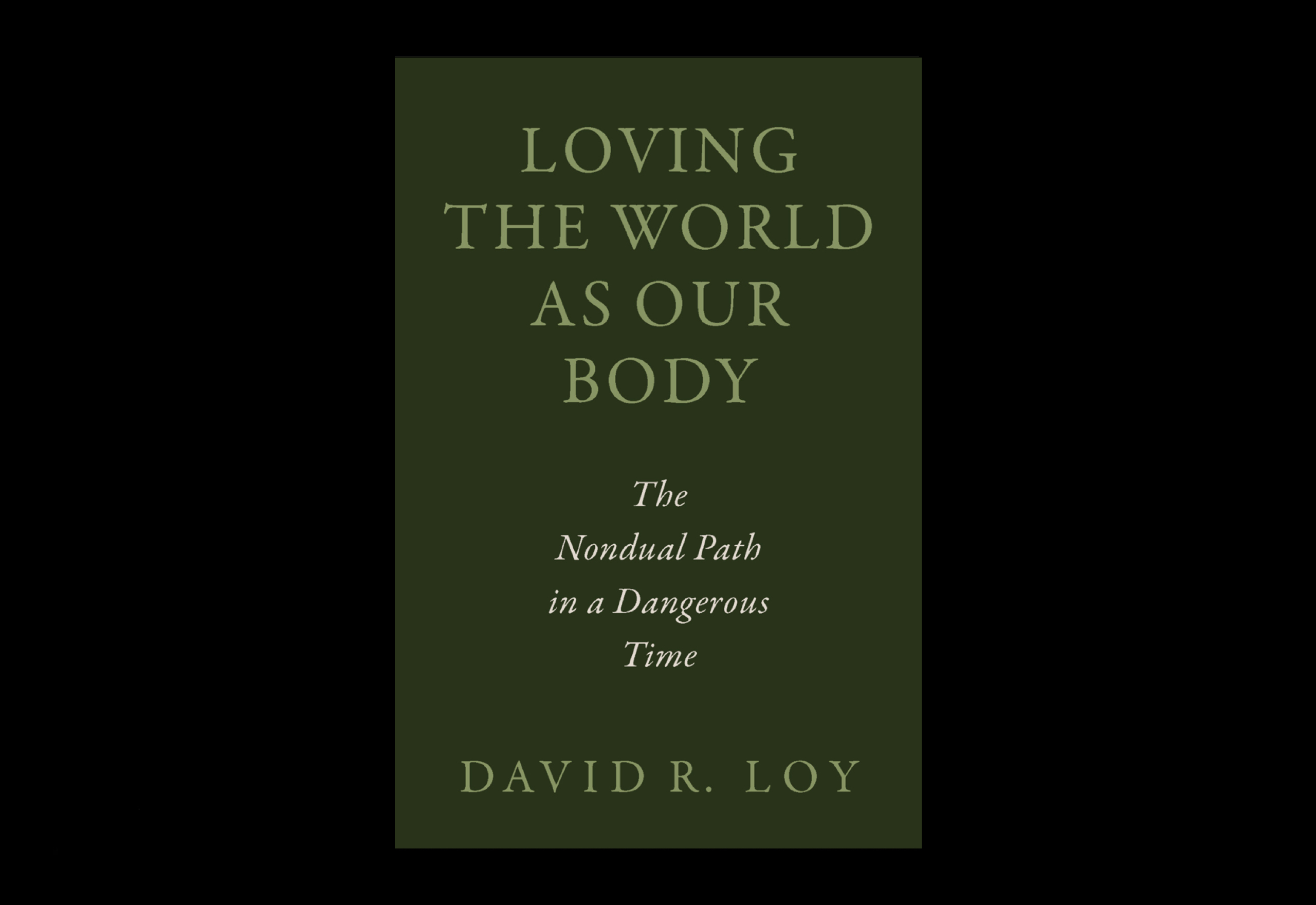
Adapted from the introduction to Loving the World as Our Body: The Nondual Path in a Dangerous Time, © 2026 by David Loy, by arrangement with Wisdom Publications.