

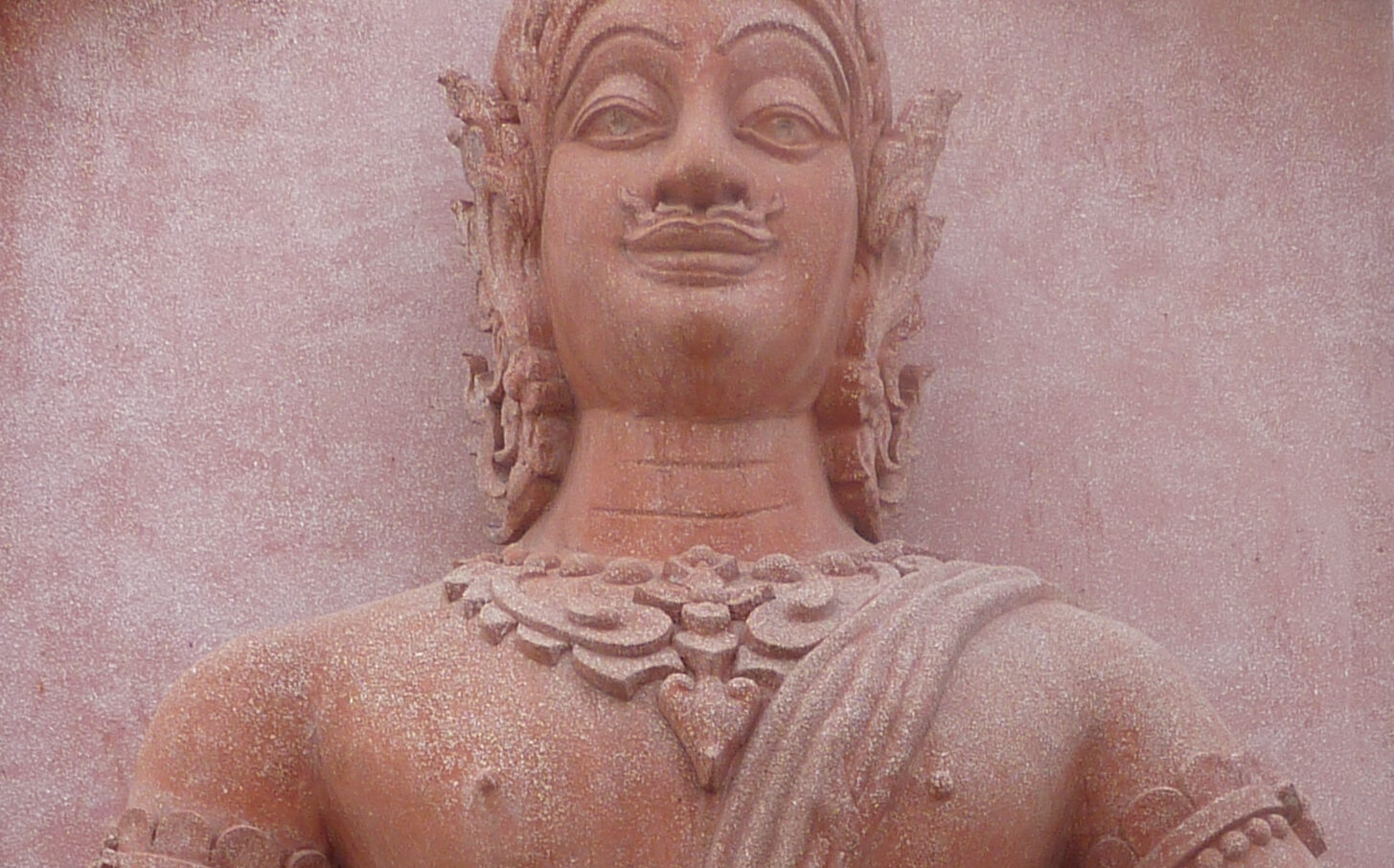

In the Samyutta Nikaya (The Connected, or Grouped, Discourses of the Buddha), the Buddha tells of a war between the devas and the asuras. The devas (“heavenly beings”) win. Vepacitti, lord of the asuras (“demons;” “titans”), is captured, bound by his hands and feet and neck, and dragged before Sakka, king of the gods. And there, in chains, Vepacitti does what defeated demons do. He unleashes a torrent of abuse. Insults, curses, the worst he’s got.
Sakka says nothing.
His charioteer, Matali, can’t take it. He challenges Sakka in verse: Is it fear that keeps you quiet? Is it weakness? Why do you just sit there and take this?
I am neither afraid nor weak, Sakka says. How could someone who understands get provoked by a fool?
Matali pushes back. The fool will read your patience as fear, he argues. He’ll come at you harder. Like a bull chasing someone who runs.
And Sakka responds: Let him think whatever he likes. Among ideals and highest goods, none better than patience is found. Whoever, when strong, is forbearing to one who is weak: that is the foremost patience.
The Pali language here is doing something the English can’t quite. The word Sakka uses for forbearance, titikkhati, is a cousin of tikicchati, to heal. In the language the sutta was first told in, patience and healing are not two virtues that happen to reinforce each other. They are the same movement, named twice. To bear with what is difficult is already, in the grammar of the tradition, the beginning of repair.
***
I have been sitting with this sutta on the benefits of patience for some time. And the more I sit with it, the less satisfying it seems to me.
Sakka is a god. He has just won a war. Vepacitti is his prisoner, bound hand and foot and neck. The abuse is coming from below. A defeated enemy who has no power left except his mouth. Of course Sakka can be patient. What does his patience cost him? Nothing. He is invulnerable. His composure is real, but it is composure from a position of total safety. Nobody he loves is in that room. Nothing he cares about is at stake.
This is Sakka’s khanti — which is Pali, referring to the virtue of “patient endurance” or “forbearance.” Forbearance from a position of total safety, directed at someone who cannot touch him.
I wonder how Sakka’s patience would hold up in an ordinary life. What if he wasn’t a god? What if his tormentor wasn’t chained? What if, instead, he was sitting across the breakfast table from his partner of eight years, ragged from not sleeping, almost late to work, as their three-year-old and their infant threw a collaborative screaming fit while he tried to communicate to his wife why he wasn’t going to be able to swing by in the evening to pick up the kids at daycare?
Would Sakka be quite so calm?
***
A few years ago, Devon and I were scheduled to teach a weeklong retreat just outside Nashville. We’d been apart for a month, teaching on opposite coasts, and we had scheduled ourselves three days to spend together, recalibrate, plan, and wander around town arm in arm, before taking on the beautiful responsibility of guiding people into the deepest recesses of their psyches.
Then she got COVID and had to spend almost a week in a rented apartment in California. Which meant I had to drive our van alone from New York to Tennessee. And also teach all the online and in-person events she couldn’t attend. And it meant she was tired. And I was tired. And when she finally did arrive in Nashville, the day the retreat started, she was still masking out of caution for others, and we were sleeping in separate beds, with her inside and me out in the driveway in our van.
There was no recalibration.
Slowly the tensions built. Little things. Small disagreements that didn’t resolve. Irritations that compounded. The kinds of things we would usually roll through, if we just had a little more time together, and were just a little more resourced.
Then, on the second night of the retreat, she gave a dharma talk. In that talk, she told a very personal story about me. Which is something we often do. But we have a rule. You always get consent first. And because she was tired, and because we were busy, she forgot to run the story by me. And it landed like a sucker punch.
Afterward we went for a walk. She asked how the talk went.
“It was a good talk,” I said. Then silence.
“You’re upset,” she ventured.
“No,” I said, in a caricature of someone pretending not to be upset.
After a stretch of quiet, she said, “Are you going to tell me what’s going on?”
“I don’t think that’s a good idea.”
“Well,” she said, “what you’re doing now? Also not fantastic.”
Then the dam burst. “That story. You threw me under the bus. No warning. What the hell?”
She fired back. “I just flew two thousand miles in a COVID haze to teach this retreat with you, still masked, by the way, and you want to talk about what kind of stories I’m allowed to tell?”
We retreated to separate corners. Devon to her room. Me to the van in the driveway, where I sat, angry and also embarrassed at my lack of skill, my lack of empathy, none of it resolving into a clean feeling. There was no Sakka in this story. No place of perfect composure.
***
When I woke up the next morning, Sakka was still on my mind. First, the mild irritation at his irrelevance. A god on a throne, a demon in chains, a neat little poem about patience. What does any of that have to do with what happened last night? With the look on Devon’s face when I exploded? With the sound of her voice when she fired back? With the fact that I’m lying in a van in a driveway in Tennessee and I don’t want to go inside yet because I don’t know what to say to her?
All of this was present simultaneously: the anger and the regret and the stingy withholding of compassion, layered and contradictory, and none of it resolving into a clean feeling. I kept sitting.
I sat up. It was early. The retreat’s morning meditation period hadn’t started yet. I could hear birds. The neighborhood was quiet.
I began guiding myself through a forgiveness practice. First, asking Devon for forgiveness in my own mind for how I’d handled it. Letting myself feel the regret. Then offering myself forgiveness. I’d betrayed my own intentions. And then offering Devon forgiveness for telling the story, and for her reaction to my reaction.
None of it felt clean. I was sheepish about my own behavior and simultaneously pissed about hers and also aware, in some back room of my mind, that she’d been sick for a week and I should be giving her more grace and I wasn’t, because I was hurt, and hurt people don’t easily give grace.
All of this was present simultaneously: the anger and the regret and the stingy withholding of compassion, layered and contradictory, and none of it resolving into a clean feeling.
I kept sitting.
Somewhere in that sitting, something loosened, the way a clenched hand loosens when you finally notice you’ve been making a fist. Gradually, I sensed a little more space around it all. Enough space that I could hold the whole mess without being swallowed by it.
In that wider space, the sutta returned. Sakka returned. And this time what came into focus wasn’t his composure. It was his relationship with Matali, the charioteer, his companion, his friend who feels comfortable enough to challenge him, to call him weak to his face. When pressed by a friend, Sakka doesn’t sit there in silence. He answers. He argues back. He makes a case, under real pressure, for why he’s doing what he’s doing. He is inside the relationship, not above it.
Maybe this staying inside the relationship, inside the difficulty, is what the Pali is pointing toward. Titikkhati. Tikicchati. Forbearance. Healing. Maybe they’re cousins because they describe the same movement. The difficulty doesn’t go away. But maybe staying present to it — all of it, the mess and the hurt and the not-knowing — is already the beginning of repair.
This is often how scripture works in me. I read it one way when I’m at a distance, trying to understand it, place it, get it right. And I read it another when I’m in it, when something’s breaking open and I need it to land, to do something, to change the way I’m seeing and moving in my world.
I don’t know if what I did in the van that morning was khanti. It didn’t feel like the foremost patience. It felt like sitting in a van in a driveway at six in the morning, still angry, doing a forgiveness practice and waiting for something to open. And something did open. Just enough.
Maybe that’s what khanti is. Not the gods’ version. Not the version where you sit in perfect composure while the demon rages. The version where you stay. Where you keep your seat even though you don’t know what’s going to happen and the person you love most in the world is inside the house and you’re out here in the driveway.
And you don’t leave.
Not yet.
You sit there a little longer than you want to.
Long enough for something to loosen.