


When Western students first encounter the six realms of Buddhist cosmology, we face a translation problem that goes far beyond language. It’s not that we lack the words — it’s that we lack a frame of reference. Hell realms with molten iron? Hungry ghosts with needle-thin throats? These teachings seem to ask us to accept an iron-age cosmology that conflicts with everything we know about the universe.
Most of us respond in one of two ways. We either accept a watered-down interpretation — treating the realms as mere metaphors for psychological states — or we politely set aside these teachings as cultural artifacts, focusing instead on more palatable aspects of the dharma. Both approaches let us continue practicing without cognitive dissonance. But both also prevent these foundational teachings from doing what they’re meant to do: radically transform how we understand existence itself.
What helped me was discovering how the third turning of the dharma wheel approaches these teachings — a perspective that’s been part of Buddhist philosophy for centuries, particularly in the Yogacara and Shentong traditions.
The Gap Between Views
Over the past thirty-five years, I’ve noticed two dominant pedagogical approaches to teaching karma, rebirth, and the six realms — the big three — to Western students. The first reduces these concepts to something we can digest easily. Karma becomes simple cause and effect, detached from rebirth. Rebirth is explained as “the continuum of consciousness” — just vague enough to avoid controversy. The six realms become psychological metaphors: hell is anger, the hungry ghost realm is addiction, and so on.
This approach has real benefits. It doesn’t derail our practice with lengthy philosophical debates. Many practitioners aren’t interested in metaphysics — they want meditation techniques and ethical guidance. For them, this low-stakes interpretation works perfectly well. But it may come at a cost. By keeping these teachings at arm’s length, we also prevent them from penetrating deeply enough to transform us. We get Buddhism-lite: all the mindfulness, none of the worldview shift.
The second approach is more traditional. Teachers present karma as the link between past actions and present circumstances. They emphasize rebirth in the context of future suffering. The six realms aren’t metaphors — they’re described as actual destinations where beings experience actual torment or pleasure.
This approach doesn’t try to make Buddhism more palatable. It presents the teachings as they’ve been transmitted for centuries. The potential benefit is enormous: if we can truly understand suffering and its causes — the first two noble truths — we gain access to the entire path. The weakness, of course, is that it doesn’t close the cultural gap. It doesn’t make these concepts any more plausible to people raised on scientific materialism. We’re left to either accept them on faith or privately dismiss them.
The Struggle to Understand
Like many Western students, I’ve struggled with these teachings. I’m not particularly smart or special — but I am someone who gets frustrated when something doesn’t make sense, especially when I know it makes sense to countless others who probably aren’t geniuses either. That frustration drove me to keep looking for clearer explanations. What I eventually found wasn’t something new, but something old: the way these concepts have been understood within certain Mahayana traditions for over a thousand years. Here’s what helped me understand the six realms in a way that felt both intellectually honest and transformative.
Samsara Is Not a Place
The key insight is this: samsara is not where we exist — it’s how we exist. Samsara isn’t a location on any cosmic map. It’s a state of delusion. And if samsara is how rather than where, then the six realms aren’t destinations either. They’re modes of experiencing.
Think about your experience right now. You have a sense of being “you” — a subject. That sense of self has a vantage point, which, generally speaking, we call “here.” But “here” only makes sense in relation to “there” — places you’re not. And “there” only has meaning when something exists there: objects, other people, the world. These elements — self, here, there, world — arise together. You can’t have one without the others. There’s no subject without a world to experience, no world without a subject to experience it, no “here” without a “there,” and no “there” without something being there.
The seventh-century Buddhist logician Dharmakirti articulated this precisely: a cognizing subject and cognized objects arise in mutual dependence. Neither can exist without the other. At the level of experience, they’re not separate things that come together; they arise as a single event.
This isn’t just philosophy. Check your direct experience. Right now, the sense of being someone and the sense of being somewhere arise together. They’re not separate things. There’s no “you” that exists independently and then has experiences — there’s just experience taking the shape of a subject and a world simultaneously.
The Dream Analogy
The traditional descriptions of the six realms — fiery hells, hungry ghosts with distended stomachs, jealous gods in constant warfare, humans struggling with desire, animals driven by instinct, gods in celestial bliss — seem to describe real places with real beings. But a more accurate way to understand them is as dreams.
Not that there’s a dreamer having the dream. Rather, dreaming is what confused mind does. This is known in the third turning as the imaginary nature. When mind manifests as a dream, the dream world appears completely real to the dream experience itself. The scenery, the people, the emotions, the physical sensations — all of it has the quality of reality within that manifestation. If mind manifests as hell, the fire burns. If mind manifests as starving, the hunger gnaws. If mind manifests as divine, the pleasure delights.
The six realms work the same way. They’re not cosmic destinations waiting to be filled. They’re the ways confused mind can manifest. Each realm is a complete pattern of experience — a way perceiving, feeling, interpreting, and world arise together as one.
When anger dominates as the pattern, a hostile and painful world appears. This is the hell realm manifesting. When craving dominates, a world of endless lack and insatiable hunger appears. This is the hungry ghost realm. When pride and pleasure dominate, a bright world of deserved happiness appears. This is the god realm.
In each case, there’s no separate “who” experiencing a “where.” The apparent experiencer and the apparent world arise together as a single confused manifestation of mind.
Why We Can’t Just Choose Bliss
If these are all manifestations of confused mind, why doesn’t mind simply manifest as blissful god realms all the time? Because mind’s manifestations unfold according to causes and conditions—specifically, karmic patterns. We can’t control what mind manifests any more than a dreaming mind controls what it dreams. The dream arises from conditions.
The ways grasping, aversion, and delusion have operated leave imprints that shape how experience manifests. These karmic tendencies don’t merely color an already-existing world. They condition the only kind of manifestation that can arise. This is the dependent nature.
This is what rebirth actually means. Not a soul hopping from realm to realm. Not even consciousness transferring between destinations. Rather, rebirth is mind manifesting again according to karmic patterns — an entire world-and-experiencer arising as one, shaped by confusion, with no separate self anywhere in the process.
Real Suffering, Not Real Places
Does this mean the suffering described in traditional texts isn’t real? Absolutely not. For the hell realm manifestation, the violence and fire are completely real to that experience. For the hungry ghost manifestation, the hunger and thirst are agonizingly real. For the god realm, the pleasure — and its inevitable loss — is real. For the human realm, our particular blend of pleasure and pain is every bit as real.
The point isn’t that suffering is imaginary. The point is that suffering doesn’t require the realms to be geographic locations or the beings to be independently existing selves. A nightmare causes real terror even though there’s no solid, independent monster. The suffering is real; the independent existence of what suffers is not.
Understanding the realms this way doesn’t dilute the dharma. If anything, it makes the teachings more urgent. These aren’t distant cosmological maps. This is the structure of confusion itself, the mechanics of how suffering arises from delusion.
And that’s exactly what we need to understand if liberation is to occur.
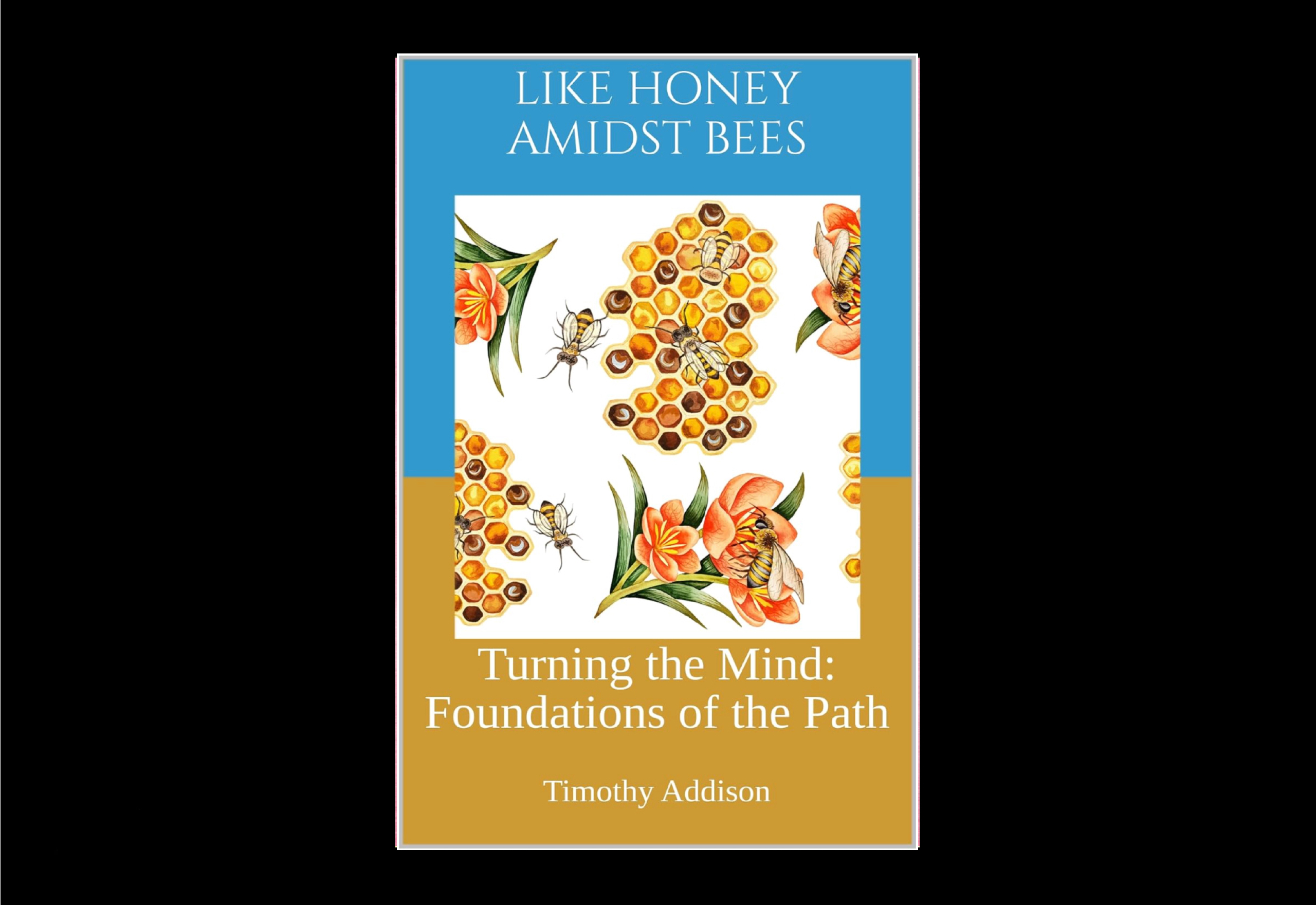
Adapted from Turning the Mind, the second book in Timothy Addison’s new series, Like Honey Amidst Bees, with permission from the author.