

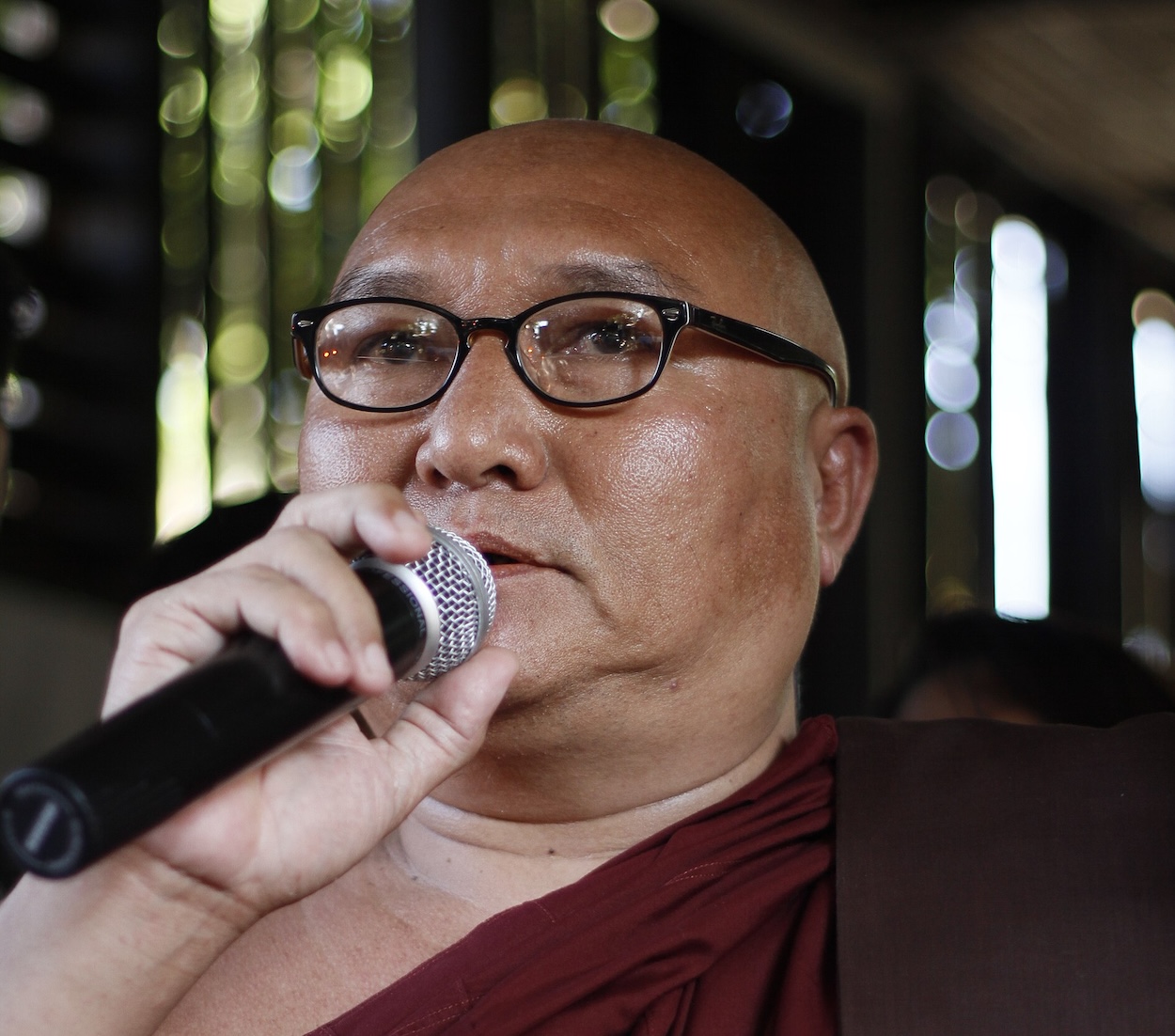

International commentary on Myanmar’s Buddhist monastic community often relies on a simplistic binary of two opposing camps: the pro-democracy activists fighting the military regime, and the ultranationalists who back it. This neat division makes the critical error of surrendering the definition of “nationalism” entirely to the junta. The legacy of Shwe Nya War Sayadaw shatters this assumption, demonstrating an inclusive Buddhist nationalism that actively resisted military tyranny while championing a civic identity that included Muslims as fellow citizens rather than scapegoats.
Venerable Pinnyasiha, commonly known as the Shwe Nya War Sayadaw, was a prominent pro-democracy Buddhist monk, passed away on July 2025 in his 60s from liver disease developed during his imprisonment. He was one of three prominent monks arrested on the first day of the coup in February 2021 alongside Aung San Suu Kyi and senior figures from the National League for Democracy (NLD) party. His immediate detention underscores the military junta’s acute apprehension regarding his extensive social and political influence. He was later released from Yangon’s Insein Prison on November 17, 2022 during a junta amnesty.
Buddhist Teachings for the Struggle for Democracy
The involvement of Venerable Shwe Nya War in politics began back in 1988 during the 8888 Uprising in which he became a co-founder of the All-Yangon Young Monks’ Association. Within the framework of this association, he often went out in protest marches alongside other Buddhist monks, chanting the Metta Sutta. Additionally, there were cases when the monks united with different minorities, such as Muslims, within the framework of the mass democracy against the “Burmese Socialist Programme Party” rule. This resulted in the six-month imprisonment of the Sayadaw within the period of BSPP rule. Afterward, Venerable Shwe Nya War decided to devote himself to developing the suburban areas where he lived through conducting charity events, development initiatives, and public lectures combining political rhetoric and Buddhist sermons. As the abbot of Sadhu Pariyatti Monastery, he organized civic meetings on a regular basis, including celebrations of national holidays, marking Aung San Suu Kyi’s Nobel Peace Prize, and other NLD-related political events.
As part of his sermons in this era, the Sayadaw developed a particular approach involving application of Buddhist principles to criticizing socio-economic realities of the country. For instance, referring to the notion of sappaya (that which is beneficial; wholesome; suitable), a concept that can be found in the Visuddhimagga, he claimed that Myanmar lacked these critical factors for ensuring the well-being of its society due to the failures of the state, i.e., the military government at that time. Back then, owing to the lack of proper infrastructure, there were daily electricity blackouts of up to eight hours, while access to necessities, such as clean drinking water and the medical care, was not guaranteed to all residents. Additionally, he promoted an anti-war position through calling attention to intentional burning of religious places and monasteries of ethnic minorities. As a result, he had to suffer a one-year-long public speaking ban imposed by the regime in February 2011.
Shwe Nya War Rebellion
At the same time, Sayadaw’s reputation was acknowledged in international civic circles as, in December 2011, he took part in a high-level talk on behalf of the civil society along with other representatives, including then-US Secretary of State Hillary Clinton. Additionally, the Sayadaw disregarded the state-imposed speaking ban, giving a speech for the NLD party during an almsgiving event in October 2011. As part of the ceremony held on September’s International Democracy Day, he preached a powerful sermon named “Pin Wa Yon” (The Clump of Yellow Bamboo) in which he discussed the importance of democracy, peace, and mutual respect.
The state-run State Sangha Maha Nayaka Committee responded to this act of defiance by issuing a notice on December 12, 2011, demanding the Sayadaw resign and vacate Sadhu Pariyatti Monastery by late of 2012. He disagreed with this demand and started a public defiance. As a result, Venerable Shwe Nya War received support of prominent pro-democracy movements and leaders of the 88 Generation student movement, Min Ko Naing, and Ko Ko Gyi, by essentially making encampment inside the monastery.
Early Days of Buddhist Nationalism
Shortly after, in early 2012, the infamous “Face of Buddhist Terror” — Venerable Wirathu — was freed from prison, along with many other political prisoners. In celebration of his freedom, members of the All-Burma Monks’ Alliance (ABMA) – the vanguard organization in the 2007 Saffron Revolution – and monks from Ma Soe Yein Monastery came to greet Wirathu outside prison. Initially, Venerable Shwe Nya War warmly received Wirathu as a comrade in fighting against the Myanmar military dictatorship. At the request of Wirathu to follow the State Sangha Maha Nayaka Committee directives concerning the Buddhist clergy, Venerable Shwe Nya War agreed to renounce his position in the Sadhu Pariyatti Monastery. Later, Venerable Shwe Nya War moved to the peripheries of Hmawbi Township, establishing Shwe Nya War Forest Monastery on open fields and making it his permanent home.
He associated himself with the Patriotic Association of Myanmar — the ultranationalist group that supported the 969-movement led by Wirathu — in its early days. Soon enough, in 2012, inter-communal violence broke out between Rohingya Muslims and Arakanese Buddhists all over various cities, reaching places such as Meiktila, Okkan, and Thandwe. To stop the violence, Shwe Nya War Sayadaw, along with some prominent monk leaders — Venerable Dhammaduta Chekinda, Venerable Wirathu, and Venerable Sandādhika — went to Meiktila and Okkan to mediate and broker peace among conflicting parties.
In November 29, 2012, white phosphorus — an extremely poisonous incendiary agent — was used as part of a government crackdown on protesting villagers and monks who complained about the social and environmental repercussions of the Letpadaung copper mine, a partnership mine in Sagaing Region operated jointly by China North Industries Corporation (NORINCO). In reaction to the events, Sayadaw Shwe Nya War paid a visit to injured protesters to extend his support by providing money to the monks and civilian victims who’d been severely burned. The Sayadaw immediately showed his solidarity with labor forces by backing labor strikes at the Yangon Crown steel factory in Hmawbi and Tai Yi footwear factory in Hlaing Tharyar Industrial Zone.
Around February 2013, an illegal confiscation of 5,500 acres of land near Palaung Village for a drainage project — which ultimately benefited the Orchard Company — left dispossessed residents starving and with no alternative but to occupy vacant plots for survival. This desperate socioeconomic reality led to a direct standoff between 500 villagers and 200 police officers, which escalated into a physical clash fueled by rising tensions and verbal insults from law enforcement. Venerable Shwe Nya War and Venerable Wirathu visited the hospital to provide financial aid to all injured villagers and police officers, with the Sayadaw noting that the tragic conflict was a direct consequence of a severe trust deficit between farmers and the authorities.
Reclaiming Buddhist Nationalism
Soon enough, the 969 movement and Patriotic Association of Myanmar began turning into a movement of extreme racism towards Muslim population in Myanmar, especially the Rohingya Muslims. They started a campaign calling people to boycott Muslim businesses, shame interfaith marriages, and convert Buddhists back to Buddhism.
Shwe Nya War strongly opposed this. Commenting on the new ideology of Patriotic Association of Myanmar and the 969 movement, he said, “In my objectives, my disposition, and my implementation practices, my ultimate goal is to advance the collective interest of the entire nation.”
He once mentioned in a dhamma sermon that it is exaggerating to blame Muslims solely for any compromises to Buddhism and insisted that the most prominent threats against Buddhism come from within. In particular, he pointed to the Myanmar military dictatorship of murdering and physically abusing the Buddhist monks during the 2007 Saffron Revolution and Letpadaung Copper Mine protests.
Indeed, according to Shwe Nya War Sayadaw, the issue of forced conversion within domestic interreligious marriages should not have been the main problem to discuss, while the problem of international human trafficking, with thousands of Burmese women exploited in China, should have received more attention. Calling those interested in interreligious relations for political reasons “blind nationalists”, Shwe Nya War Sayadaw completely disassociated himself from the ultranationalist 969 movement and Patriotic Association of Myanmar.
Sayadaw Shwe Nya War’s concept of nationalism was quite different, yet complicated. In some instances, he emphasized Buddhist nationalism, defining it as the necessity for citizens to support and defend the poor Burmese migrant labor force working in difficult conditions in neighboring countries such as Thailand, Japan, and Singapore. It was the same cultural preservation and engagement with the diaspora that the Sayadaw was concerned about when giving his speech to the Burmese community in Tokyo, Japan on June 15, 2013, with an aim to reinforce the Buddhist national identity. His vision still embraced a protective form of nationalism aimed at protecting Myanmar’s native identity as inherently Buddhist. When interviewed by Radio Free Asia (RFA)’s U Khin Maung Soe, he openly supported the 2015 Race and Religion Protection Laws — the legislative package fiercely endorsed by the ultranationalist organization Patriotic Association of Myanmar (Ma Ba Tha). Reflecting on the laws, the Sayadaw himself affirmed, “I, myself, personally like the 2015 Race and Religion Protection Laws.”
This legislative pack included, among others, the Interfaith Marriage Law, which limited Buddhist females’ marriage with non-Buddhists by means of stringent property inheritance requirements for non-Buddhists. In response to the restrictive law, the Sayadaw defended his position by stating, “this is not unjust, but just to secure our national boundary, making sure our country, our racial identity, and our religious identity are defended.”
Unconditional Love and Solidarity
During the last earthquake in Myanmar, which killed more than 4,549 people and injured more than 11,366, Shwe Nya War traveled multiple times to affected areas, showed solidarity, donated, and fundraised for the victims of any religious or ethnic background. This was
just before four months before Shwe Nya War’s death; his body was terribly weakened.Ironically, Min Aung Hlaing, the leader of the military junta, who claimed to defend Buddhism and national identity, had barred Sayadaw Shwe Nya War from traveling abroad for medical treatment.
Shwe Nya War was an individual whose sense of nationalism could not be described through restrictive terms. Instead, his sense of unity embraced members of minority groups such as Muslims, including the Rohingya, and diverse ethnic groups in accordance with the Buddha’s teachings on metta. His understanding of nationalism did not include any elements of demonizing minorities but rather promoting the interests of Burmese immigrants and ensuring the safety of poor people from the dangers of trafficking across nations. He had a vision for a state in Myanmar that would not rely on the politics of scapegoating minority groups but promote liberal democracy as the key principle of a good state in alignment with Buddha’s teachings. Although Shwe Nya War was indeed political, his commitment to Buddhism cannot be overstated since he always relied on its philosophies in fighting for social unity, democratization, and liberation.