

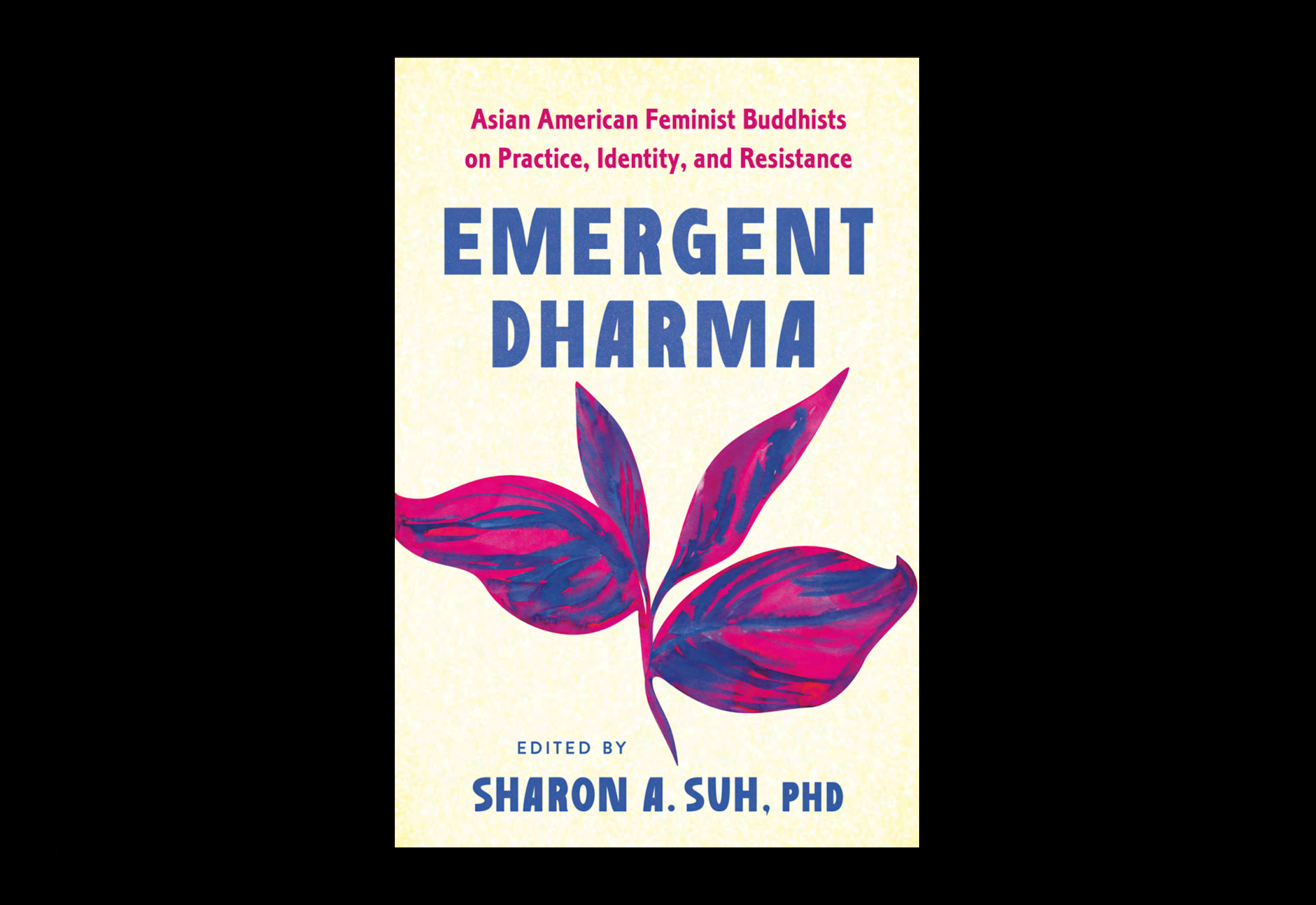

The following is excerpted from Emergent Dharma: Asian American Feminist Buddhists on Practice, Identity, and Resistance and was written by the book’s editor, Sharon Suh. Emergent Dharma boasts 11 diverse authors in total, including Chenxing Han, Funie Hsu, Jane Naomi Iwamura, Mihiri Tillakaratne, Mushim Patricia Ikeda, Nalika Gajaweera, Naomi Kasumi, Tâm Thâm Tịnh and Thanda Aung, and Syd Yang.
Like all minoritized people, Asian Americans have become habituated to the daily effects of oppression and violence in public and private spaces that often compromise our integrity. This habituation comes at a cost. In Restorative Yoga for Ethnic and Race-Based Stress and Trauma, Gail Parker notes that “Racial stress is a cumulative experience that is often magnified by lack of opportunity to recover before the next experience, causing it to be chronic.”
Racism carries physiological and psychological effects that cause lasting scars that render our bodies vulnerable. By practicing embodied mindfulness through restorative yoga and trauma-informed yoga, I have learned to experience pockets of parasympathetic rest by slowing my heart rate, metabolic rate, and breath. A practice that invites me back into my body as a haven and refuge has been a profound act of positive self-regard and self-love that many Asian Americans are still uncomfortable acknowledging. But learning to care for the self and explicitly cultivate self-love are not shameful selfish acts. They are survival skills that also help us thrive.
Learning to practice self-care and self-love has meant deeply listening to the anger and rage that I have suppressed for fear of retaliation for as long as I can remember. It means trusting my gut when it tells me that I am in an unhealthy and emotionally abusive relationship. It means loving myself enough to walk away from my second marriage of just shy of three years to become a twice-divorced woman. It means forgiving myself with compassion, allowing myself to say, “Oops, I did it again,” and no longer remaining in a relationship out of fear of what others will say.
An Asian American feminist Buddhist ethic of self-love also means being willing to break from shame culture, stigmatization, and the Model Minority stereotype in order to experience liberation. It also means being a willful single mother in my fifth decade who is willing to wade through the fear, delusion, and anxiety that can come from choosing to be alone.
For this Asian American feminist, Buddhism is about liberating ourselves from systems of domination and cycles of trauma that requires a deliberate and thoughtful process of self-care and self-love.
My Asian American feminist Buddhist ethic of self-love also means that I embrace myself as a bad Buddhist who skips meditation practice often, who sometimes spends hours zoning out on Netflix, who doom scrolls, and who has an affinity for fashionable boots, jackets, and handbags. In All About Love: New Visions, bell hooks articulates a self-love that is a process of self-recovery based in truth-seeing and telling. She writes, “When we see ourselves as we truly are and accept ourselves, we build the necessary foundation for selflove.” But, she counsels, we cannot do this alone. For hooks, love is “the action we take on behalf of our own or another’s spiritual growth,” and when we see love as “a combination of trust, commitment, care, respect, knowledge, and responsibility,” we can learn to direct this love to ourselves. In other words, the ability to cultivate self-love is dependent on our capacity to love others in a generative, capacious, healthy manner.
For this Asian American feminist, Buddhism is about liberating ourselves from systems of domination and cycles of trauma that requires a deliberate and thoughtful process of self-care and self-love. Self-care and self-love are not the result of self-conceit or excessive self-centeredness, which Asian American families and Western Buddhists so readily proclaim. They are the result of an ethics of care that requires abandoning our cultural propensity to self-silence, practicing techniques that keep us from dissociating from our wise bodies, acknowledging our anger and rage, and affirming our inherent worth and value. An Asian American feminist Buddhist ethics of self-love is therefore foundational to collective healing and liberation.
Love is a topic undertheorized in Asian American cultures because it is often equated with loyalty, whose foundation is often about power and domination. In All About Love, hooks explains that love cannot exist in dominator culture which is premised on power relationships. That is, love and domination are mutually exclusive. Love is a verb and a process that involves both self-love and the connection of the self to the other in a perpetual drawing toward the other.
I am inspired to foreground love and self-love because many of us were not explicitly taught to love ourselves in our own families and in our own communities. Instead, we often mistook love for obligation. The Asian American notions of love that are given voice tend toward proxies of expressing true love. In fact, many of us joke and balk at using the words “I love you” in Asian and Asian American cultures, as if the phrase itself were a misguided and frivolous energy. How many of us lament that we did not hear the words “I love you” from our parents’ mouths; instead, love was expressed through feeding us and stories of self-sacrifice. But, if, as hooks writes, love is a verb and an action, and love can end domination, why are Asian Americans so afraid to talk about it and express it verbally? Talking about love is, after all, a speech act, and yet in Asian American cultures, it is a word we so rarely expect to hear from our parents. But, if we cannot expect to hear the words “I love you” from those who raise us, how can we be expected to cultivate it for ourselves? As Asian American feminist Buddhists, can we love ourselves as fiercely as we love others? Is there an Asian American feminist Buddhist ethic of love that is not duty-bound, not based on expectations and accusations of gratitude and ingratitude? What does it mean to love the self deeply, and how do we begin to have these potent and healing conversations in our own minds, hearts, families, and communities? What kinds of love are we talking about when we are not talking about love? What is an Asian American Buddhist ethic of love? Is it just metta (lovingkindness) and karuna (compassion) or is there something more? Do Confucian values of filial piety and duty blunt our ability to love outside of the scripts of affinity, obligation? Is love really about obligation to the other? Is obligation really liberatory?
hooks suggests that we often misconstrue love by experiencing it through the lens of woundedness or loss, but perhaps Buddhist teachings can help us transform this sense of loss by bearing witness to our broken-heartedness and encouraging us to cultivate self-love. hooks’s meditation on love recognizes that we may not have been raised in a loving way and that we are perhaps unfamiliar with a love that is unconditional, non-transactional, and liberatory. Yet Buddhism and the buddhadharma have the power to liberate us from our traumatic experiences and our mistranslations of love as something we are obligated to give to others through our own self-sacrifice. The buddhadharma can, in fact, teach us to love our Asian American selves, despite our cultural hesitance to focus on self-love. The desire for self-love is a spiritual impulse for healing and resilience and becomes the training ground and seat of liberation.
In the ever-emergent sangha of Asian American feminist Buddhists, self-love is not an indulgence or a private act of self-care, but the essential ground from which our collective liberation arises. In a culture that demands our erasure and extracts our compliance and our silence, practicing self-love as Asian American feminist Buddhists is an act of resistance and reclamation. It is the radical turning toward ourselves internally and toward community with our bodies, our rage, our joy, our imperfect humanity, with tenderness and compassion, that inspires this Asian American feminist Buddhist spirit. This act of deep care of the self and other-as-self is not a rejection of Buddhist understandings of no self; rather, it is a clarification and adaptation reminding us that the self is relational, contingent, and fluid.
To practice self-love from an Asian American feminist Buddhist perspective is to honor our embodied experience as worthy of attention and deep care. An Asian American feminist Buddhist ethic of self-love embodies the practice of non-harming of self and other and is a refusal to participate in our own diminishment and continued invisibility. In this way, self-love is not only compatible with the Buddhist path but a necessary ground for awakening. It is how we cultivate the resilience and tenderness to show up for ourselves and for others in this ever-evolving and ever-more-needed collective struggle for liberation.
From Emergent Dharma by Sharon A. Suh, published by North Atlantic Books, copyright © 2025 by Sharon A. Suh. Reprinted by permission of North Atlantic Books.