

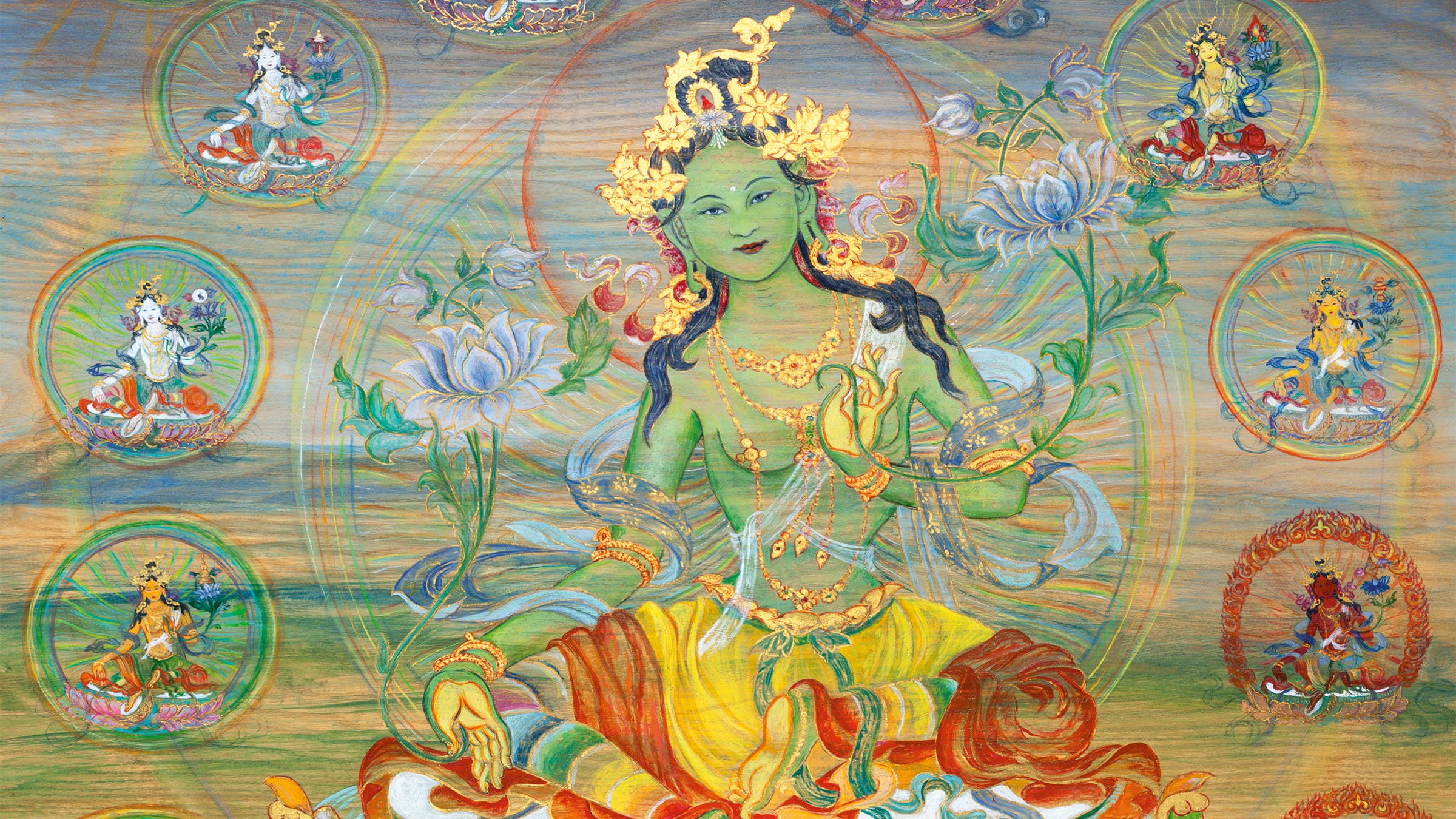
Some of the most meaningful shifts in our lives don’t come from avoiding difficulty but from discovering a new relationship to it. What feels like an obstacle becomes part of the path. Difficult experiences reveal unexpected wisdom, and confusion begins to give way to greater clarity and freedom. In the Vajrayana Buddhist tradition, this capacity to embrace difficulty and recognize its deeper nature is embodied in the female buddha Tara.
Traditionally, many practitioners relate to Tara as an embodiment of awakened compassion whose protection and blessings are invoked in times of difficulty. At the same time, Vajrayana teachings invite us to contemplate the inner meaning of Tara, recognizing that her qualities of awakening can also be discovered within our own experience. Through practice, these qualities begin to shape how we see, relate, and respond to the world, becoming the basis for wise discernment, compassionate engagement, and courageous action.
Green Tara is the central form from which her twenty-one emanations arise, each demonstrating a distinct facet of wisdom and compassion. Together, these emanations form a living map of transformation, revealing how awakened qualities emerge, deepen, and find expression in our lives.
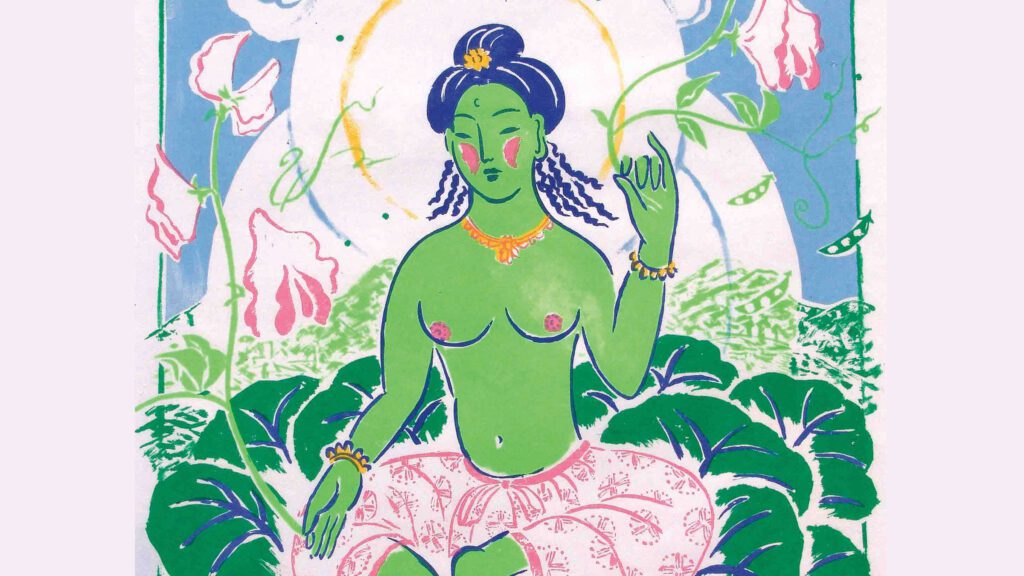
This article is the fourth and final installment in a series exploring the traditional liturgy Praises to the Twenty-One Taras. This ancient text, which has an associated practice by the same name, serves as a path of connection to the awakened qualities that the twenty-one Taras embody. Earlier articles introduced Green Tara and the first fourteen of her emanations whose activities emphasize swift protection, courage, restoration, and realignment. This final installment turns to the last seven Taras—numbers fifteen to twenty-one—who reveal another dimension of her compassionate activity. Traditionally associated with protection from poison, illness, harmful influences, conflict, and other obstacles, they also illuminate a process of transformation through which confusion gives way to clarity, difficult experiences become sources of wisdom, and a deeper freedom begins to emerge.
In the pages that follow, each of these final seven Taras is introduced with her corresponding verse of praise from the liturgy, followed by an exploration of how her qualities can be understood and practiced in our own lives.
15. Jetsun Drölma Rabtu Shima
Tara Who Is Perfect Peace
Homage to Her who is happiness, virtue, and peace,
Who lives in the peace beyond suffering,
Who overcomes great negative deeds
With the purity of Svaha and OM.
Jetsun Drölma Rabtu Shima serves as the gateway into the final seven Taras. Where the earlier Taras meet fear, confusion, and conflict more directly, her activity begins with the pacification of what veils our natural clarity. Through her, we enter a mandala of release, restoration, and the unfolding of wisdom.
Rabtu Shima is soft white in color and radiates a deep peace that gently settles the mind and heart. She holds a vase brimming with wisdom-awareness nectar and a blossoming lotus. The vase and nectar symbolize her activity of purification, cleansing negative karma and revealing the peace that has always been present.
Rabtu Shima’s verse of praise describes her as abiding in the peace beyond suffering and overcoming great negative deeds. Traditionally, her activity is the purification of harmful actions, obscurations that conceal our innate wisdom and compassion, and the disturbing emotions that cloud the mind. As their hold loosens, suffering loses its footing and greater clarity emerges.
When obscurations accumulate, grasping, aversion, confusion, and deeply conditioned reactions narrow our perspective and conceal the qualities of wisdom and compassion that are already within us. Rabtu Shima embodies the release that becomes possible when these obscurations begin to dissolve. As they recede, space opens, old patterns soften, and the mind naturally settles into peace.
As the first of the final seven Taras, Rabtu Shima marks the beginning of this unfolding. What once obscured our deeper nature starts to fall away, and the path ahead becomes visible.
16. Jetsun Drölma Rigngag Tobjom
Tara Who Destroys the Power of Harmful Intentions
Homage to Her who completely delights her entourage,
Who destroys the bodies of enemies,
Who liberates with the light from the ten syllables
And with the mantra HUNG.
Jetsun Drölma Rigngag Tobjom embodies illumination. Through her, the light of awareness reaches places that were previously hidden, bringing into view what confusion obscured.
Rigngag Tobjom is red in color, her fierce presence conveying the uncompromising clarity of awakened awareness. She holds a vase filled with wisdom-awareness nectar and a blooming lotus. Her symbol is a double vajra, radiating the light of wisdom in all directions. It represents an awareness so stable and clear that confusion cannot gain a foothold.
Traditionally, Rigngag Tobjom is associated with destroying harmful influences, intentions, spells, and negativity. Her verse of praise speaks of destroying the bodies of enemies, language that can sound startling to modern ears. Yet the enemy is not ultimately a person. It refers to harmful intentions, conflicting emotions, and forces that disrupt peace, joy, and benefit.
Her praise shifts immediately from enemies to light. Tara liberates through the radiance of her mantra and the wisdom represented by the sacred seed syllable HUNG, which symbolizes awakened awareness itself. As awareness illuminates experience, what was concealed becomes visible. Reactivity, fear, resentment, and self-deception lose much of their power when brought into the light of clear seeing.
The light celebrated in the praise is the light of awareness itself, exposing the workings of confusion and allowing harmful intentions to be seen for what they are.
17. Jetsun Drölma Pagmé Nönma
Tara Who Subdues Boundless Harm
Homage to Ture who stamps with her foot,
Whose seed syllable is HUNG,
Who shakes Mount Meru, Mandara,
Kailash, and the three worlds.
Jetsun Drölma Pagmé Nönma embodies enlightened protection. Her activity arises from compassion and a profound commitment to safeguarding life and preventing harm.
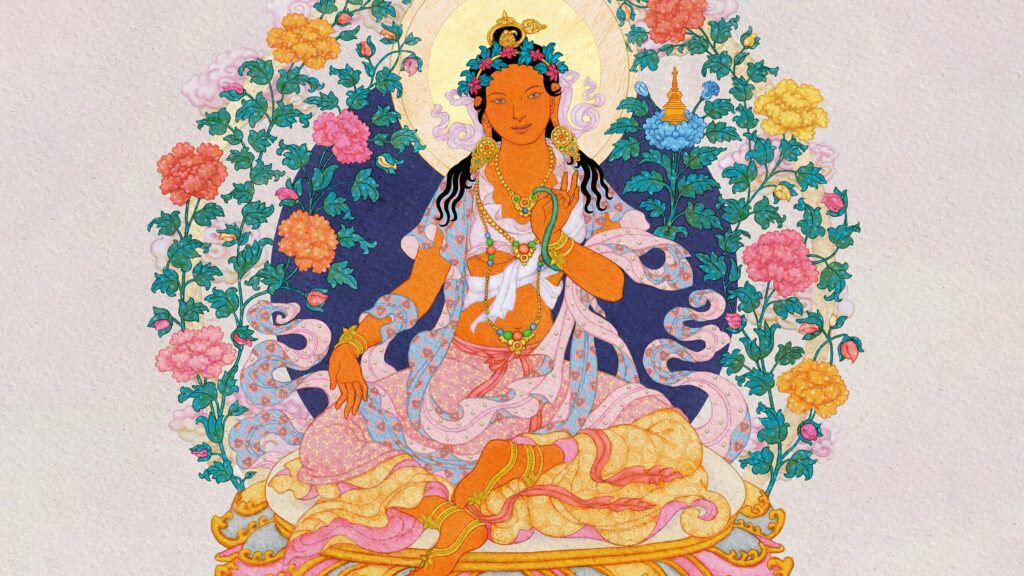
Pagmé Nönma is saffron in color, conveying warmth, vitality, and strength. Her activity is fierce, but her appearance is peaceful, expressing a strength that is steady, grounded, and free from aggression. She holds a vase of wisdom-awareness nectar and a blossoming lotus. Her activity is symbolized by a golden stupa, representing the Buddha’s awakened mind. The stupa reminds us that genuine protection arises from wisdom and compassion. When awakened mind encounters suffering, it naturally responds.
Pagmé Nönma’s verse of praise describes her stamping her foot and shaking mountains and worlds. These dramatic images convey her power to subdue violence, harmful activity, and forces that threaten the well-being of others. Traditionally, she’s associated with protecting beings from thieves, hunters, bandits, and those who would cause harm. Yet her activity isn’t directed against individuals themselves. Its aim is to pacify the causes of violence and establish peace for all beings.
The seed syllable HUNG appears at the center of Pagmé Nönma’s verse of praise and represents awakened awareness itself. The power that shakes mountains is the power of wisdom and compassion disrupting the patterns of confusion that give rise to suffering. When suffering is clearly seen, care naturally begins to move. Pagmé Nönma embodies this protective response, guided by wisdom, courage, and compassion.
18. Jetsun Drölma Maja Chenmo
Tara Who Dispels All Poison
Homage to Her who holds in her hand
The rabbit-marked moon, like a celestial lake,
Who totally dispels poison
By reciting twice Tara and PÉ.
Jetsun Drölma Maja Chenmo embodies transformation. Her activity is the transmutation of poison into wisdom and suffering into a path of awakening.
She is luminous white in color, her presence conveying a soothing coolness, gentleness, and care. She holds a vase of wisdom-awareness nectar and a lotus in full bloom. Her peaceful activity is expressed through the symbol of the moon, which is described as being “rabbit-marked.” (Traditionally, in Tibet, the lunar markings are interpreted as a rabbit rather than a man.) Like a celestial lake, the moon evokes a sense of stillness, clarity, and healing. It symbolizes a compassion that soothes what has become disturbed and restores balance where there has been harm.
Traditionally, Maja Chenmo is associated with dispelling poisons, illness, and forces that threaten well-being. She is also said to offer special protection to children. Her verse of praise speaks of poison in a literal sense, yet the tradition understands poison more broadly.
It includes the poisons of attachment, anger, jealousy, and ignorance that cloud the mind and give rise to suffering.
There are experiences that leave a residue. Fear, grief, anger, disappointment, betrayal, and loss can continue to reverberate long after the initial event has passed. Left unattended, they can gather momentum, shaping the ways we perceive, respond, and relate. Maja Chenmo reveals another possibility. Rather than becoming a source of further suffering, even painful experience can become a condition for wisdom, compassion, and awakening.
Maja Chenmo’s name means “Great Peacock.” In Buddhist symbolism, the peacock is said to consume poison
and transform it into the brilliance of its plumage. For this reason, the peacock has long served as a symbol of the bodhisattva and Vajrayana ideal of transforming suffering into awakening. The peacock doesn’t avoid poison, nor is it overcome by it. Instead, poison becomes part of its beauty. In the same way, Maja Chenmo embodies the possibility of transmutation. Rather than rejecting difficult experience, she reveals how wisdom and compassion can transform even the causes of suffering into conditions for awakening.
The mantra in the praise expresses this same activity: Reciting Tara twice liberates grasping, while exclaiming PÉ cuts through the poisons that bind us. Together they express the principle that liberation isn’t found by turning away from experience but by recognizing its deeper nature and allowing it to become part of the path.
19. Jetsun Drölma Mipam Gyalmo
The Invincible Queen
Homage to Her who is honored by hosts of Gods,
Kings, local deities, and spirits,
Who transforms conflicts and disturbing dreams
With the armor of resplendent joy.
Jetsun Drölma Mipam Gyalmo embodies harmony. Through her, conflict settles, disturbing influences lose their hold, and the natural radiance of wisdom begins to shine unobstructed.
Mipam Gyalmo is white in color, her presence conveying peace, dignity, and protection. She holds a vase of wisdom-awareness nectar and a blossoming lotus. Her activity is symbolized by a white parasol, an ancient emblem of nobility, wisdom, and compassionate care. Traditionally, the parasol signifies protection, sheltering beings from fear, confusion, and harmful influences. Its rounded form suggests the all-embracing nature of wisdom, while the flowing fabric beneath it expresses compassion extending outward. Together they create a field of protection in which harmony can take root and resplendent joy can shine.
Mipam Gyalmo is associated with protecting beings from conflict, violence, disturbing dreams, harmful influences, and negative omens through the armor of resplendent joy. Whether arising outwardly as discord and conflict or inwardly as fear, anxiety, and troubling dreams, these disturbances disrupt harmony. Mipam Gyalmo’s activity restores harmony, creating conditions in which peace, clarity, and joy can flourish.
The armor celebrated in the verse is the radiance of wisdom itself. As wisdom and compassion become more accessible, fear, conflict, and confusion begin to lose their power. Joy emerges naturally—as an expression of qualities that have always been present. In this way, joy becomes a form of protection. It is not an emotion dependent upon circumstances, and it doesn’t deny suffering or shield us from life’s difficulties. Rather, joy allows us to meet experience from a place of greater openness, confidence, and freedom.
Beneath the protection of her white parasol, we discover that genuine security arises not from controlling circumstances but from trusting the awakened qualities already present.
20. Jetsun Drölma Ritö Loma Gyönma
Tara Clothed in Leaves
Homage to Her whose two eyes shine
With the luminosity of the sun and moon,
Who dispels virulent epidemics
With two Hara and with Tuttara.
Jetsun Drölma Ritö Loma Gyönma embodies restoration, replenishing what has become depleted and returning it to balance.
She’s saffron in color, conveying warmth, vitality, and renewal. She holds a vase of wisdom-awareness nectar and a blossoming lotus. Her peaceful activity is expressed through the symbol of a sacred basket filled with medicinal substances. It evokes nourishment, healing, and the restoration of balance, reminding us that healing isn’t merely the removal of illness; it’s also the replenishing of what has been depleted and the reawakening of wholeness.
Ritö Loma Gyönma’s verse of praise describes her eyes shining with the luminosity of the sun and moon. Together they symbolize a complete healing process: The radiant light of the sun dispels sickness, harmful influences, and the causes of suffering, while the cooling light of the moon restores health, vitality, and well-being. One aspect removes what is harmful; the other replenishes what has been diminished.
Traditionally, Ritö Loma Gyönma is associated with dispelling epidemics, contagious illnesses, and the suffering they bring. Her verse of praise speaks directly of virulent epidemics, reminding us of the vulnerability that accompanies life in an interconnected world. Yet the tradition also understands epidemics symbolically. Just as illness can spread from one person to another, so can fear, anger, despair, and confusion. Each moment conditions the next, and when these states remain unchecked, they can gather momentum and spread through our experience, relationships, and communities. Ritö Loma Gyönma’s activity addresses both levels. She restores balance where illness has taken hold and helps dispel the conditions that allow suffering to spread.
21. Jetsun Drölma Özer Chenma
Tara of Great Rays of Light
Homage to Her who through the suchness of ground, path, and fruition
Completely possesses the power to pacify,
Who quickly is victorious over yakshas and
Spirits who cause harm and sickness.
If Jetsun Drölma Ritö Loma Gyönma reveals the restoration that follows healing, Jetsun Drölma Özer Chenma reveals the freedom that emerges when all that obscures our true nature has been pacified. Her activity is complete pacification. When the true nature of experience is recognized, suffering, confusion, and obscuration loosen their hold.
Özer Chenma is rich white in color, radiating luminosity, vitality, and clarity. She holds a vase of wisdom-awareness nectar and a lotus in full bloom. Her peaceful activity is expressed through the symbol of a pair of golden fishes. The fishes represent freedom, spontaneity, and unobstructed movement. Moving effortlessly through water, they symbolize a mind no longer constrained by confusion, fear, or fixation. They point toward the freedom that emerges when the true nature of experience is recognized.
Özer Chenma’s verse of praise describes this realization as the suchness of ground, path, and fruition. Ground refers to our fundamental nature, path to the journey of awakening, and fruition to its full realization. Suchness points to their true nature as it is, free from our habitual assumptions. When this is recognized, suffering, confusion, and habitual patterns begin to lose their power. What once seemed solid and limiting is seen more clearly, allowing a deeper freedom to emerge.
The praise goes on to speak of victory over yakshas and other kinds of spirits who cause harm and sickness. These may be understood as unseen forces associated with illness, obstacles, and misfortune, or more broadly as suffering, karma, conflicting emotions, and all that disturbs peace and clarity. Tara’s activity is to pacify whatever obstructs freedom, whether understood outwardly, inwardly, or at the deepest level of realization.
As the final Tara of the mandala, Özer Chenma brings the journey to its completion. The obscurations that once concealed our true nature have been purified, illuminated, transformed, harmonized, and restored to balance. What remains is a freedom that is naturally open, clear, and unobstructed. Like the golden fishes moving effortlessly through water, the mind is no longer constrained by confusion or fear.
Across the final seven Taras, we encounter a progressive unfolding of enlightened activity. What begins as the clearing of obscurations gradually reveals illumination, protection, transformation, harmony, restoration, and ultimately, freedom. Together, these Taras remind us that awakening isn’t separate from the challenges we encounter. Each difficulty, when met with wisdom and compassion, can become part of the path.
The twenty-one Taras invite us into relationship with the awakened qualities they embody.