


When people think of the Buddhist world, Bangladesh may not come to mind. The imagination travels instead to Bodh Gaya, where Siddhartha Gautama awakened beneath the Bodhi tree; to Sri Lanka and its ancient Theravada monasteries; to the temples of Thailand and Myanmar; or northward to the Himalayan traditions of Tibet and Bhutan.
Yet between these better-known Buddhist worlds lies Bangladesh, a Muslim-majority country where a small but remarkably resilient Buddhist community continues traditions rooted in the ancient Buddhist civilization of Bengal.
For Bangladeshi Buddhists, this history is not simply something preserved in archaeological ruins or scholarly books. It lives — in monasteries, festivals, family practices, oral histories, and sacred landscapes. It lives when devotees offer flowers before an image of the Buddha, when monks chant the teachings in village monasteries, when families observe the precepts on full-moon days, and when thousands gather for festivals whose origins reach back through generations.
I grew up within this Buddhist world. For me, Buddhism in Bangladesh has never been only a subject of historical research. It is a living inheritance.
And its story complicates our usual map of Buddhism.
Where the Buddha Is Remembered
In southern Bangladesh, particularly around Chattogram, Buddhist memory is woven into the landscape.
One of the most fascinating examples is Chakrashala, in the Patiya area of Chattogram. Local Buddhist tradition holds that the Buddha and his disciples stopped there on a journey to ancient Arakan, in what is now Myanmar. The tradition remembers the Buddha practicing walking meditation there and teaching the local people.
Whether every detail of such traditions can be historically established is not ultimately what gives them their enduring power. For generations of local Buddhists, these landscapes have become places where history, memory, and devotion meet.
At Chakrashala, the Buddha does not belong exclusively to a distant Indian past. He is remembered as someone who walked upon this land.
That sense of proximity matters.
Pilgrimage allows religious history to become embodied. We walk where our ancestors believed the Buddha walked. We bow where generations before us bowed. Through such acts, an ancient story enters the present.
Bangladesh contains other places surrounded by similar layers of Buddhist memory. In Ramu, in the Cox’s Bazar district, the ancient Rangkut Buddhist tradition is associated in local narratives with Emperor Ashoka and the preservation of relics. In northern Bangladesh, the ruins of great monasteries point toward another dimension of this history, an era when Bengal stood near the intellectual heart of the Buddhist world.
When Bengal Was a Center of Buddhist Learning
The modest size of Bangladesh’s Buddhist population today can make it difficult to imagine how important this region once was to Buddhist civilization.
During the Pala period, beginning in the eighth century, Buddhism flourished across Bengal. Royal patronage supported monasteries, centers of learning, Buddhist art, philosophical scholarship, and networks connecting South Asia with the wider Buddhist world.
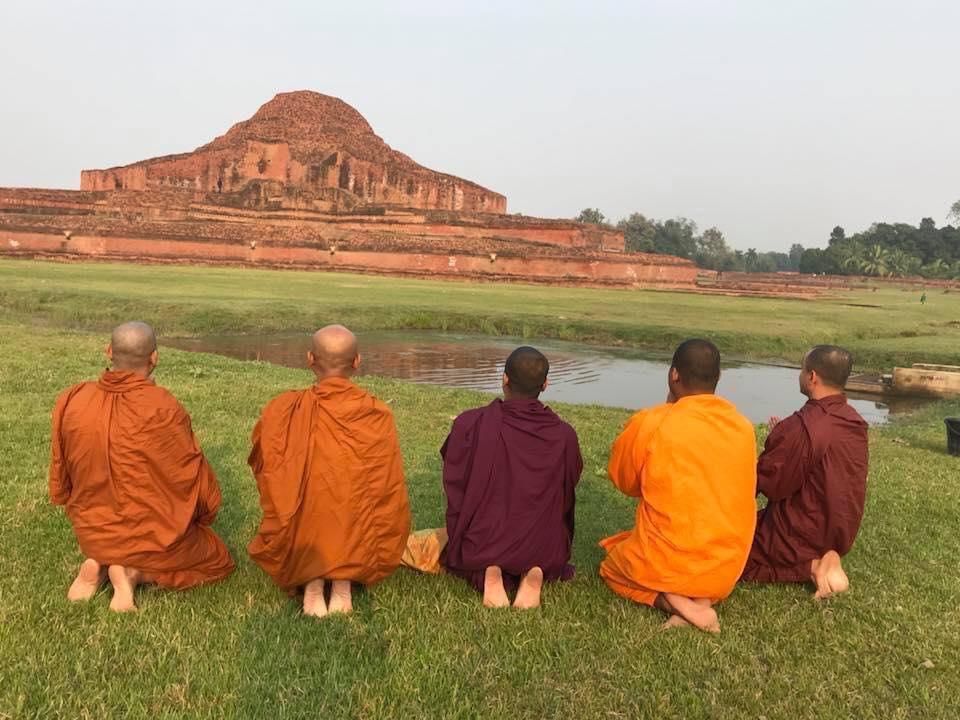
The ruins of Somapura Mahavihara at Paharpur offer perhaps the most spectacular surviving testimony. But these ruins were once alive with monks, teachers, students, ritual, debate, and study.
Bengal was not on the margins of Buddhist intellectual history. It helped shape it.
Among the masters associated with this wider cultural world was Shantideva, whose Bodhicaryavatara, or Guide to the Bodhisattva’s Way of Life, remains one of Mahayana Buddhism’s most cherished works on compassion and the bodhisattva path.
Another was Atisha Dipamkara Shrijnana, born in Bikrampur, present-day Bangladesh, around the end of the tenth century. Atisha traveled widely in pursuit of the dharma, including to the islands of Java and Sumatra in Southeast Asia, before eventually journeying to Tibet.
His influence there was profound. His Lamp for the Path to Awakening helped systematize the Buddhist path and contributed to developments that would shape Tibetan Buddhism for centuries.
Today, Buddhists around the world may study Atisha without realizing that the landscape of his childhood lies in modern Bangladesh.
This is one of the paradoxes of Bangladeshi Buddhist history: its influence traveled extraordinarily far, while the Buddhist identity of the land from which it emerged gradually faded from global memory.
Decline, Survival, and Renewal
Buddhism’s prominence in Bengal did not last.
Political transformations, the disappearance of royal patronage, changes in religious institutions, invasions, and centuries of social change contributed to the decline of the great Buddhist monastic culture that had flourished during the Pala period.
But Buddhism did not disappear completely. It survived particularly among communities in southeastern Bengal and the Chittagong Hill Tracts. Today, Bangladesh’s Buddhist communities include Barua, Chakma, Marma, Rakhine, Tanchangya, and other peoples, each carrying distinctive histories and cultural expressions.
Modern Bangladeshi Buddhism is predominantly Theravada. Its institutional life was profoundly shaped by monastic renewal movements, particularly from the nineteenth century onward.
Two important monastic fraternities emerged in this landscape: the Sangharaj Nikaya and the Mahasthabira Nikaya. Generations of monks worked to renew ordination, strengthen Vinaya practice, teach the dharma, establish monasteries and schools, and reconnect Buddhists in Bengal with the wider Theravada world.
The significance of these monks is difficult to understand if we think of a monastery simply as a place for meditation. In many Bangladeshi Buddhist villages, the monastery is also the spiritual heart of communal life. Monks teach children, counsel families, conduct ceremonies, offer ethical guidance, preserve texts and traditions, and remind communities of a Buddhist identity that has endured enormous historical change.
The survival of Buddhism here has therefore depended not only on institutions but also on relationships — between monks and laypeople, parents and children, teachers and students, and one generation and the next.
Buddhism as Something We Do Together
Some of my most vivid impressions of Bangladeshi Buddhism are not of philosophical doctrines. They are of people gathering.
On Buddha Purnima, which commemorates the Buddha’s birth, awakening, and passing into parinirvana, monasteries are filled with devotees. People bring flowers, candles, incense, and food. They undertake the five or eight precepts, listen to dharma teachings, meditate, and make offerings to the sangha.
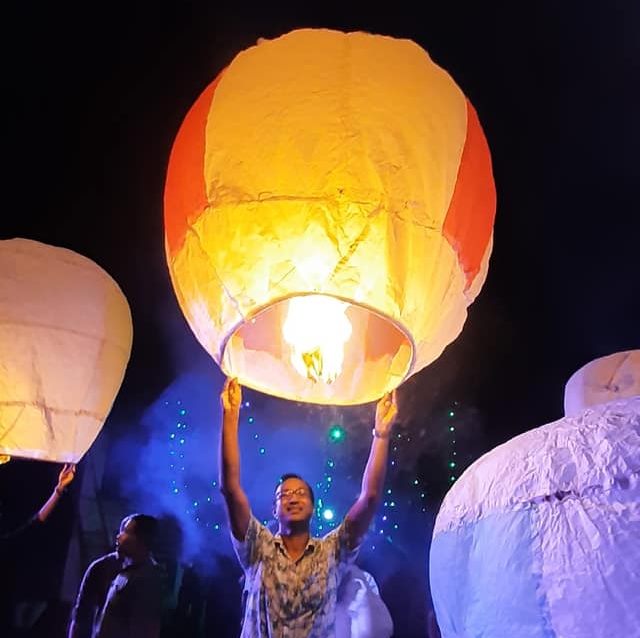
During Kathina, communities gather to offer robes and other requisites to monks following the rains retreat. Madhu Purnima recalls the traditional offering of honey to the Buddha. At the conclusion of the rains retreat, Pravarana is celebrated, and in some communities glowing fanus or paper lanterns rise slowly into the night sky.
A lantern ascending into darkness is a simple thing. Yet standing among a community watching those lights drift upward, one can sense something essential about the survival of Buddhism in Bangladesh: Traditions survive because people continue to practice them.
A grandmother brings a child to bow before the Buddha. A family prepares food to offer the sangha. A monk explains the five precepts to young people. Villagers gather to hear a dharma teaching. Someone lights a lamp.
None of these actions alone appears historically monumental.
Together, repeated across generations, they keep a tradition alive.
A Small Community with a Large Inheritance
Bangladeshi Buddhists today constitute only a small portion of the country’s population. Yet numbers alone tell us very little about the significance of a religious tradition.
The story of Buddhism in Bangladesh invites us to reconsider what it means for a tradition to endure.
We often imagine religious history through moments of greatness: powerful kings, monumental monasteries, celebrated philosophers, and expanding institutions. Bangladesh certainly possesses that history. The Pala era and masters such as Atisha connect Bengal to some of the most consequential chapters in Asian Buddhist history.
But there is another kind of history.
It is the history of survival.
It belongs to communities that continue lighting candles after empires have vanished; monks who preserve teachings without the patronage once enjoyed by great monastic universities; parents who teach children to take refuge in the Buddha, dharma, and sangha; and devotees who continue returning to sacred places because those places tell them who they are.
This quieter history may offer something valuable to Buddhists everywhere.
Impermanence is one of the Buddha’s most fundamental teachings. Civilizations rise and disappear. Monasteries become ruins. Political borders change. Languages evolve. Communities migrate.
Yet impermanence does not mean that nothing continues.
The dharma survives through causes and conditions. Sometimes those conditions are great monasteries and celebrated teachers. At other times they are a village temple, an elderly monk, a family offering, a remembered story, or a child learning for the first time how to place their palms together before an image of the Buddha.
The Buddhist history of Bangladesh contains both worlds. There are the ruins of an extraordinary past, when Bengal helped carry Buddhist thought across Asia. And there are living communities whose everyday acts of generosity, ethical practice, devotion, and remembrance continue that inheritance today.
To encounter Buddhism in Bangladesh is therefore not merely to discover a forgotten chapter of Buddhist history.
It is to see how the dharma continues after history has changed almost everything around it.
The great monasteries may become ruins.
The light can still be passed from one generation to another.