


This interview has been edited for clarity and length.
Melvin McLeod: Sonia, tell us a bit about writing The Robe and the Sword: How Buddhist Extremism Is Shaping Modern Asia.
Sonia Faleiro: It is based on two years of research. I started out in India, where I was born, and which is of course the birthplace of Buddhism. I then traveled to Thailand, to Sri Lanka, and to the borderlands between Myanmar and Thailand.
Buddhism is not just the dominant religion in these countries. In fact it is the state religion. So Buddhism has a very powerful role in politics and society and is influencing how these countries function.
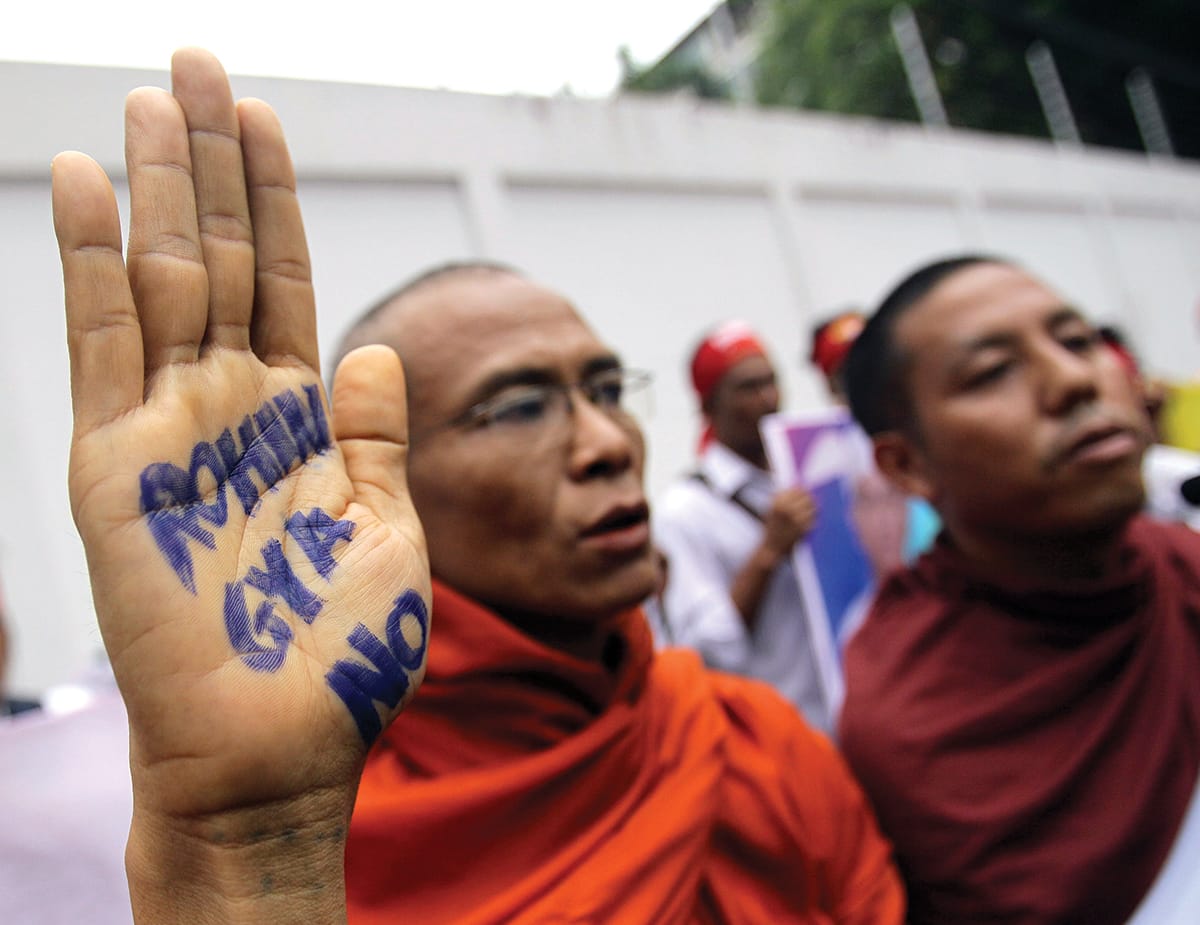
My purpose was to investigate the Buddhist-inspired violence that has been taking place over the last few years in South Asia and Southeast Asia. In Myanmar, it is the genocide of the Rohingya Muslims. In Sri Lanka, we have seen ongoing attacks on religious minorities, from Tamil Hindus, to Muslims, and now to Christians. In Thailand, it is a matter of corruption and vices.
The role that Buddhists have played in all this, and specifically Buddhist monks, is really quite troubling for those of us who have studied the religion and admire it. What we are seeing is that in many cases it is monks who have supported or participated in this violence or incited it. This has been documented by human rights organizations. It is these facts that drew me to this story and to voyage across these countries.
The subtitle of your book is “How Buddhist Extremism Is Shaping Modern Asia.” Why is Buddhist extremism that influential?
The extremist Buddhist monks have close ties with each other transnationally. They communicate via social media and they travel and meet in person quite frequently. We are seeing that these ideas are moving across borders and what could potentially be confined to one area or even one country is now crossing borders. That makes this issue of potentially greater significance than it might have otherwise been.
Most if not all of the world’s religions have been used to gain political power or to rationalize violence, and in many cases that is still happening. Why should we be surprised if Buddhism too falls prey to this?
That’s such a good question. I’m a Roman Catholic and as I say in the book, going to churches in Europe can be such a distressing experience because you know instinctively that these incredible temples to God have actually been built on blood money — on the backs of slavery and colonialism. And of course the Catholic Church has been plagued with more scandals than one can keep track of at this point.

This is certainly true of all religions, because who are the clergy, if not just regular individuals who will fall prey to normal vices and influences? In that sense, no religion is exempt. What was surprising to me, and then became distressing as I continued to report in this book, was the level of violence connected to Buddhism, particularly the genocide of the Rohingya.
There is a dissonance between the global idea of what Buddhism is and what a small number of people in these places are doing, relative to the millions of people who practice Buddhism. It is surprising because of how we understand Buddhism, particularly its emphasis on ahimsa, non-harming.
I think the violence being done by Buddhist extremists will surprise people who don’t really understand how religion is practiced — that ultimately the practice of any faith rests on individuals, and as we know, all individuals are prone to corruption, irrespective of which particular scripture they follow.
Nonetheless, Buddhist extremists must at least have to pay lip service to Buddhist principles. They have to find a way to reconcile their violence with the teachings, or even use Buddhist teachings to justify it. How do they try to do that?
They claim they have to protect Buddhism. That it is their duty as Buddhist monks to do whatever needs to be done to protect Buddhism. That’s the justification they go with.
I think one of the most dangerous things politically is the conflation of religion and nationalism — when one religion is identified as a core element of the national identity, and on the other side, nationalism is seen as an important expression of the religion. This often leads to alliances between governments and conservative religious establishments. This is happening in places like Russia, India, Israel, and the United States, where religious conservatives are allied with authoritarian or right-wing regimes, often targeting religious minorities. Is that what is happening in the majority Buddhist countries you studied?
It’s exactly what we are seeing. In all of these countries, Buddhism is the state religion and there is a very close relationship between the monastic sangha and the politicians. The politicians in power need the monks to validate them, to make the public believe that they are the right choice to vote for. And the monks need the politicians to keep their rights secure and to maintain their privileges. It is a relationship in which both elements rely on and feed off each other.
In Myanmar, there is close proximity between the most powerful monks and the most powerful members of the junta. They work in lockstep, mirroring each other’s message, complimenting each other, supporting each other.
Sri Lanka is a democracy, but it has had a lot of ups and downs, including a civil war over the past few decades. The government tends to be conservative with authoritarian tendencies. In Thailand, the royal family rules supreme, and you have to be very careful about what you say about them. The slightest negative stance can have you arrested. And in Myanmar, of course, there is the junta.
In all three of these places, we are seeing societies that are very tightly controlled, where you need to align yourself with the government in power. So we see the monks aligning with these right-leaning or authoritarian governments. This can be a survival strategy for some, and for others it elevates their position, it gives them power.
This mirrors what we are seeing elsewhere in the world, where dominant religious communities are claiming victimhood. They claim that minority religious groups or minority individuals are causing problems and that they are likely to destabilize the nation or threaten the dominant religious identity. They’re using that excuse to get people to support the most populist and nationalist factions in the country.
In these Buddhist majority countries, prominent monks with large followings are essentially saying that this populist party or that authoritarian individual is good for the country because they’re going to protect us from this minority group, which is a threat to Buddhism and therefore to our very survival in this country. Again, we see this in various parts of the world in various forms.
Will the Buddhist establishments in these countries at some point draw a red line on the political activity of the extremists?
I don’t know what the red lines are, Melvin. In Myanmar, we’ve seen a genocide that was incited and supported by very prominent Buddhist monks, and the Muslims I’ve interviewed who have recently fled Myanmar say the attacks are ongoing. The fear is very much a real and present thing.
I’ve interviewed many monks in Sri Lanka, in Thailand, and in Myanmar who are doing their very best to form interfaith groups, to support victims, to draw attention to this violence. In Myanmar especially, they are doing this at great risk to themselves. I interviewed at least half a dozen monks in Mesa, Thailand, where monks have had to flee because the junta is after them for standing up for Muslims. So what is the red line? It’s very hard to say.
In Sri Lanka there have been two major incidents of violence over the past few years in which Muslims were targeted, and Muslims continue to feel very much like second class citizens. This is also true to a large extent of Sri Lankan Christians and Sri Lankan Hindus. So incredibly disturbing environments have been created in these countries as a result of this Buddhist nationalism.
Is there opposition to this extremism, and even to the belief in Buddhist dominance at its core, within lay Buddhism or monastic sanghas? Did you see anything that gives you hope?
We are not seeing a large response to Buddhist extremism in these countries, but a powerful one, a thoughtful response. In Sri Lanka, for example, the response is being led by both monks and nuns. They are working with other religious communities to educate each other about what is happening, and those conversations are proving very fruitful.
In Myanmar, there’s very little work that can be done without drawing the attention of the junta and risking being arrested and put away. So we have a large number of progressive monks fleeing the country, and mobilizing outside the country to draw attention to what’s happening, to send money back, and to offer whatever protections they can to fellow monks and nuns, and also religious minorities.
In Thailand, what you’re seeing is a really interesting movement of what I call in the book Rebel Temples, which are focused on women and are run entirely by nuns. They are attempting to respond to this crisis by changing, here and there, how they practice Buddhism. I did get the sense in the places where I spent time among the nuns that patriarchy is baked into how the religion is practiced and that needs to change. That Buddhism at the level of the clergy and the orders needs to be more egalitarian, needs to be more welcoming of women, and then perhaps there could be a power shift that might in some way address these challenges we are witness to.
These are the responses that are taking place and I think it’s something to take heart from. I think they will continue to grow. I think people will continue to mobilize because they have seen what happens to other religions when these excesses are allowed to take over, and they don’t want that to happen to Buddhism.