

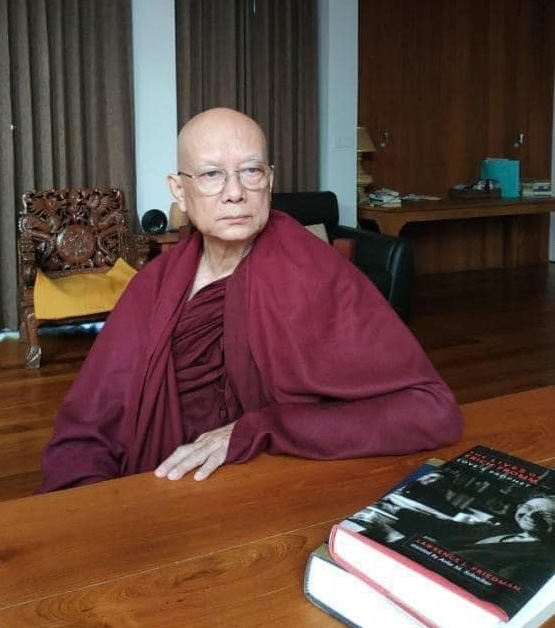

In 1970s Myanmar, it was not uncommon for highly educated professionals, such as engineers with a deep understanding of Western philosophy and psychology, to transition into the Buddhist monkhood. Given Myanmar’s status as a multicultural nation, instances of individuals from Muslim backgrounds converting to Buddhism or even ordaining as monks — as well as the reverse — were not entirely unheard of. However, it was a profound anomaly for someone of Muslim heritage with those same intellectual credentials to undergo such a conversion, especially one that culminated in the rigorous, ascetic life of a forest monk rather than a standard monastic path. Venerable U Jotika of Maha Myaing Forest monastery is a prime example of such a remarkable transition.
[Note: The name Venerable Jotika represents the Romanised Pali spelling, while “Zawtika” could be considered more conventional renderings.]
Personal Background
Venerable Jotika was born in Mawlamyine city into a Muslim family. He completed his elementary education in a missionary Roman Catholic education centre, and graduated with a Bachelor of Electrical Engineering from Rangoon Institute of Technology (RIT), a renowned university in Yangon at the time, which is now into Yangon Technological University.
Since childhood, he had been deeply intrigued by the daily activities of the monastery in front of his house. Curious about what the novices (sramaneras) were chanting, he would often borrow their prayer books to read. He would also watch the novices and monks meditate and ask them about their methods of mindfulness.
During his time at RIT, he would practice sitting very still in the classroom, focusing intensely on a single white chalk mark on a blackboard, not realizing that this practice was actually a form of Kasina (meditation on an object). During his university time, he also extended his interests into Western Philosophy and Psychology, which helped lead to his later interest in Buddhism and Vipassana insight meditation.
Becoming a Forest Tradition Monk
Material riches, sensory gratification, and social prestige held little interest for U Jotika. He’d found that Buddhist meditation offered a unique path to mental tranquillity, sparking a profound and lasting interest. Eventually, he decided to become a Buddhist monk. As a result, Venerable Jotika faced profound estrangement from his mother. In fact, he learned of her passing three years after she had died.
After ordination, he initially stayed with Venerable Paramawunna Thindi, from the Popa region. However, realizing that the standard monastic path was not what U Jotika sought, Venerable Parama directed him to the Venerable Nandiya (Taungpulu Tawya Kaba-Aye Sayadaw), a bhikkhu (forest monk) residing in Upper Burma. During his time at the forest monastery, he had to walk two miles every day to the edge of Maethe Village for alms food since it was only many years later that the Great Sayadaw allowed devotees to offer food within the monastery grounds. He also, like all monks in that forest tradition, observed a number of dhutanga (ascetic practices), which refined his meditation routine and enhanced his discipline and spiritual commitment. He would dedicate three years to the intensive practice of Vipassana insight meditation under the mentorship of Venerable Taungpulu Tawya Kaba-Aye Nandiya, followed by a further fifteen years of dedicated practice at the Htantabin Forest Monastery.
Later, Venerable Nandiya, recognizing that Venerable Jotika was highly educated, sent him to the Htantabin Forest Monastery under the guidance of the Vinaya (monastic code) expert, Venerable U Tissara, so that he could master the Vinaya. This led him to reside at the Maha Myaing Forest Monastery, a branch of the Htantabin Monastery located on the border of Pyinmana and Lewe.
Beyond Myanmar and Buddhism
Venerable U Jotika traveled to Melbourne, Australia, to perform missionary work once in 1977 and again in 1998. In addition, he visited the United States between 1983 and 1984, where he resided for approximately sixteen months and conducted dhamma talks in Santa Cruz, New York, Boston, and Washington, D.C. He has also embarked on numerous missionary journeys to Singapore throughout his life.
Beyond Superstition: Engaged Buddhism Inside Myanmar
While some monks and meditation centers inside Myanmar have claimed their head trainers as enlightened beings and employed supernatural folk tales, astrology, fortune-telling, horoscope, and ritual remedies to attract followers, Venerable U Jotika focused more on the concentration meditation (samadhi) and insight meditation (vipassana).
He combines his knowledge of Western philosophy and psychology in his talks and meditation instruction. Using this multidisciplinary approach, he is able to establish a strong connection with laypeople, providing them with useful advice on how to deal with stress at work and navigate the challenges of their social and economic lives. He has authored books in both Burmese and English. (Snow in the Summer, written in English, has been translated into ten different languages, with over a million copies in print.)
His Buddhist teachings exhibit a secularized perspective firmly anchored in traditional fundamentals rather than Western modifications. In order to develop the concentration and insight meditations required for attaining true enlightenment, he places a strong emphasis on moral purity (sila-visuddhi). His use of concepts such as “inertia” and the idea of “inner noise” from continuous thought, and his description of greed and anger as “imprisoning one’s own mind,” have been invaluable guiding principles for his followers.
Advocating democracy, interfaith and multi-culturalism
Beginning around 2001, waves of anti-Muslim sentiment and nationalist agendas emerged, fueled in part by the Taliban’s destruction of ancient Buddhist statues in Afghanistan — a region with deep historical Buddhist roots. During this period, Venerable Adiccavamsi (formerly U San Lwin), a convert from Islam who became an Insight meditation teacher, frequently spoke out against what he witnessed as the exploitation of interfaith marriages by radical Islamists to forcibly convert Buddhist women. Since the early 2000s, unlike Venerable Adiccavaṃsi, Venerable Jotika has consistently refused to participate in discourses that could incite resentment toward the Muslim population. The only exception was a personal anecdote he shared about his childhood: his mother would burn the Buddhist books he brought home from the monastery to read. By recounting this incident, he aimed only to highlight his deep-seated attraction to Buddhism and his innate spiritual inclination from a young age. Beyond this, he steadfastly urged his followers to prioritize moral purity, concentration, and insight meditation. He reminded his followers to practise unconditional loving-kindness to all beings and insisted that such unconditional loving-kindness is the kind of energy or wave that will be acknowledged by others, even those in opposition.
Coincidentally, between 2009 and 2011 — just years prior to the 2012 Rakhine State riots that sparked nationwide inter-communal violence — distressing rumors began to circulate among former followers of Venerable U Jotika in Pyinmana. These former followers distanced themselves from Venerable Jotika for his refusal to spread anti-Muslim rhetoric in his dhamma teachings, and targeted him with baseless accusations of covertly aiding Muslim interests. Specifically, he was accused of advocating for and planning the construction and maintenance of mosques (masjids). These allegations were particularly inflammatory given Myanmar’s strict legal environment, which prohibited the building or even the repair of Islamic structures without explicit and often unattainable government authorization.
These accusations likely stemmed from to his Muslim family background and his subtle advocacy for interfaith harmony and peace. In response to these various attacks, instead of engaging in defensive arguments, Venerable Jotika met his detractors with a stoic reminder: “The higher the mountain, the stronger the wind.” Through this analogy, he conveyed that profound spiritual attainment naturally attracts intense scrutiny, as well as opposition from some, and reminded his laypeople to focus on the improvement of their interpersonal skills and spiritual maturity.
Nowadays
Venerable Jotika has consistently maintained a strict distance from capital-P political involvement. Even in the current climate, he continues to disseminate his dhamma teachings in both Burmese and English, with a primary emphasis on developing physical and mental resilience. Averse to the spotlight, he has kept a low profile, declining administrative or academic positions in Buddhist universities. Instead, he focuses solely on his leadership role within his own monastery, remaining steadfast in his commitment to the traditional forest monk way of life. Having reached age 78 on August 5, 2025, he is still traveling extensively to places such as Singapore, sharing the Buddha’s teachings and the practice of unconditional loving-kindness with a global audience.
His unique transition — from intellectually gifted individual from a Muslim heritage to sincere forest monk — highlights a remarkable spiritual integrity; his actions consistently demonstrate that he is motivated neither by fame nor material gain. Such a steadfast commitment to spiritual practice and simplicity is all too rare in today’s world.