

The Dhammapada is one of the most beautiful, enduring collections of the Buddha’s teachings. Dhamma in Pali means “the teachings” or “the Way.” Pada means “footstep” or “path.” The word Dhammapada, then, can be understood as “The Path of the Dharma.”
My teacher, Thich Nhat Hanh, wrote, “There is no doubt that the 423 verses of the Dhammapada contain the authentic teachings of the Buddha. When we read and contemplate this book, we touch seeds of understanding and love that are buried deep inside of us, and we help them grow.”
Here I offer some well-known verses from the “Opposites” section of Dhammapada, each followed by a Zen Key and a Reflection based on my experiences as a monk and a chaplain, and also as a husband, father, and twenty-first-century citizen. The keys open us to the insights of Zen, pointing toward presence, freedom, and nonduality. The reflections offer ways we can bring the teachings of the Dhammapada into daily life, suggesting how we might live with understanding, stability, and compassionate action. Together, the verses, the keys, and the reflections offer a path that can lead from confusion to clarity, from suffering to wisdom, from despair to joy.
Pure and Impure
Mind is the director,
The master, the creator.
When we speak or act with hatred,
Misery follows, as an ox pulls a cart.
—Dhammapada, verse 1
Mind is the director,
The master, the creator.
When we speak or act with a pure mind,
Peace is close behind, like a shadow
that follows us everywhere.
—Dhammapada, verse 2
Zen Key
The opening verses of the Dhammapada are based on a notion of purity. But Zen teachings remind us that an impure mind is important, too. Hatred is the other side of the coin of peace. If you read these verses dualistically, you will surely choose peace and purity. But hatred and despair have their place. Non-peace can show us the way to peace. Peace and conflict inter-are.
After his enlightenment, the Buddha taught that suffering is an ennobling truth. He did not say suffering is a problem to solve or an obstacle to overcome. He didn’t say we need to be happy all the time. Recognizing the presence of suffering, he explained, is the first noble truth. We can say hello to misery just as we’d say hello to peace. Seeing the ways a so-called “impure mind” affects us is an important practice. The Dhammapada begins with this challenge.
Reflection
We don’t need to try to be happy. By slowing down and being ourselves, we’re already contributing to inner peace and peace in the world. Wisdom and happiness are our birthrights. You are already a buddha, and the world needs buddhas now more than ever.
Most of us are trapped in ignorance, fighting within ourselves and with others. To find peace, we only have to be ourselves and let others be themselves. Speaking and acting with a “Big Mind” that includes purity and impurity, you are a buddha, and you recognize others as buddhas, too. This is not a pipe dream. With insight, it can become a shimmering reality.
A student told me, “My suffering comes from others.” I said, “No, it comes from your mind.” Our minds produce suffering. They are like factories, always working, producing judgments, comparisons, fears, and regrets. They generate the idea “They hurt me. They are the cause.” But that idea is painful, and it’s manufactured. Still, we believe it. The mind that creates suffering needs to identify a perpetrator. But when we realize that mind is at the root of it all, we stop looking for someone to blame and instead look inward. Only then is healing possible. And the mind not only produces suffering; it produces happiness as well.
When we think happiness is better than suffering, we’re declaring war within ourselves. When we know that happiness and suffering are both truths, peace becomes possible. There’s no need to push away impurity. Hold it gently. Even ill will wants to be understood. When you hold the whole coin in your hand—heads and tails—you’re no longer divided or afraid. You are beyond pure or impure.
We become pure by embracing impurity, by seeing that even our darkest feelings are not separate from the dharma. Who we are, right now, with our greed, anger, and confusion, is the raw material of awakening. We don’t need to be different from this. The point is awareness.
Your anger, your jealousy, your fear are not enemies to be conquered but doorways to enter, and when we look inside, we’ll see understanding and love. If you can stay present with dark emotions long enough, you’ll see that they aren’t solid. They rise and fall like waves, and what remains is vast and still. This is the stillness of your true nature.
To look at discomfort with clarity is to walk the Buddha’s path. To smile at your suffering, not in denial but in recognition, is the first step of liberation. What you think makes you “less than” or “too much” is, in fact, an entry point. What you think is too ugly, too heavy, or too impure is the very place from which wisdom blooms. Impurity is a mirror that reflects back our deepest longings—to come home to ourselves, to be real, and to feel complete. Purity is not the absence of impurity. It is the fullness of being.
Staying Open to Life
Destroying hatred with hatred
Isn’t possible.
Only love can transform hate.
This is the eternal law.
—Dhammapada, verse 5
We forget that
Sooner or later, we’ll all pass away.
When we acknowledge this, without flinching,
Conflicts can resolve themselves.
—Dhammapada, verse 6
Zen Key
The Buddha taught the “truth of suffering,” but we mustn’t forget that love is also a truth. These two truths—love and suffering—are partners. When we suffer, we understand love, and when we understand love, we will choose not to add to anyone’s suffering, including our own. Conflicts are resolved first in our own heart. This is key for transformation. And when we know deeply that we’ll all pass away sooner or later, we will discover compassion for ourselves and for others.
Reflection
A few years ago, a dear friend suffered a heart attack, and it hurt me, because there is no boundary between us. If we think another person’s pain is not our own, we don’t understand life. Their happiness is our happiness, and their suffering is our suffering. When we realize the extent to which we’re connected, we don’t need to ask what to do. We just act from our heart, and what happens next is always a surprise. We are bigger than we’ve ever imagined. I messaged my friend’s wife at the hospital that I was there with them.
Every day, we learn from life, not only from things that go well but from the things that go badly, too. My friend’s heart attack reminded me how much I cherish him. When you love someone and they’re having a hard time, you may discover something about them and about yourself that you had overlooked. The more we care about others, the more we’re able to open to life. When we remember that we’ll all pass away, conflicts fall into perspective.
You are an expression of life itself, and after you pass away—no longer manifesting in this form—you and I will still be connected. We’re not just here; we’re also there and everywhere. You may think I’m in a different place from you on our blue planet, but it’s not true. I am with you. You, your beloved, and your child are not limited to a particular form or location. We are all wondrous expressions of life; we are everywhere.
Thich Nhat Hanh died in 2022 at the age of ninety-five. My father passed away earlier. But, to me, they are still here, in my voice, the way I hold my body, and in each breath. When I look at trees, I see them. When I bow, they bow with me. When you touch the essence of life, you touch all those who have gone before and all those yet to come. Nothing is ever lost.
Knowing that we will pass away is not meant to make us afraid. It’s a way to encourage us to love more deeply, to stop delaying peace, to look at our loved ones and say what we need to say. We don’t have to agree with everything everyone does. We can love them as they are, and this verse reminds us to do so before it’s too late. When you hold their hand, hold it fully. When you listen, listen with your whole body. We don’t know how long we have. Life is fragile. Fragility is what allows us to see the preciousness of everything.
Sometimes we try to protect ourselves from pain by shutting down. But dissociating doesn’t protect us; it isolates us further. It may have been an important survival strategy at some point in our lives, but usually it’s a reminder that we need to observe what in this moment feels threatening and whether it’s true. Usually it’s a reflex, not a response to danger in the present. Knowing how to navigate these states of our nervous system, we can begin, slowly, to stay open to life as it is and to let both joy and sorrow move us. It means knowing that suffering and happiness are both a part of life. When grief arrives, let it arrive. When love arrives, let it arrive. That is easier said than done. Mindful breathing and a moment of pause can help. The more porous you are, the more alive you will feel. And over time, you will feel safe to open, and it will help others feel safe when they’re with you.
Real Happiness
Those who indulge—
Overeating or drinking too much,
Those who are lazy or immoderate,
Will be vanquished by Mara the tempter,
As the wind snaps off the weak limbs of a tree.
—Dhammapada, verse 7
Those who live mindfully—
Seeing clearly, eating and drinking in moderation,
Living with faith, practicing diligently,
Cannot be touched by Mara.
These Way-Seekers are like mountains,
Unshakable, even in the wildest of storms.
—Dhammapada, verse 8
Zen Key
The Dalai Lama wrote, “A tree with strong roots can withstand the most violent storm, but the tree can’t grow roots [if it waits until] the storm appears on the horizon.” Michael Kearney, who teaches “luminous resilience,” comments, “We are already in the midst of violent storms of war, wealth inequality, discrimination, and an escalating climate crisis. We need to begin growing roots now, so when the winds get even stronger, we’re stronger too.”
The United States Declaration of Independence speaks of an “inalienable right” to happiness. But sometimes we try to satisfy ourselves at the expense of others. To experience real happiness, we need to care for ourselves while being mindful of others and not exploiting the environment. When we live in this way, our mind will be steady and those we care about will be well, too. We need to be solid as a mountain and steady as the rain so we can embrace life to its fullest.
Reflection
We have the ability to feel alive, receive what life offers, and savor each moment. But sometimes we draw too impenetrable a line between our life and the lives of others. We think, “This is mine,” not considering the well-being of others and even separating ourselves from Mother Earth, and we wreak havoc.
During the Vietnam War, Americans dropped Agent Orange throughout the country of my birth, knowing that its active ingredient, dioxin, causes cancer, neurological disorders, and birth defects in those not yet born. The consequences of their actions are still visible. How can anyone do things they know will cause so much harm? The answer is in the Dhammapada. We cause damage when we’re self-serving at the expense of others, and it turns out, it’s also at the expense of ourselves. “Those who are lazy or immoderate will be vanquished by Mara the tempter.” Without discipline, our insight and compassion remain undeveloped, and we focus solely on what we crave for our own body and mind, as if we’re separate from the rest of creation.
When we act selfishly, we struggle. We hold on to our fear and anger, and they weigh us down. Conversely, the more we support others, the lighter we feel. When our energy isn’t flowing, we’re prone to illness. When we know what’s true and stop swimming against the current, we’re able to contribute to others and have fewer blockages within. Love is the most intelligent investment. The more we care about others, the healthier we’ll be. If we’re unhappy, it means we’re comparing our idea of happiness to what’s in front of us. Real happiness is never based on an image. Real happiness has no cause; it just is.
When we chase pleasure at the expense of others’ needs, something essential is lost. True happiness arises when we care for ourselves and our environment. Living this way, we feel whole, relaxed, and focused. Relationships deepen, and the world we cherish will begin to recover. In the Plum Village monastery, when we walked slowly and ate our meals in silence, we could witness life unfolding on its own. At times, one morsel of food reveals how complete this moment is, that nothing is missing. Joy isn’t just up the road. It lives in each breath, each step, each awake gaze. But if we try to hold on to them, they’ll fade. The beauty is in enjoying them and then letting them pass. Joy doesn’t demand perfection. It asks only that we see and feel.
Moderation isn’t just restraint; it’s also freedom. When we live with care and discipline, we can touch the fullness of life, and generosity flows like a river. We stop “consuming” and begin nourishing and being nurtured. This happiness cannot be taken from us. It’s already present. When we know that we are already enough, we don’t have to chase happiness; we only need to arrive.
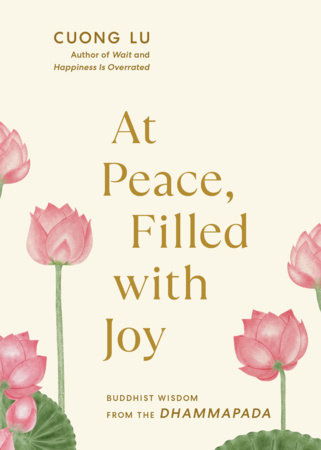
Adapted from At Peace, Filled with Joy © 2026 by Cuong Lu. Reprinted in arrangement with Shambhala Publications, Inc. Boulder, CO. www.shambhala.com