


The sky stretched wide and bright above the golden cottonwoods of October. Nestled in the ancient Sangre de Cristo Mountains, I felt myself as much a part of the earth as the ravens, spotted towhees, and pinyon jays, as well as the flora—juniper, piñon, and four-winged saltbush. On such a day, gratitude makes sense. A deep appreciation for the sheer abundance of life makes sense.
I set an intention to connect, to receive, to offer myself freely to the world. Yet my human conditioning, shaped by a lifetime of feeling othered, misunderstood, and treated as an object of curiosity, had the best of me. Instead of carrying an open heart and clear-seeing mind, I walked along the high trail in the nature preserve caught in a funk about feeling so different, so not the norm, with my Black skin and dreadlocks. My chest tightened reading road sign after road sign: KEEP OUT, PRIVATE PROPERTY, NO TRESPASSING, DO NOT ENTER, PRIVATE DRIVE, BEWARE OF DOG.
Snobs, I thought to myself. All of them—rich, indolent snobs.
Even as the aspens offered themselves so freely, I felt a distance in my heart. I was hyper-vigilant and activated, scanning the landscape, picturing being attacked at every turn—by vicious dogs or, worse, entitled and territorial Santa Fe drivers. Convinced of my own alienation, I started down a steep trail toward a tangle of red willow and cattails.
Just then, a young mother appeared with two small boys, about three years old. She stopped to ask, “Which way is it to the parking lot?”
“It’s just up the hill,” I replied.
She and the boys walked on, and by chance, we crossed paths again. I greeted them—barely—when the mother turned to me and said, “My son has something he wants to give you. He found this flower and loves the softness.”
I looked down. The little boy extended his tiny hands toward me. Curled in his fingers was the torn-off tip of the softest, fuzziest mullein leaf.
“My son thought you would like this flower,” she said. “He wanted you to have it.” I looked at the tiny leaf, then at the little boy, and back at his mother. I extended my hands to receive the gift.
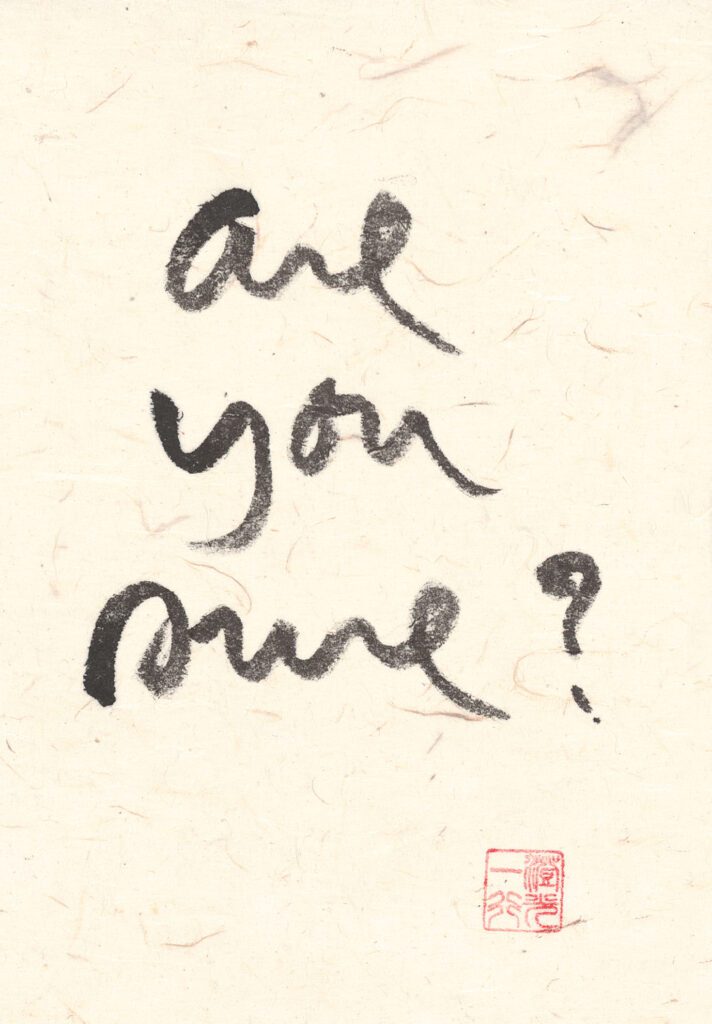
As a dharma teacher in the Plum Village tradition, I’ve long been drawn to Thich Nhat Hanh’s teaching expressed in his calligraphy: Are You Sure? Affectionately known as Thay, he often reminded us to question whether our perceptions are truly accurate. He taught that our perceptions are inevitably incomplete and often mistaken, sometimes with painful or even tragic consequences. Such misperceptions—about others or ourselves—can entangle us in confusion and lead to harmful actions. The simple question “Are you sure?” invites us to examine our perceptions and open to greater clarity, understanding, and well-being.
In our fast-paced lives, we often form beliefs quickly, based on selective or faulty perceptions that reinforce implicit bias. We interpret information as confirmation of what we already believe, filtering out what is contrary to our worldview. From a neuroscience perspective, the pattern-seeking nature of the brain helps support critical thinking and problem-solving—but it also can lead to overgeneralizations and blind spots when we disregard information that contradicts our beliefs.
Shunryu Suzuki’s Zen Mind, Beginner’s Mind is a classic Buddhist text that emphasizes the value of cultivating openness and curiosity. The beginner’s mind is spacious and flexible; the expert’s mind, by contrast, is narrow, entrenched in one’s preexisting beliefs. To practice beginner’s mind is to have a willingness to explore, learn, and grow.
Bringing this attitude into daily life opens us to the miracles of the present moment, including things we often take for granted: perhaps our morning bowl of cereal or our partner’s presence. This invites reverence, kinship with all beings, and a sense of awe. Cultivating beginner’s mind acknowledges the gift of life and creates a sense of satisfaction, contentment, and gratitude.
To cultivate beginner’s mind, we practice stilling the mind (shamatha) and looking deeply with insight (vipassana). We pause to ask: What’s really happening? How am I feeling? We check in with body, breath, feelings, and perceptions, which opens us up to a change of heart and mind. We notice tension and heaviness in the chest, our tendency to react and make rapid decisions, and how holding on to our judgment of another person makes us feel. These are signals—clues—showing us when we’re clinging to fixed ideas.
That October day, in the golden light, I was reminded of the power of beginner’s mind. The tiny, torn mullein leaf was a bell of mindfulness, calling me back to my intention: to encounter fully, to connect deeply, to receive openly, and to offer myself freely to the world.Beginner’s mind is fluid and flexible, open even to the smallest leaf. It invites me to stop and look deeply—to remember that all of life is relational and abundant. It invites me to ask: Are you sure about those Santa Fe drivers? Are you sure about those people you labeled “snobs”? This practice is slow and deep rather than shallow and quick. Beginner’s mind is a practice of gratitude and reciprocity that creates awakening.