

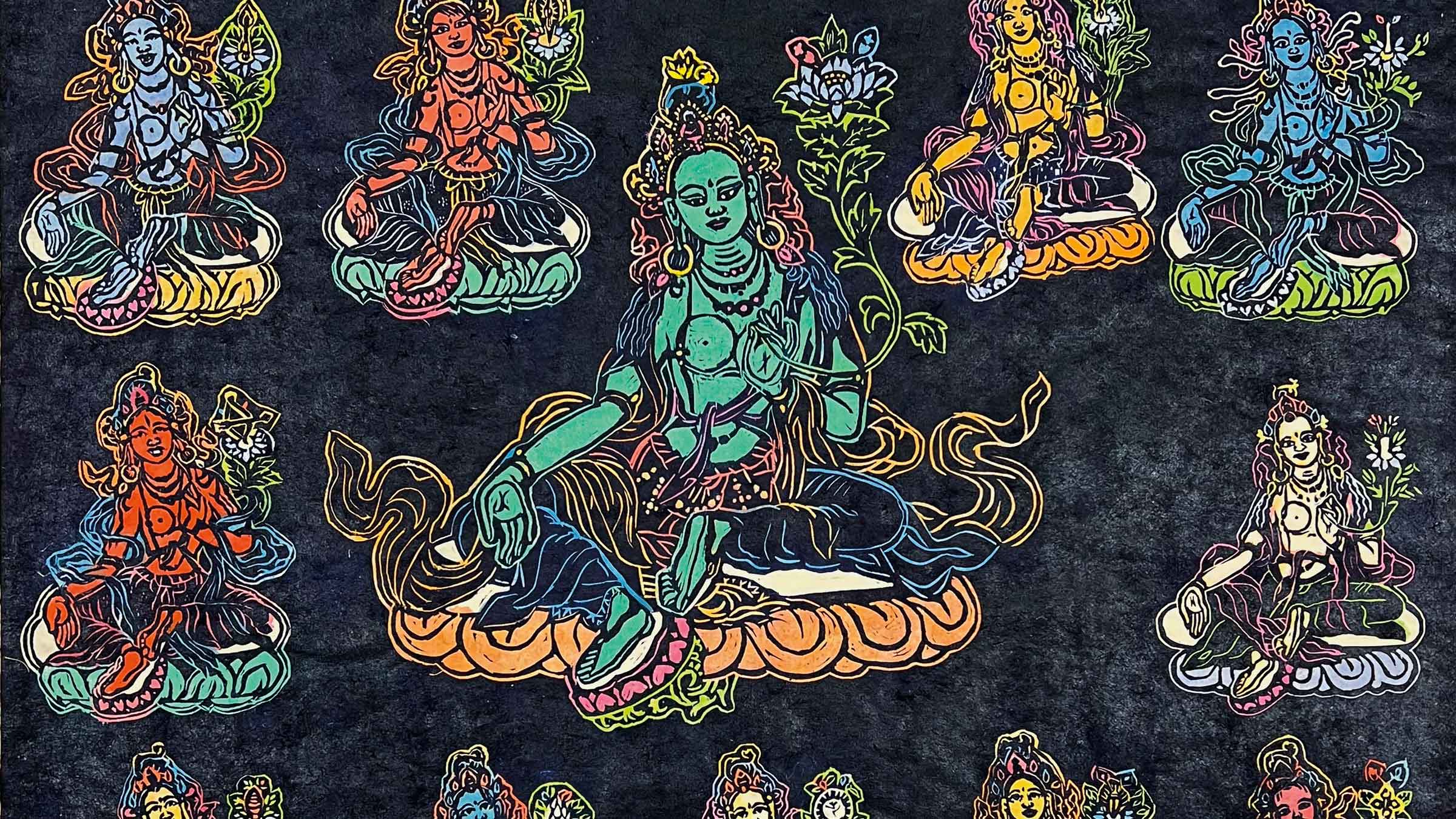
There is a quality of presence that is at once deeply still and immediately responsive, an awareness that doesn’t turn away yet moves swiftly to meet what arises. In the Vajrayana tradition, this is expressed through Tara, the embodiment of awakened, compassionate activity.
Green Tara is one of Tara’s principal manifestations. Here, she is the central form from which her twenty-one emanations arise, each expressing a distinct facet of her wisdom and compassion. She responds without hesitation wherever there is fear, confusion, or need. She doesn’t stand apart from what she meets but expresses the innate capacity of awareness to respond with clarity and care.
Tara may initially be experienced as a supportive presence, embodying a compassion we don’t yet fully recognize in ourselves. As practice deepens, this sense of separation softens. Tara is no longer encountered as other. Instead, she’s recognized as a direct expression of the very awareness through which all experience is known.
Green Tara’s twenty-one emanations are honored in Praises to the Twenty-One Taras, a traditional liturgy in which each verse celebrates a different quality of her activity. This article is the third in a four-part series exploring Tara’s twenty-one forms and the practices connected with them, offering a way of recognizing and embodying awakened responsiveness. The first article introduced Green Tara, and the second explored the first seven emanations. Here, we turn to the middle seven.
While often associated with protection from outer circumstances, the deeper function of these twenty-one forms of Tara is to reveal how we meet experience itself, especially in moments of fear and reactivity.
The first seven Taras form a mandala of protective activity, meeting fear the moment it arises. Their responsiveness is immediate, arising from a natural readiness that doesn’t hesitate or turn away.
The next seven Taras meet what remains after that initial intensity has passed. They’re associated with a range of protective activities, including pacifying disturbance, increasing well-being, and restoring balance. They’re invoked in relation to injustice, fear, delusion, conflict, poverty, and environmental instability. These outer expressions remain meaningful and widely relied upon, while also pointing to something more subtle.
These Taras restore balance in how we relate to experience, allowing what arises to be met with increasing clarity, responsiveness, and care.
The middle seven Taras are as follows, each with her verse of homage from the ancient text Praises to the Twenty-One Taras.
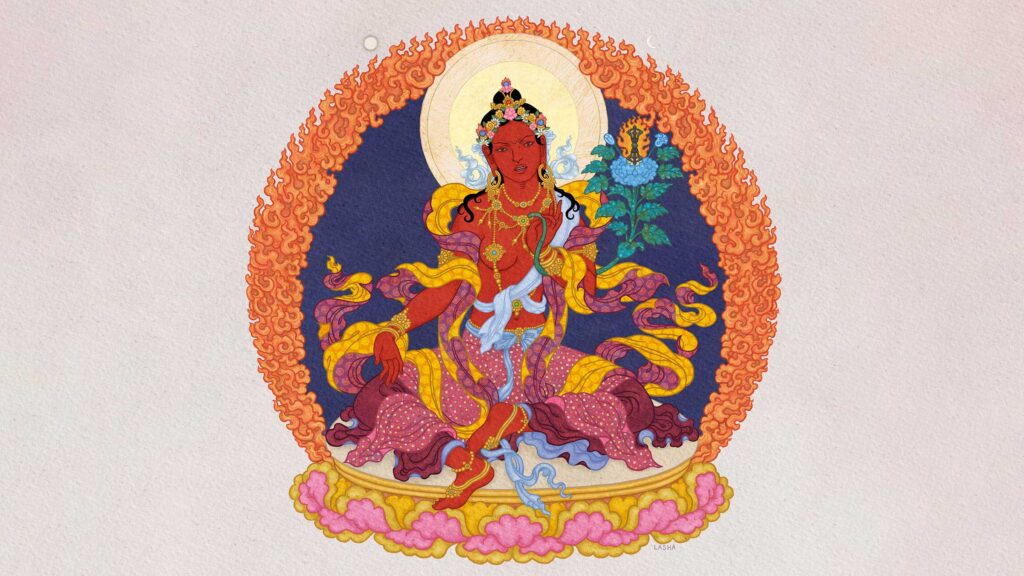
8. Jetsun Drölma Zhen Migyalwa’i Pamo
Unconquerable Heroine
Homage to Ture, the terrifying,
Who has complete victory over Mara’s warriors,
Who slays all enemies
By frowning with her lotus face.
Jetsun Drölma Zhen Migyalwa’i Pamo embodies the activity of recognizing that what appears threatening is not as solid as it seems. She’s praised as the Unconquerable Heroine, not because she overpowers external forces, but because she’s no longer deceived by them.
In the same way that Jetsun Drölma Nyurma Pamo is the point of entry to the first seven Taras, Zhen Migyalwa’i Pamo serves as a gateway into the mandala of the middle seven. As the earlier Taras meet fear in its initial surge, Zhen Migyalwa’i Pamo’s activity reveals what becomes visible as that intensity settles.
She appears deep red, seated upon a lotus and moon disc, holding a vase filled with indestructible nectar of awareness and a blossoming lotus. Her presence is vivid and steady, expressing a confidence that doesn’t rely on controlling what arises.
Her expression, described as “frowning with her lotus face,” reflects uncompromising clarity. Even in the intensity of her expression, nothing is added or distorted. What appears fierce is a refusal to turn away from what is seen.
She’s associated with subduing maras, the forces that obstruct the path, which can be understood as patterns of perception that give rise to fear, doubt, and distraction by appearing more real and more solid than they are.
Her activity is expressed through the image of a flaming vajra, a symbol of indestructible clarity that doesn’t harden or defend but reveals what has been misperceived.
What appears solid or threatening begins to lose its hold when its true nature is seen. Nothing is removed. What changes is how it is known.
In this recognition, something fundamental reorients. The need to struggle against experience begins to ease, and awareness remains steady in the midst of what arises.
9. Jetsun Drölma Sengdeng Nagchi
Protector from All Fears
Homage to Her whose fingers in the mudra
Of the Three Jewels adorn her heart,
Whose own light rays, in the form of a wheel on her hand,
Radiate in all directions.
Jetsun Drölma Sengdeng Nagchi embodies protection from fear in all its forms. Where the previous Tara reveals the insubstantial nature of what appears threatening, her activity supports a shift in how fear is met.
She appears green, seated upon a lotus and moon disc, holding a vase filled with the nectar of fearless presence and a blossoming lotus. Her presence is composed and steady, neither withdrawing from experience nor tightening against it.
Sengdeng Nagchi forms a mudra at the heart, a gesture expressing refuge in what is reliable and enduring. From this center, her activity radiates outward, symbolized by the dharma wheel, which turns in all directions as the lived movement of wise response in each moment.
She’s associated with protection from the eight great fears—outer dangers such as lions, fire, and water, and their inner counterparts: pride, anger, attachment, jealousy, distraction, and doubt.
Sengdeng Nagchi’s protection isn’t about eliminating fear but about not being governed by it. Fear can be recognized and met without being followed, allowing response to arise with clarity and care. In this way, fear becomes a signal rather than a command, and protection arises from remaining aligned with what is steady and awake.
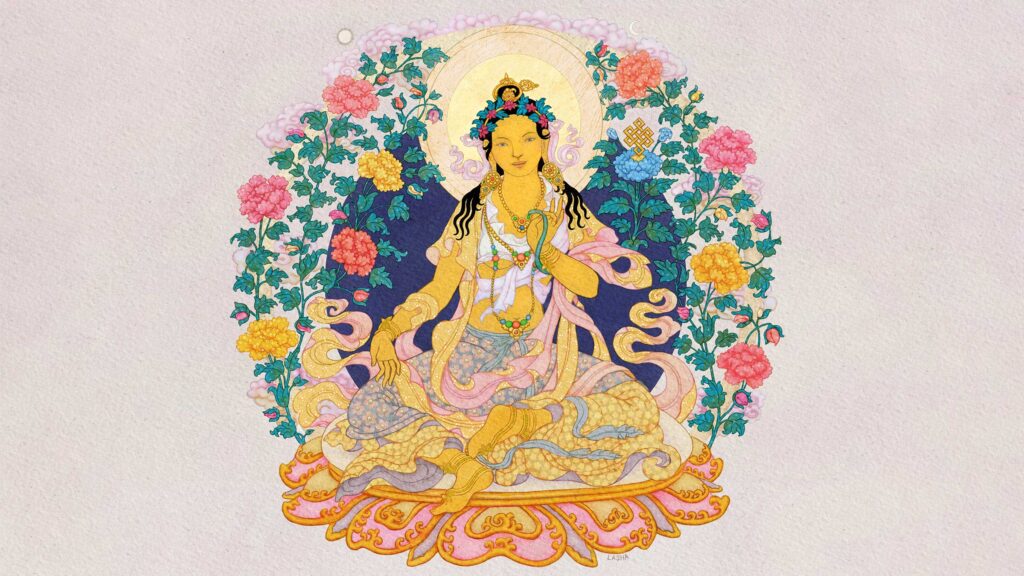
10. Jetsun Drölma Jigten Sumlé Gyalma
Victorious over the Three Worlds
Homage to Supreme Joy, She, whose sparkling tiara
Radiates garlands of light,
Subjugates demons and worldly gods.
Who with great laughter and Tuttara
Jetsun Drölma Jigten Sumlé Gyalma embodies release from the pressure to maintain a fixed sense of self. Where the previous Tara supports a shift in how fear is met, her activity loosens the patterns of grasping and self-reference that shape experience.
Sumlé Gyalma appears rich red, seated upon a lotus and moon disc, holding a vase filled with self-liberating nectar and a blossoming lotus. Her presence is dynamic, assured, and subtly fierce, expressing a confidence that gathers experience into coherence without force.
She’s praised as victorious over the three worlds—traditionally understood as the realms of desire, form, and formlessness—not as a conquest of external realms but as freedom from the patterns of grasping and self-reference through which these realms are experienced. The syllables Tuttara, part of Tara’s mantra, echo this activity, dissolving the subtle forces that sustain that confusion.
Jigten Sumlé Gyalma’s activity is symbolized by the victory banner, celebrating confidence that doesn’t depend on conditions. What is released isn’t effort itself but the strain of needing to hold everything together, to manage, defend, or prove.
Within Sumlé Gyalma’s activity, experience becomes workable and easeful. Joy arises naturally, not as something pursued but as something uncovered when the burden of maintaining a fixed identity loosens.
11. Jetsun Drölma Norter
Bestower of Wealth
Homage to Her who has the power to summon
The hosts of the guardians of the Earth,
Who delivers all beings from misfortune,
With HUNG and by her wrathful frowning.
Jetsun Drölma Norter embodies the restoration of inner and outer abundance. Where the previous Tara releases the pressure of holding everything together, Norter’s activity reveals what becomes available when that strain has eased.
She appears orange-red, seated upon a lotus and moon disc, holding a vase filled with the nectar of abundance and a blossoming lotus. Her presence is warm, grounded, and steady, with a subtle fierceness that doesn’t collapse in the face of lack. Like the earth, she expresses stability, support, and the capacity to sustain. Her activity is symbolized by the inexhaustible treasure vase, pointing to what sustains, protects, and allows growth.
Norter is praised as delivering beings from misfortune “with HUNG and her wrathful frowning.” This doesn’t suggest aggression but clarity that doesn’t yield to patterns of scarcity or fear. The seed syllable HUNG expresses the immediacy of awakened awareness, inseparable from wisdom and compassion. It conveys dynamic, stabilizing activity that refuses to collapse into the perception of lack.
Her protection addresses the deeper sense of scarcity that can persist even when conditions are adequate. As this pattern loosens, grasping relaxes and generosity arises naturally. A sense of sufficiency takes root.
12. Jetsun Drölma Tashi Dönjé
Auspicious Completer of Aims
Homage to Her whose tiara is a moon crescent
Ablaze with ornaments,
Who unceasingly spreads the light
From Amitabha who sits upon her crown.
Jetsun Drölma Tashi Dönjé embodies the recognition of auspiciousness within unfolding experience. Where Norter reveals sufficiency, Tashi Dönjé’s activity brings a deeper trust that what arises can be worked with as the interconnection of conditions becomes more apparent.
She appears golden, seated upon a lotus and moon disc, holding a vase filled with the nectar of alignment and a blossoming lotus. Her presence is balanced and steady, expressing a quiet confidence that doesn’t depend on controlling outcomes.
Her activity is expressed through the infinite knot, symbolizing the interconnection of all conditions. Nothing arises independently, and nothing is without relationship. What appears as obstacle or interruption can begin to be understood within a larger field of meaning and connection.
Tashi Dönjé is associated with bringing the elements into balance and pacifying disturbances in the natural world, including environmental imbalance. This reflects the restoration of balance within body, mind, and relationship.
Within her activity, trust replaces urgency. What unfolds isn’t controlled. It’s met with openness, allowing a deeper coherence to emerge.
13. Jetsun Drölma Yullé Gyaljema
Victorious on the Battlefield
Homage to Her who abides in garlands of flame,
Blazing like the fire at the end of time,
Who, right leg extended and left folded,
Dances, giving joy and destroying hordes of enemies.
Jetsun Drölma Yullé Gyaljema embodies the transmutation of conflict at its root. Where Tashi Dönjé reveals interconnection, Yullé Gyaljema’s activity engages directly with the forces that fracture it.
She appears deep red, seated upon a lotus and moon disc, holding a vase filled with the nectar of unbound clarity and a blossoming lotus. Her presence is vivid and alert, expressing strength without aggression, fully responsive yet unentangled.
Her activity is symbolized by the open vajra, its radiating prongs reflecting reactive energy transmuted into clarity. What arises as anger or conflict is not suppressed or acted out. It is clarified, revealing a spaciousness that reflects without distortion. Nothing needs to be pushed away, and nothing needs to be defended.
Yullé Gyaljema is praised as dancing, giving joy while destroying hordes of enemies. This points to the joy of liberation, the release of what no longer needs to be held or defended. Even in the midst of conflict, there is movement, fluidity, and a freedom that isn’t bound by opposition.
Yullé Gyaljema is associated with protection from violence and war. This includes the subtle ways aggression arises within the mind as resistance or division into opposing sides.
Within her activity, conflict no longer escalates but is met with clarity and steadiness. A different kind of strength emerges, one that doesn’t depend on opposition but on not leaving the field of responsiveness.
14. Jetsun Drölma Trönyer Chen
Tara of Fierce Countenance
Homage to Her who strikes the ground with the palm
Of her hand and stamps with her foot,
Whose fierce expression, with the syllable HUNG,
Shatters the seven underworlds.
Jetsun Drölma Trönyer Chen embodies clarity that reveals what is most deeply hidden. As the previous Tara transforms visible patterns of conflict, Trönyer Chen’s activity reaches the subtler layers of confusion that aren’t easily recognized.
She appears blue-black, seated upon a lotus and moon disc, holding a vase filled with the nectar of penetrating clarity and a blossoming lotus. Her presence is steady, with a fierce expression that doesn’t turn away from what is difficult to see.
Her activity is symbolized by the pestle, which breaks apart what has become hardened or obscured, revealing the subtle habits of perception that shape experience before we are aware of them.
In her verse of praise, Trönyer Chen shatters the “seven underworlds.” This points to deeply embedded layers of confusion, patterns that operate beneath conscious awareness. The syllable HUNG expresses direct and immediate activity, cutting through in a single moment of recognition.
Trönyer Chen is associated with subduing powerful obstructing forces. This includes the most refined forms of misperception, those that are quiet, familiar, and easily overlooked.
Within her activity, these patterns loosen through recognition. What once seemed fixed opens, and awareness becomes more sensitive to how experience takes shape. From this, a deeper freedom emerges—not from changing experience but from no longer being bound by how it is understood.
The middle seven Taras form a mandala of restoration and rebalancing. Where the first seven Taras respond the moment fear arises, what comes into view with the middle seven is more subtle—not the sharp edge of fear but the ways we lose alignment over time: the pull of old patterns and the quiet sense of disconnection that shapes how experience is held.
What comes into view here is more subtle—not the sharp edge of fear but the ways we lose alignment over time: the pull of old patterns and the quiet sense of disconnection that shapes how experience is held.
Zhen Migyalwa’i Pamo reveals that what appears threatening in these moments isn’t as solid as it seems. As this recognition takes hold, Sengdeng Nagchi supports a shift in how fear is met, allowing response to arise with clarity rather than reactivity.
With less reactivity, the pressure to maintain a fixed sense of self loosens. Jigten Sumlé Gyalma releases this pressure, allowing experience to become workable and easeful. As this loosens, Norter restores a sense of sufficiency, opening into grounded confidence.
From this ground, Tashi Dönjé reveals the interconnection of all conditions, supporting trust in the unfolding of experience. Within this recognition, Yullé Gyaljema transmutes the energy of conflict itself, allowing strength to emerge without aggression. Finally, Trönyer Chen brings clarity to the most subtle layers of confusion, revealing what is usually unseen.
Taken together, these Taras show that restoration isn’t a return to a previous state but a reorientation within experience itself. Awareness becomes more attuned, responsive, and stable in how it meets what arises.
Through this mandala, we begin to recognize that what we call healing isn’t the elimination of difficulty. It is the restoration of relationship to experience, one that allows clarity, care, and responsiveness to emerge naturally.
A Practice of Unconquerable Clarity
The following practice is offered for Jetsun Drölma Zhen Migyalwa’i Pamo, though the same structure can be used with any of the twenty-one Taras. It follows the familiar arc of Tara practice: visualizing Green Tara and her twenty-one emanations, invoking the Tara you wish to connect with, offering praise and mantra, receiving her blessing, and allowing her to dissolve back into Green Tara.
Take Refuge & Awaken Intention
Settling into the body, allow the breath to flow naturally and rest in the felt sense of being aware and alive. Recite the following three times:
Until enlightenment, I take refuge in the Buddha, dharma, and sangha.
Through the accumulation of merit and wisdom,
May I awaken for the benefit of all beings.
Visualize Green Tara & the Twenty-One Taras
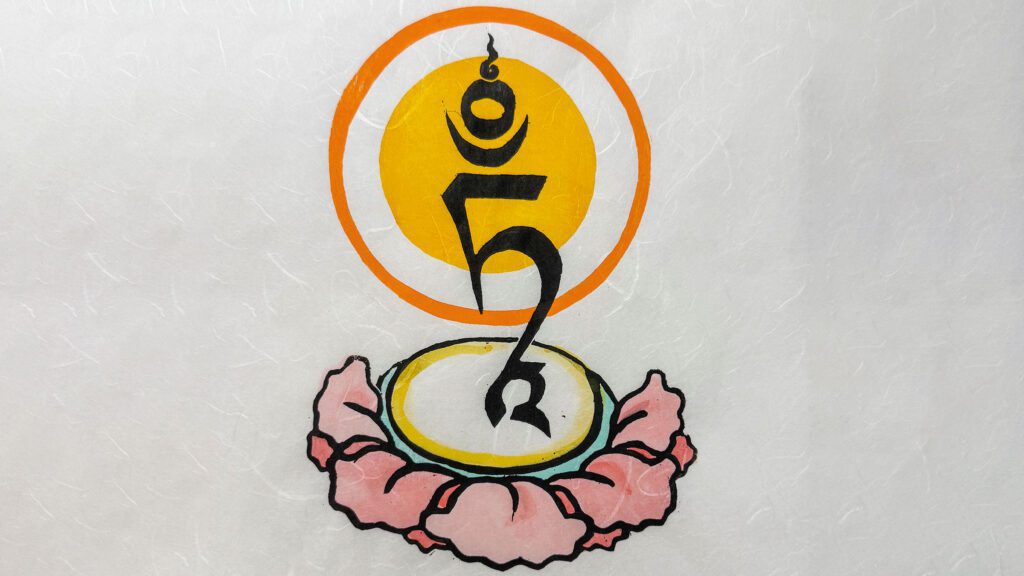
Rest briefly in the open essence of awareness, then recognize its compassionate nature. From that recognition, the essence of Tara’s awakened wisdom appears as a vivid green syllable TAM (see the facing page) in the sky before you. Light radiates from the TAM, making offerings to all awakened beings. Their blessings return as light, gathering back into the syllable, which transforms into Green Tara.
Green Tara appears radiant and vibrant, seated upon a lotus and moon disc, her gaze meeting yours with care and responsiveness. From her heart, light radiates in all directions, giving rise to the twenty-one Taras as a luminous field of awakened activity.
Invoke Jetsun Drölma Zhen Migyalwa’i Pamo
From among the Taras, Jetsun Drölma Zhen Migyalwa’i Pamo, the Unconquerable Heroine, comes into the foreground.
She appears deep red, seated upon a lotus and moon disc, holding a vase filled with the nectar of indestructible awareness and a blossoming lotus.
Her demeanor is semi-fierce, her expression direct and unwavering, her presence vivid and uncompromising. Zhen Migyalwa’i Pamo embodies a clarity that is not deceived by appearances, seeing through what seems threatening or solid.
Sense this quality of undeceived clarity within your own body and awareness.
Offer Praise & Devotion
From your heart, offering goddesses arise, making boundless offerings. Gently open to devotion as you recite Zhen Migyalwa’i Pamo’s verse of praise three, seven, or twenty-one times:
Homage to Ture, the terrifying,
Who has complete victory over Mara’s warriors,
Who slays all enemies
By frowning with her lotus face.
Chant the Mantra & Receive the Blessing
Resting your attention on Zhen Migyalwa’i Pamo’s presence, recite her mantra twenty-one, one hundred eight, or more times:
Om Tare Tuttare Ture Sarva Mara Satruna Maraya Phat Svaha
As you chant, allow the mantra to resound clearly and precisely, like a sharp recognition that reveals what has been misperceived. The syllables don’t push anything away but reveal what cannot remain when seen clearly.
Visualize deep red nectar of wisdom-awareness flowing from the vase into the crown of your head, filling your body. Fear, doubt, and confusion are seen through. What once appeared solid loosens, revealing a sense of openness and stability that was already present.
Dissolve & Rest
When the mantra naturally comes to silence, rest quietly. Then visualize that Zhen Migyalwa’i Pamo and the field of the twenty-one Taras dissolve into light and merge with Green Tara.
Green Tara then dissolves into light that gently settles in your heart, not as a form to maintain but as a living clarity. Rest here, allowing awareness to remain open, steady, and unentangled.
Dedicate the Benefit
When you’re ready, dedicate the benefit of the practice by saying:
Through this goodness, may awakening spontaneously arise in our streams of being.
May all obscurations and distortions fall away.
May all beings be liberated from suffering
and the stormy waves of birth, sickness, old age, and death.