


I was sure everyone else in the three-year retreat was navigating the challenge of doing prostrations better than I was. After all, I was the only one bursting into tears, the only one falling asleep while we chanted in the shrine room, my head bobbing, then my chin hitting my chest. I pondered the words I’d written on a three-by-five white index card, translated from one of the prayers we repeated in Tibetan several times each day: “Whatever bad conditions arise, may I come to be able to carry them as companions on the path of developing a mind that strives toward awakening and compassion for the benefit of all sentient beings.”
Each morning, I returned to my prostration board. Here emotion was immaterial. Tears or no tears, exhaustion or bursts of energy didn’t penetrate the simple unending motion of kneeling, sliding, pushing, standing, all while chanting the prostration prayer. The repetition combined with my focus on the visualization began to dissolve my ordinary perception of time. Prostrations didn’t require logic, understanding, or agreement. No need for thought. I could simply melt into the one-pointed simplicity of the physicality of the practice. In the movement there was no doubt, no ambiguity, no comparison, no contradiction.
Day after day after day, I returned my attention to simply completing the prostrations. My body knew exactly what to do. In my mind’s eye, I conjured the complex visualization, focusing on one element at a time. I imagined the refuge tree rising from the ground in front of me, filled with deities and their retinues. In the center of the branches, my beloved teacher, Kalu Rinpoche, appeared as the sapphire-blue primordial buddha, surrounded by all the past teachers of the lineage, including the sixteen Karmapas with their black-hat crowns. On a branch to the left, the buddhas of the ten directions and the three times. On a branch to the right, Peaceful Chenrezig, white with four arms. Floating on a branch directly in front of me, wrathful Khorlo Demchok in a ring of fire with his four faces and twelve arms, surrounded by his retinue of six deities. On a branch on the back of the tree, books holding the dharma teachings. I visualized my mother and father standing directly to my right and left, surrounded by my relatives, friends, and acquaintances. Behind me, all beings. Everyone prostrating.
Over, and over, and over again, flat on the ground then back to standing, imagining the scene. I could imagine only one segment of the visualization at a time, and couldn’t hold the details in my awareness, but I could rest in the safe harbor, the sanctuary, the shelter of Kalu Rinpoche’s quiet grace. And I could repeat the prostration prayer, the syllables washing through my mind.
One late afternoon, after completing thousands of prostrations, I silently whispered the prostration prayer while wearily placing my hands into the indented handprint of my carpet squares. I slid face down onto my prostration board and pushed myself back to a standing position. Then, for just a moment, I paused and stared at my white wall as I visualized the refuge tree and its surrounding retinue of deities. In the waning of the afternoon light, in that moment of pausing, the entire visualization suddenly appeared as a peaceful, silent, brilliant white glow—a radiance not imagined, not visualized, but actually present. Luminous white light penetrated the room, penetrated me. Maybe it was the stillness of the afternoon sunlight, or the silence of the warm breeze, or maybe the lack of sleep and nutrition created an overload, a short circuit, in my body and brain.
I sat down on my prostration board. I wasn’t separate from this silent wholeness. I couldn’t be. Nothing was needed. Nothing was missing. Nothing to do. Nowhere to go. I was simply home. In those few ordinary extraordinary moments of clarity, I knew that all, every appearance, was simply an out-picturing of this embracing, silent, clear expansiveness.
After a perilous journey down the yellow brick road in Oz, Dorothy saw Toto yank on a curtain and reveal the true identity of the “great and powerful” wizard. That revelation changed her view of reality forever. Watery instant oatmeal, a jarring screen door, exhaustion, comparing, questioning, doubting, even my delicate emotionality—had all led directly to this penetrating moment of grace, to this yanking of the curtain. And even though I’d try, I couldn’t unsee what had been revealed.
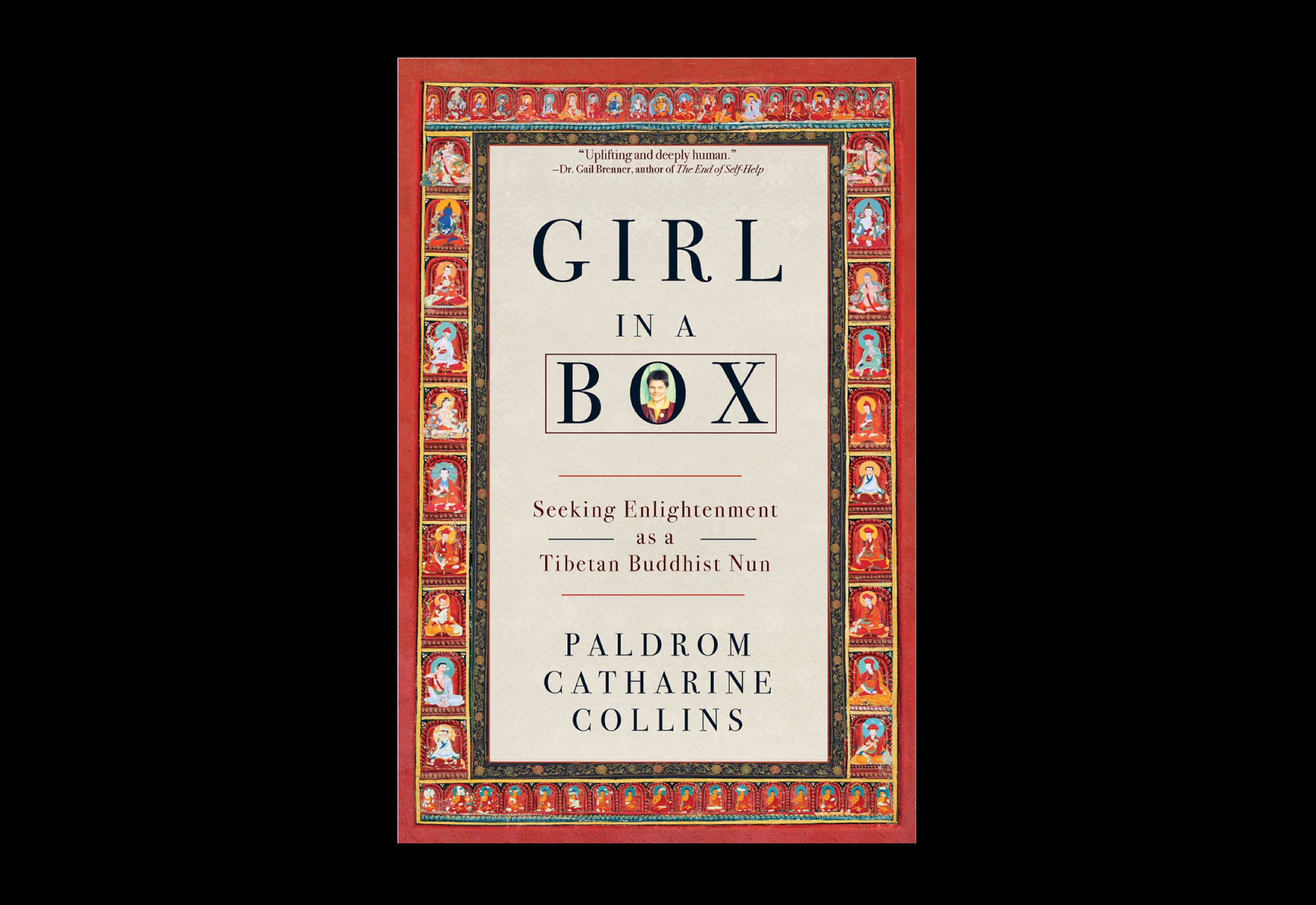
From Girl in a Box: Seeking Enlightenment as a Tibetan Buddhist Nun, by Paldrom Catharine Collins, excerpted with permission of Monkfish Book Publishing.