

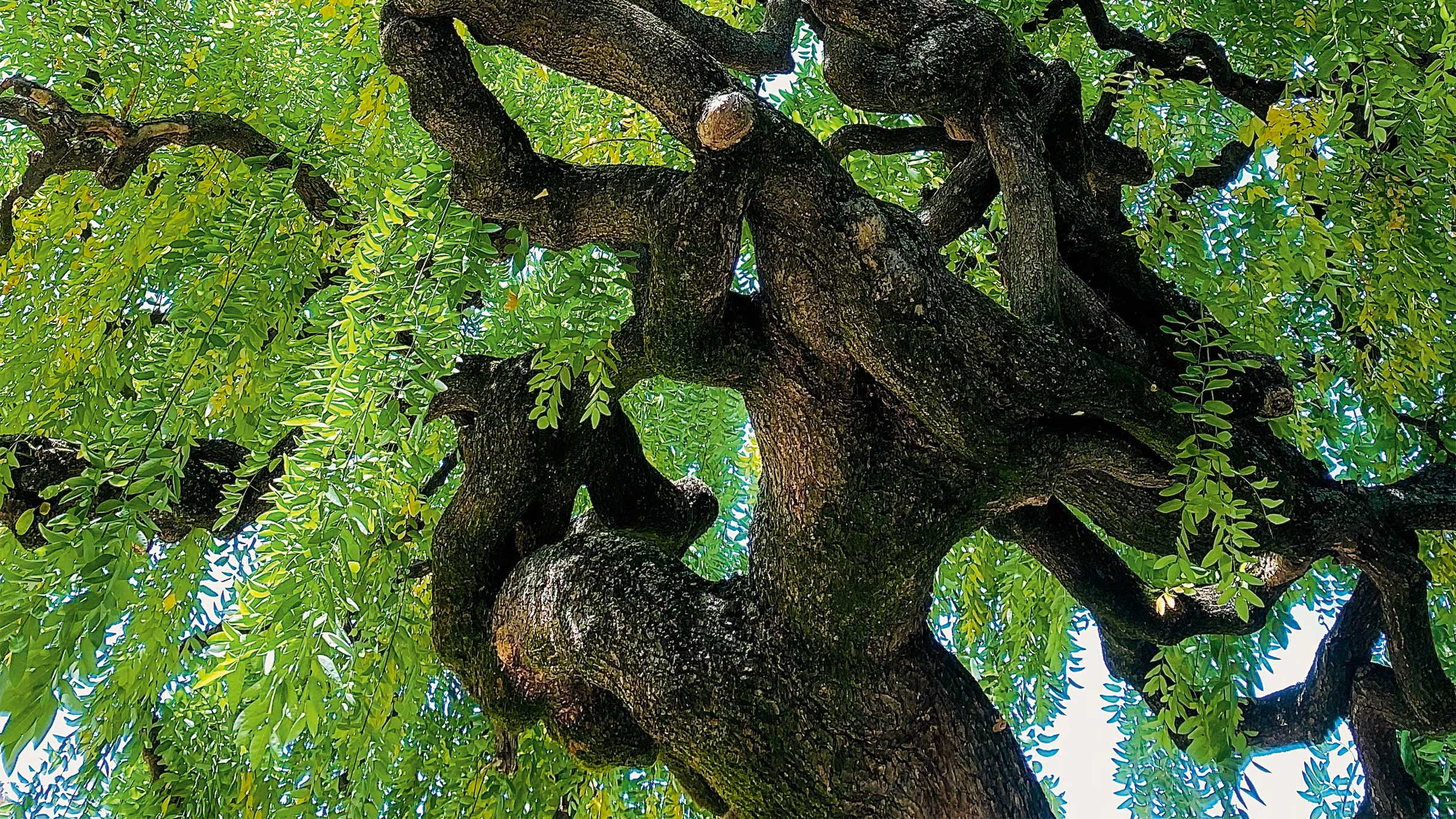
There was a large banyan tree across the street from the house where I grew up. I called it “The Big Tree.” After a prolonged illness, I climbed that tree every day to strengthen my fragile body. At first, I could only climb into the sturdy lower branches, but as time passed, I grew stronger and began to venture farther up.
The boys in the neighborhood also used the tree as a place to play. But I was a girl and physically weak, so I went to the tree when boys weren’t there. I wanted the privacy and silence. Also, I was afraid of falling and didn’t want to show them my fear.
One day, I managed to pull myself up through the smaller branches near the top. It felt glorious being high in the tree’s summit. From this lofty perch, I could see out through the glossy leaves far past our neighborhood. My fear dropped away, so did my thinking mind.
Years later, when I encountered a koan that also takes place in the branches of a tree, I felt both unease and sense of familiarity.
“At the edge of life and death, at the edge of suffering and compassion, conceptual knowledge reaches its limit. We cannot explain, nor can we retreat.”
The koan is vivid: Someone is hanging from a branch by their teeth. Their hands cannot grasp another branch; their feet cannot reach the trunk. Beneath the tree, someone asks, “What is the meaning of Bodhidharma’s coming from the west?”
If the person answers, they’ll fall and die. Yet if they remain silent, they fail the question and will be of no use to the questioner. What should they do? What should I do? What should we do?
The situation feels impossible: Speak and you fall. Remain silent and you fail. As a girl, no one asked me, “What is the meaning of Bodhidharma’s coming from the west?” and yet the problem felt familiar. I too often felt uncomfortably suspended between worlds, not only physically, but also existentially. Yet there was more to that dilemma, I was to learn.
This koan lives in the Mumonkan, or The Gateless Barrier, the famous collection of forty-eight koans compiled in 1228 by the Chinese Chan (Japanese: Zen) teacher Wu-men Huikai. Each koan records a moment between a teacher and a student—a question, a gesture, a fragment of dialogue that can free the conceptual mind. This tells us something subtle about practice. The barrier between ourselves and awakening is not actually outside of you and me. There’s no locked gate barring entry. Yet the barrier feels utterly convincing.
Among the cases in the collection, the koan of the person up a tree is one of the most direct. The Tang Dynasty teacher associated with this case is Hsiang-yen (Japanese: Kyogen). Long before presenting this koan, he’d studied deeply and knew the teachings thoroughly. But when his teacher challenged him to express the essence of Zen, Kyogen discovered that all his learning could not meet the moment. Every explanation collapsed. Facing this, Kyogen burned his notes and books, saying they were useless for awakening, and he left the monastery to live in solitude.
One day, while sweeping, his broom struck a broken roof tile. The tile flew through the air and hit a stalk of bamboo. The sharp sound rang out in the silence—Tock! In that instant, something opened in Kyogen. The years of striving, the effort to grasp awakening through explanation…gone. The simple sound of tile striking bamboo revealed the intimacy of reality.
Awakening does not arrive through explanations or striving—it arrives when explanations and striving fall away.
“What is the meaning of Bodhidharma’s coming from the west?” This question is not about history. Bodhidharma, the legendary founder of Chan in China, is the living heart of the dharma. The question is, “What is the nature of enlightenment?” How should such a question be answered with words?
In Zen training, students are asked to show the meaning of Bodhidharma’s coming from the west—not to explain it but to embody it. Here the challenge comes at the worst possible moment—the person hanging from a tree branch by their teeth cannot open their mouth without falling.
The koan places us squarely in one of the deepest tensions in spiritual life: the tension between expression and silence. Zen often emphasizes that ultimate reality cannot be captured in words. Bodhidharma himself is associated with this famous description of Zen: A special transmission outside the scriptures / Not relying on words and letters. And yet Zen is filled with words—teachings, poems, koans. Teachers speak, students ask questions, teachers answer. The dharma moves through language even as it exceeds language.
The person in the tree exemplifies this tension in a stark way. Silence alone is not enough. But ordinary speech will not do either. The koan presses us into a place where categories collapse.
When I reflect on this koan from the vantage point of my own life, another layer appears. Many of us have felt like this person hanging from a tree. Speak and risk being attacked or pushed aside. Remain silent and participate in your own disappearance. In spiritual communities, in medicine, in academia, in the political world, in marriage, we are well familiar with this tension. To speak truth may carry consequences. To remain silent may mean failing the moment.
So, when I hear this koan, I sometimes imagine not only the person in the tree but all of us who have felt suspended between these two choices. Perhaps this is why the koan resonates so deeply with me. It’s not merely a philosophical puzzle. It’s the human condition.
The teacher Wumen’s commentary on this case cuts directly to the point. He says that even if your eloquence flows like a river, it will not help. Even if you can expound the entire body of Buddhist literature, it will not help. Even if you have a university education, a doctor’s degree, if you’re a clinician or politician, these strategies will not help. This is not a rejection of learning. Study and reflection are vital aspects of practice. But Wumen points to something deeper.
At the edge of life and death, at the edge of suffering and compassion, conceptual knowledge reaches its limit. We cannot explain, nor can we retreat. In this moment, we’re challenged to be intimate and completely immediate with reality, as it is.
The mind searches for solutions. In this situation, I myself have searched for a way out or through. When climbing that great banyan tree as a girl, I would come to places where I could neither ascend nor descend. I was suspended and forced to rest there in my dilemma. Just as I could not see a solution, the koan is not interested in answering the problem. The more we calculate, the tighter the knot of fear becomes. The more I tried to figure out how to get out of the bind of being caught in the tree, the more frozen in fear I became.
Zen practice works this way. The mind exhausts its strategies until something deeper begins to open. Eventually we may discover that a true response does not arise from calculation. It arises directly from immediacy and intimacy. In the end, the koan demands that we discover the very source from which genuine expression emerges.
What makes this koan enduring is that it defies resolution. We’re still in the tree. I’m still in that banyan. As are we all, whether we know it or not. Do I fall or fail, or is there something else? Practice does not remove us from this dilemma. Practice invites us to inhabit it more fully, just as I inhabited that great banyan with increasing ease. Perhaps, over time, with practice, we begin to trust there is a deeper intelligence within awareness itself—an intelligence that can respond spontaneously when the calculating mind falls into silence.