

When my Tibetan grandmother died on a winter night in Darjeeling, India, lamas came to the house and began reading aloud from The Tibetan Book of the Deadto guide her through bardo, the liminal state between death and rebirth. Seated in the altar room next to her body, they chanted from the ancient text, urging her to pay attention to reality:
Let not thy mind be distracted.
Thou wilt pay undistracted attention to that with which I am about to set thee face to face…
That which is called death hath now come.
If the deceased is inattentive to the lamas’ prayers and instructions, she floats along in darkness, wandering in the suffering of samsara. Unable to perceive the truth of her situation, she’s diverted from the path to liberation.
The guidance offered to the dead is for the living as well. In the bardo of life—the span between our birth and death—we may float along aimlessly, pulled by habit, fear, and desire. The happiness we long for feels out of reach as, in a constant state of distraction, we ruminate on the past and speculate about the future.
Like the dead as they journey through bardo, we may find ourselves adrift in the world of the insatiable hungry ghosts, the pretas. It’s a realm populated by wretched beings with throats as thin as a piece of hair and stomachs as big as the Grand Canyon. “Never enough drinks or eats for them,” my grandmother used to say.
In the preta realm, The Tibetan Book of the Dead tells us, there are “desolate treeless plains and shallow caverns, jungle glades and forest wastes. If one goeth there…one will suffer various pangs of hunger and thirst.” This quenchless desire is seen in the Buddhist idea of tanha (thirst), which the Merriam-Webster Dictionary defines as “an intense desire for life.”
I first became familiar with hungry ghosts during my girlhood in California. I’d perch on the living room sofa and study a thangka scroll painting that my mother had brought with her when she came to America from Darjeeling in the 1950s. The painting showed fierce, buffalo-headed Yama, Lord of Death and symbol of impermanence, holding the wheel of life in his claw-like hands and feet. The wheel contained illustrations of the realms in which we can be reborn as we go around and around in the cycle of samsara: god, demigod, human, animal, hell, and—the one I especially hoped to avoid—hungry ghost, where skeletal beings with distended bellies kneeled in supplication as flames consumed them.
Years later, I would remember those hideous creatures when I came upon a parable from the Lotus Sutra in which a man’s children are playing inside a broken-down house that’s on fire. The man urges his children to leave the house, telling them,
The sufferings here are already hard to deal with,
How much more so in the midst of this raging fire.
But lost in their play, too distracted to notice the flames, the children ignore their father. In life, we are the children and the father is the Buddha. The house is the world of samsara. It’s possible to exit the burning house and live an enlightened existence, the parable tells us, but to do so, we must stop playing our games. In other words, we must give up our distractions.
One way of freeing ourselves from distraction is related to what’s known in Tibetan as kora, which means to circumambulate a place without any goal of arrival or reward. In the West, “going around in circles” usually refers to wasting time or acting in vain, but in the Tibetan way of looking at it, walking in circles brings us deeper and deeper into the moment and ourselves.
Kora can be performed by circumambulating a natural site, such as a mountain or a lake; an object or a place created by humans, like a stupa, a monastery, or a hamlet; or the residence of a spiritual master. Famous sites where Tibetans practice kora include the Jokhang Temple in Tibet and the Dalai Lama’s compound in Dharamsala, India. Kora may also be carried out along straight paths or roads, especially in urban areas.
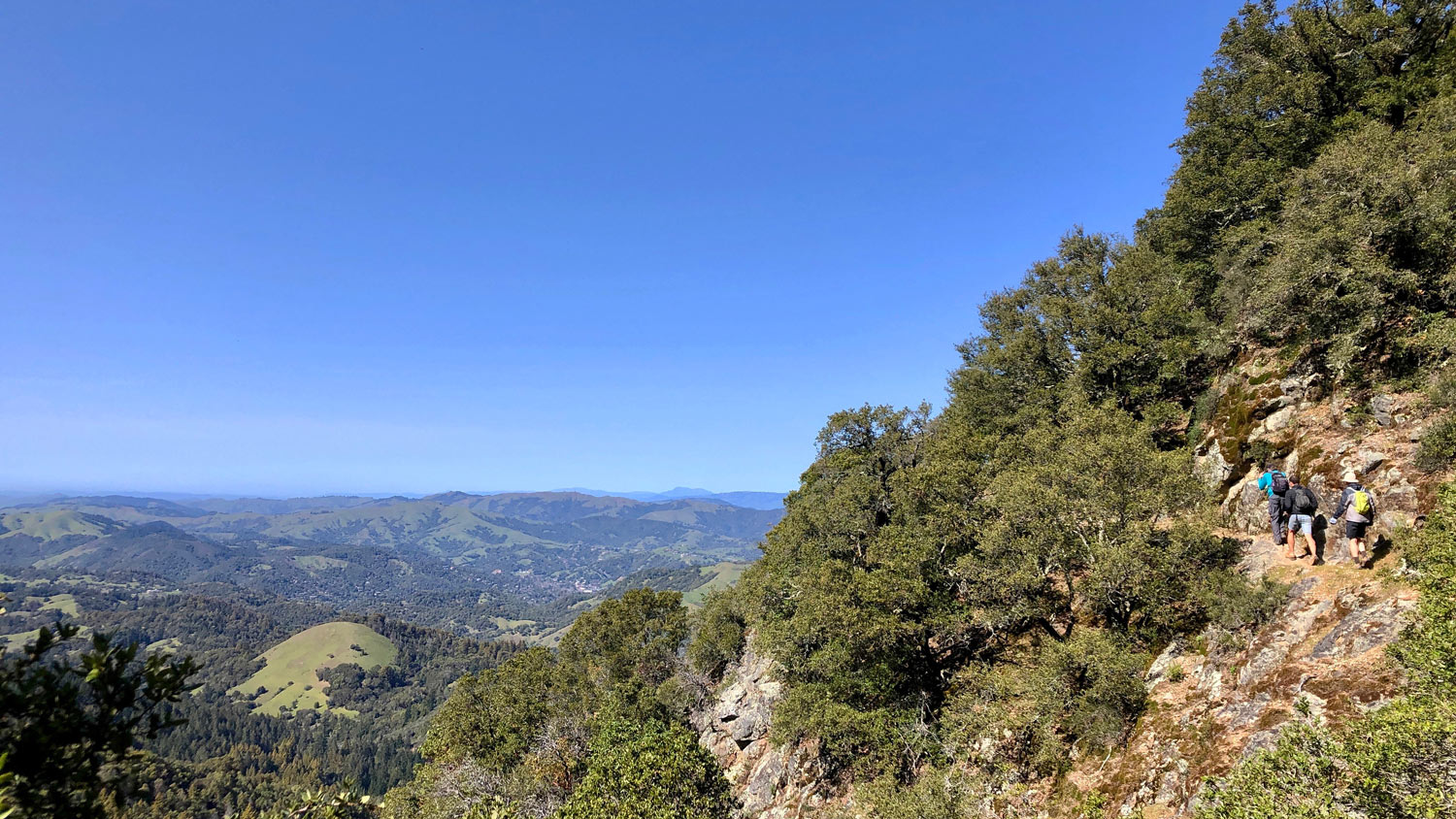
In 1965, Beat poets Gary Snyder, Allen Ginsberg, and Philip Whalen circumambulated Mount Tamalpais (Tam), a peak near where I grew up in the San Francisco Bay Area. Tam is often compared to holy mountains in India and Tibet; there are clear streams and verdant meadows; the sun glints on the Pacific and hawks glide in the sky. Snyder, Ginsberg, and Whalen “opened the mountain,” blowing a conch shell as they commenced the walk. The idea had come to Snyder and Ginsberg during their travels in Asia, where they learned about the ritual circumambulation of holy Mount Kailash in western Tibet.
As Snyder, Ginsberg, and Whalen walked around Tam, they paused at creeks, rock outcroppings, caves, and redwood groves to bow and chant mantras, establishing a tradition that continues on the mountain today. “The main thing,” Snyder said in an interview with UC Davis English professor David Robertson, “is to pay your regards, to play, to engage, to stop and pay attention. It’s just a way of stopping and looking—at your self too.”
Whalen had similar feelings: “[Circumambulating Tam] stopped me from worrying a lot,” he said in the same interview. Short on money, grieving his father, and preparing to leave San Francisco for Japan in the hope of a better life, he was “worrying about a whole lot of things right then.” But he discovered that as long as he was walking around the mountain, the worry loosened its grip. “I was able just to open up to things,” he said, “and see them.”
We can perform our own ritual walks at places that have personal meaning to us. For me, these include Darjeeling’s Ghoom Monastery, where my family has prayed for over a hundred years and our dead are cremated; Montparnasse Cemetery in Paris, the final resting place of one of my literary heroes, Marguerite Duras; and the traditional Tokyo neighborhood where I lived in a teahouse when I moved to Japan in the 1980s.
For you, it might be a local pond, a church, or the town where you were born. No matter what the route, kora holds the possibility of shifting how we pay attention. Free of hungry ghost dreams and worries, we turn toward our immediate surroundings and experience a fertile kind of mind wandering that opens us to reality.