

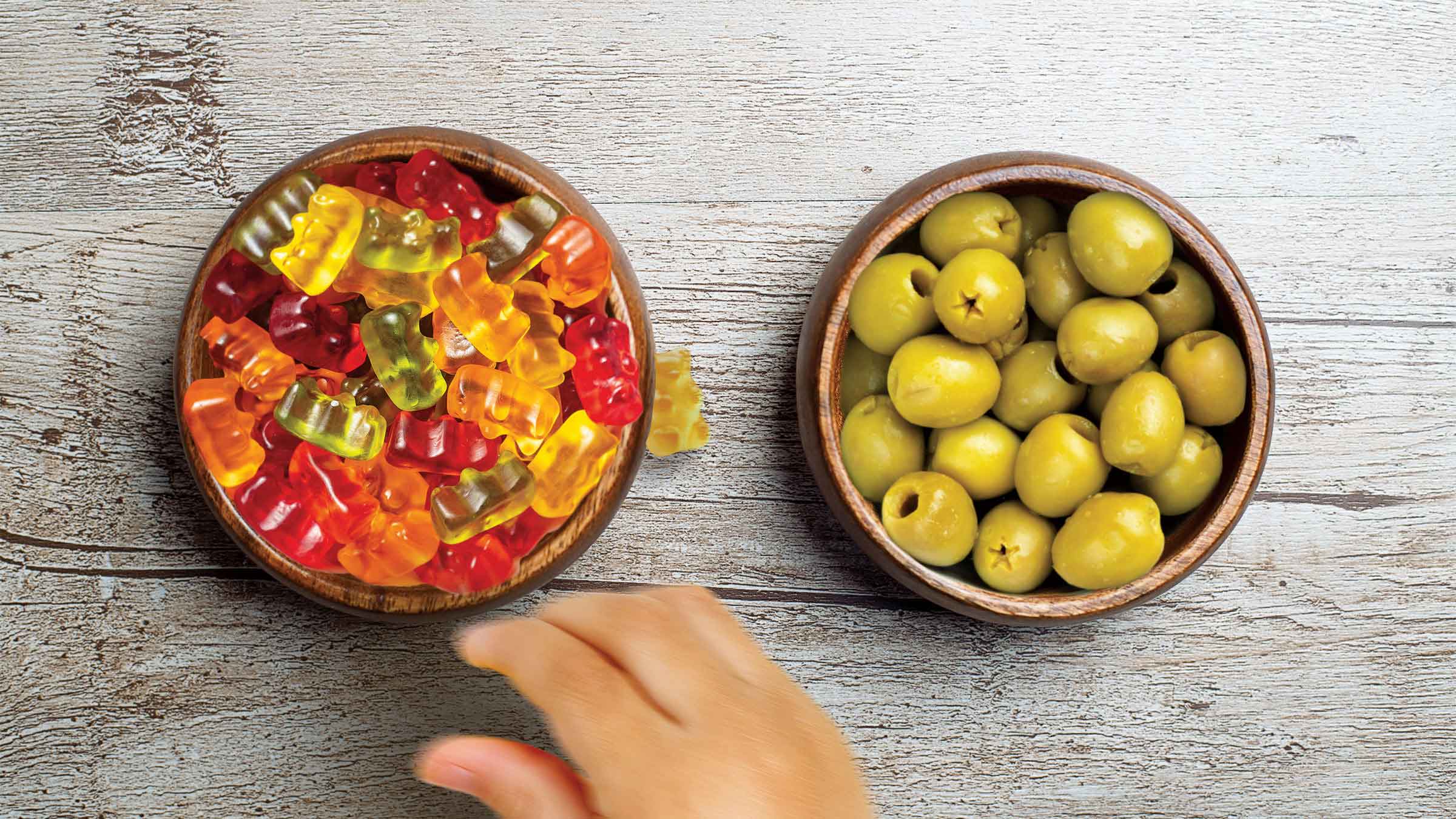
“Mama, is it feast day today?” my son asks, masking his true question.
Every time he sees me bring out the little table and set it up in front of the shrine with the brocade tablecloth, he knows what’s coming. He likes to help me set up, but more than an interest in Buddhist ritual, his real interest lies in seeing what kinds of offerings we’ll be making, since that will determine the treats he’ll have afterward.
He’s accustomed to our twice-a-month practice. Sometimes he’s excited about what we’re offering, such as when it’s chocolates or gummies. Other times, when we’re offering something he doesn’t like to eat, like olives, he’ll say, “This doesn’t seem like a lot” or “This is disgusting.” His disappointment and preferences are very honest.
In the Tibetan Vajrayana tradition, practitioners celebrate two auspicious days each lunar month. The tenth day of the month, Guru Rinpoche Day, is a celebration of the energy of compassion, which is considered masculine. The twenty-fifth day, Dakini Day, is a celebration of the feminine energy of wisdom. Both are marked by the practice of tsok, a ritual feast.
How a feast offering is performed can vary greatly depending on your particular Tibetan lineage and the deity practice you’re doing. In some traditions, the feast is elaborate with carefully arranged offerings, specific liturgies, and a structured sequence of prayers and praises. In others, it’s more intimate—a small group of practitioners gathered around a simple spread of food. What remains consistent across these variations is that a feast is never only about the people in the room. The assembly of practitioners goes beyond the physical to invite all realized beings—buddhas, bodhisattvas, meditational deities, dharma protectors, dakas, and dakinis—as honored guests. The space is understood to be full of seen and unseen beings who are present and welcomed.
During the practice, prayers and praises are offered, and the food itself becomes an offering, blessed and transformed through the practice before being shared. Vajrayana practitioners gather to recite the liturgy together, to make offerings, and ultimately to partake of the feast communally—the physical and the nonphysical guests sharing in the same meal. This communal dimension is essential. The feast is not a solitary practice but a gathering, a moment of connection across realms. And it’s not solemn. It’s a joyful celebration, which often opens into spontaneous offerings of song and dance, expressions of joy and devotion that arise naturally from the practice itself.
Like any ritual or practice found across Buddhist lineages, feast practice is a skillful means, a tool for working with our minds. At its heart, tsok is a practice of equanimity. We’re invited to let go of dualistic thinking, to cultivate a pure view in which we release our habitual categories of good and bad, pure and impure, desirable and repulsive. Everything that arises is met as sacred. Traditionally, tantric practice made this point explicitly; some offerings were intentionally chosen because they were considered repulsive or transgressive—alcohol, meat—directly challenging our notions of what is acceptable or pure. The point was never indulgence, but rather the dissolving of dualistic thinking. The gummy bears my son loves and the olives he despises are offered and consumed with the same reverence, the same open hand. We don’t discriminate between what delights us and what repels us—both are placed on the shrine. Feast practice helps us recognize attraction and aversion as it arises in ourselves and to soften our attachment to both.
I’ve participated in feasts where hundreds of offerings were made and others where the offerings were just a handful. What matters most is the view we bring. The idea isn’t indulgence; it’s seeing things as they are—reflections of our own minds—and learning to let go of dualistic thinking.
In some ways, the spirit of a feast offering is the same as that of dark dining. At a restaurant providing dark dining experiences, meals are served in complete darkness. You cannot see your food, cannot identify what’s on your plate, and cannot pick around what you dislike or reach for what you prefer. This is similar to tsok in that you’re not there to survey the table and select what appeals to you. You receive the feast as it comes, without discrimination.
Of course, the intention of dark dining and tsok is different. Dark dining is often marketed as a way to heighten pleasure, to indulge the senses more fully by removing one of them. A feast offering points in the opposite direction: not toward self-serving indulgence but toward enjoyment without grasping.
In the removal of choice, something interesting happens to the mind. Feast practice is a form of deep mindfulness—a skillful means for working directly with attachment to desire and aversion. Just like how in other forms of mindfulness practice, we work with whatever arises in the mind, during a feast, we work with whatever arises at the feast itself. Everything that’s consumed is seen as pure—all that arises is sacred, all that we consume is wisdom nectar, everyone partaking is seen as a daka or dakini (wisdom being).
You do not refuse what’s offered during feast practice. Tsok is not about sense pleasure itself; it’s about transforming our relationship to desire and aversion. The sense pleasures aren’t denied; they’re transmuted. Poison becomes medicine. What ordinarily fuels craving becomes, with the right view, what fuels awakening. There’s joy in a feast offering, there’s celebration, yet it’s an enjoyment that lies beyond dualistic thinking, and that’s something different from ordinary indulgence. Without the right view, the same feasting would simply reinforce attachment rather than dissolve it.
Tsok is a practice of generosity. Before we partake of anything ourselves, we offer first to the buddhas, the bodhisattvas, our gurus, and all beings seen and unseen. This reversal of our ordinary impulse is part of the practice. Rather than reaching for what we want, we begin by giving. In acknowledging all those present, seen and unseen, we’re reminded of the interdependent nature of all beings, that we do not exist alone and that nothing we enjoy arises without the contribution of countless others.
The intention is that this way of seeing doesn’t stay on the shrine table. We practice it there so that we can carry it everywhere—into our daily lives, into our relationships. So much of the suffering we experience comes from the endless movement toward what we like and away from what we don’t. Feast practice gives us an explicit, joyful way to work with that. But our practice should never be limited to it.
While an elaborate feast might not be something everyone can engage in, I once heard my teacher say that if one cannot perform a feast offering, it will suffice to offer someone a meal. So perhaps the next time you’re hosting a dinner party or dining out, you can bring this to mind. Then every meal can be a sacred feast.