


It is 5:00 in the morning at the Nishiyama Betsuin, a training center for Jōdo Shinshū Buddhist priests in Kyoto, Japan. The wake-up music has not started yet. That comes at 5:30, an old beautiful song through crackly loudspeakers, the kind of melody that drifts through nostalgic Japanese dramas. Most of us are already awake when it comes on. The morning schedule is tight enough that we have learned to give ourselves a half-hour of margin: time to brush teeth, wrestle the robes on correctly, and gather at morning assembly without anyone being late.
This is the rhythm of tokudo shurai, the ordination training for priests in the Jōdo Shinshū Hongwanji-ha — the Mahayana Buddhist lineage founded by Shinran Shōnin in thirteenth-century Japan. Tokudo is the threshold ordination, the one you cross to wear the robes of a priest. There will be more training and ongoing service — but tokudo is the door. Eleven days of practice, study, ritual, testing, and chores, after which we walk into the Hongwanji temple and the Gomonshu, the spiritual head of our lineage, touches a razor to our heads three times.
When we first arrived at Nishiyama, the staff handed out name tags. I received a second one that read hanchō — group leader. The word from which English borrowed head honcho. Perhaps because my Japanese is reasonably fluent, I had been chosen to help coordinate the international group. At that moment, however, looking at the busy eleven-day schedule, I was preemptively exhausted and anxious. Being handed the hanchō tag felt like being a drowning person handed a boulder.
A hanchō has a few additional duties: assigning chores (mornings begin with cleaning toilets and sweeping floors), assigning roles for chanting and ritual practice (got to make sure everyone gets a chance to practice different roles), checking each teammate’s robes and ritual implements, and — most importantly — doing a quiet daily health check on everyone in the team, body and mind.
Being tasked with the hanchō role turned out to be a gift. I quickly found something steadying about keeping my attention on whether someone else’s robes were straight or whether someone needed help translating a doctrinal term. My problems shrank, not because they’d gotten smaller but because I knew I was not facing them alone. The Mahayana intuition that whatever ease there is in the world comes from looking after others — Shantideva says something like this in the Bodhicaryavatara — turns out to be true even at five-thirty in the morning, even when you’ve not had coffee.
My teammates came from Hawaii, the mainland US, Japan, Canada, Spain, Argentina, Vietnam, and Belgium. Alongside us, about forty Japanese aspirants were doing their own training. One of our teammates turned eighty during the eleven days. Some of the Japanese trainees were only twenty years old. In Japan, becoming a priest is often part of a family inheritance, the eldest child stepping into the temple role where they grew up; but I met young and old Japanese trainees who had come to ordination not by family expectation but by something more personal. One college student said he just thinks Shinran is really cool! The international group had varied reasons too: some wanted to staff temples that were short on priests, others hoped to plant new sanghas in places that had none.
My own road has been long. I became interested in Buddhism and meditation almost 30 years ago as a teenager living in Lynchburg, TN. After majoring in Religious Studies and Japanese in college, I moved to rural Japan to work as an English teacher. There my friends, neighbors, and students, and even the owner of the sushi restaurant below my apartment, introduced me to Jōdo Shinshū as a vibrant multi-generational Buddhist culture. I saw the dharma flourishing in the midst of everyday life and relationships: grandparents and kids, families and festivals, beers and fried chicken. Inspired by these immersive encounters I devoted my life to the study of Buddhism, earning a master’s and PhD, and returning to live in Japan several times thanks to scholarships like the Fulbright.
Somewhere along the way I began to wonder if it would be possible to replicate the scholar-practitioner model I had seen in Japan, where scholars who were serious critical historians also raised families and served a temple community. After winning the academic professional lottery and becoming a professor, I worked with friends in my community to establish a dharma school for our children and a sangha for like-minded people who wanted to practice Buddhism in community. This path led to several years of service with the Albany Buddhist Sangha and the New York Buddhist Church, and eight courses at the Institute for Buddhist Studies — the four required for tokudo and four more for kyōshi (additional training to become a resident minister).
The deepest motive, underneath the others, came from my life as a husband and father. During tokudo our phones and laptops were locked away. We could write letters, but barely had time. I thought about my kids constantly. Whatever I could carry home from these eleven days, I wanted to share with the people I love most.
What I would carry home, it turned out, was a sentence: everything is tokudo.
* * *
I came to Kyoto having heard, over thirty years of Buddhist practice and several years living and working in Japan, a wide range of stories about training to become a priest. As a scholar of Buddhism, I had read the academic literature and met many teachers from many traditions up close and personal. Some were brilliant. Some were compassionate. Some, frankly, were bullies. I have seen first-hand or heard stories of hazing, hunger, prostration as punishment, and shouting deployed as if they were transmission. I have heard accounts of physical and verbal abuse. Recent research on sexual misconduct across Buddhist traditions has confirmed what many practitioners already knew: the romance of severity opens doors that abusive teachers walk right through. There is a strain of thinking — found in more than one lineage — that if a student can endure cruelty, the cruelty must be transmitting something. I have seen what that strain costs.
I had heard of the “kinder, gentler tokudo” at the Nishiyama training center. I heard that it would be hard but not abusive, exacting but not cruel, and I was anxious to see whether that was true.
By the end of the training, I had experienced a fundamental reorientation. I felt like a beginner in the best sense, like I met the best version of myself during those eleven days. The training stripped away all the ways I might try to hide.
It was true. Our teachers were highly professional and thorough, demanding and exact. They would not let a chant land sloppily or a shallow bow go uncorrected. But they were not cruel. Mistakes were met with guidance and another try. One of our trainers in Berkeley, Rev. Katsuya Kusunoki, head minister of the Seattle Betsuin Buddhist Temple, told us early on that robes and ritual implements are bodhisattva tools, to be handled with care. The robe you tie at five in the morning is the same robe you will wear when someone calls you to a hospital bed at midnight. How you treat it now is how you will show up then. The robe is not a costume. The ceremonial fan is not an accessory. There is a long Mahayana current that runs through this teaching — the sacred is not encountered despite the mundane. It is encountered through it.
One of the first challenges was memorizing the thirty verses of the Shōshinge, Shinran’s “Hymn of True Confidence.” I had chanted it for almost twenty years at home, and thanks to the instruction of Rev. Tadao Koyama, head minister for the Tacoma Buddhist Temple, I felt prepared for my chanting exam. However, during the exam I stumbled almost immediately. My teacher nodded and said, Try again. In that nod I felt the line from the Contemplation Sutra: “grasped and never abandoned.” The teacher’s correction reminded me of something my mentor and fellow New York Buddhist Temple minister’s assistant Rev. Gary Jaskula says about the Shin Buddhist path: you can fall down, but you can’t fall off.
One of the teachers reminded me of a phrase I heard one time in a Nichiren Buddhist context, that I keep turning over: chanting from the body. When a text is memorized deeply enough, it ceases to be something you produce simply from the mind, instead it becomes part of you. The breath, the pitch, the pace are no longer technical concerns; they are the embodied form of the teaching itself. To stand in a hall with sixty voices landing on a single syllable together is to understand, before any doctrinal reflection, that form is emptiness, emptiness is form.
* * *
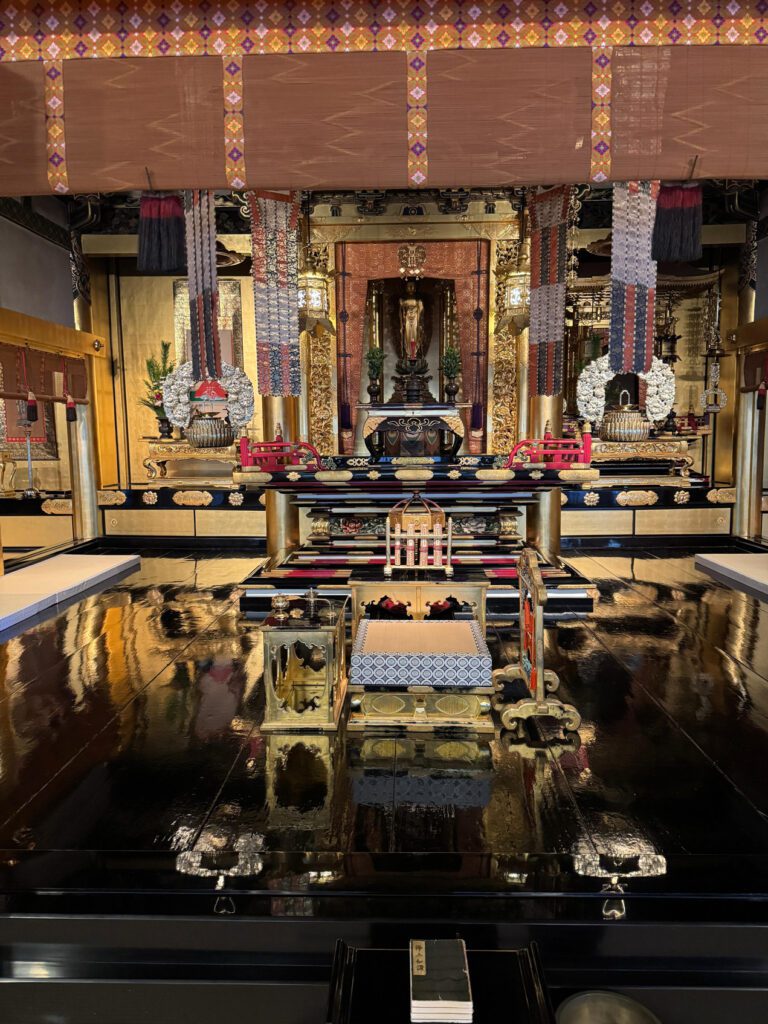
Here is what a day looked like: Wake at 5:30AM — though, as I said, most of us were up by 5:00. Brush teeth. Robes on. Morning assembly. Chores: scrubbing toilets, sweeping the steps. Morning service in the main hall. Then, mercifully, breakfast in formal silence. (The food at Nishiyama was one of the unexpected pleasures of the eleven days. I am a big guy — 220 pounds — and the smaller Japanese portions were a challenge, but rice was plentiful and my smaller teammates kept passing me what they could not finish.) Then lectures on doctrine and history. Robes off. Robes on again, this time formal robes, for ritual training in the main hall: sitting up straight, standing as one, right foot, no, left foot, the placement of incense, the precise angle of a bow. Lunch. More classes. More ritual practice. Tests on chants. Afternoon service. Dinner. Evening service. Evening study. Robes off. Coordinate with teammates to do laundry and hang dry clothes. Lights at eleven. Sleep. (My roommates from Hawaii and Canada became close friends quickly. Humor was medicine. They teased me about how fast I could fall asleep — I would roll out my futon on the tatami mat floor, lie down, like a starfish, and be unconscious before my head finished settling onto the pillow.) I will carry forever the image of the temple roofs and fall leaves through our third-floor window in the few minutes before dark. Then 5:30AM again. For eleven days.
The pace of robe changes alone could have broken us. We wore plain black robes with the simple stole and basic prayer beads for classes, chores, and meals. Ritual practice in the main hall required formal robes with five-panel outer robe, fan, and longer formal prayer beads. Up and down three flights of stairs. Across three buildings. Wash, rinse, repeat. Often back up because someone, frequently me, had forgotten something. As hanchō, one of my jobs was to make sure everyone had what they needed before we left the dorm. We moved as a group; you didn’t go to class or service or meals alone. You went together. This struck me, by the third day, as the daily-practice form of the bodhisattva path’s most foundational insight: the goal was never personal liberation. The fact that I could not even walk to breakfast alone was a small, embodied reminder of that.
One day, after I had checked everyone’s robes, gotten the whole team down three flights and across three buildings to the main hall for chanting practice, I realized I had forgotten my own fan and prayer beads. I rushed back across the buildings, up the stairs, knowing that all of the trainees and all the teachers were waiting on me. By the time I returned, sweating through three layers of robes, I was deeply embarrassed. I sat down in my place, my face burning, and let myself feel the full discomfort of having held everyone up. And then, somehow, I just sat. Breathed. The frustration was real and so was the present moment. Good, bad, or neutral, every moment was a moment of practice. The forgotten fan was tokudo. The mortification was tokudo. The breath and peace that came after was tokudo. This was the gift of tokudo, countless opportunities to experience frustration, exhaustion, and discomfort, and just keep going.
* * *
Midway through the training, in one of our classes, Bishop Marvin Harada played a short clip from the 2010 Karate Kid with Jackie Chan and Jaden Smith. In the scene, the master keeps making the student hang up his jacket, throw it on the ground, hang it up again. The student grows frustrated — when am I going to learn kung fu? — until he realizes, slowly, that the jacket was the kung fu. Wax on, wax off. Bishop Harada used the scene to open a discussion about what tokudo actually is. Yes, the threshold to ordination. But also a shift in perspective. The eleven days of training were not a pause from real life so we could do something special, so we could become something special. They were a concentrated reminder of what real life had been all along. Everything is tokudo became the line my roommates and I started yelling at each other when energy flagged. Cleaning the toilet at 5:45 — everything is tokudo. Forgetting your fan — everything is tokudo. Falling asleep mid-lecture — everything is tokudo, and also, please wake up.
I think this is the deepest gift of Shinran’s tradition, and the place where it encompasses the rest of the Mahayana most clearly. Recitation of the Name — Namo Amida Butsu — is not a practice we perform to earn awakening. Shinran calls it non-practice: not because we do nothing, but because the calculation of practice-as-mechanism has been dropped. We are not “I practice and become a buddha.” We are participants in something already underway. Practice does not produce realization; practice is its embodied form. Dogen, working in the Soto Zen tradition in the same century, arrived at a structurally similar insight also found in the Tendai teachings: practice and realization are one. This is one of those places where Shin, Zen, and Tendai are closer than one might think. I call this the Zen of Shin! This is honestly one of the things I enjoy as a scholar of Buddhism is seeing how often an insight associated with one tradition may show up in a slightly different configuration in another tradition: dependent origination, no-self, emptiness, and so on, point to something inexpressible. And our teachers help us find ways to express it.
In the Shin frame, there is a thorough leveling of hierarchies. All beings are equally bonbu, foolish beings, ordinary unenlightened humans, monkeys of mind. This is Shinran’s radicalization of a Mahayana current that runs through the Lotus Sutra’s assurance that all beings are destined for buddhahood and the tathagatagarbha teaching that buddha-nature is already present in all of us. Shinran sharpens that insight. Because we are all foolish, buddhahood embraces us, as we are. The priest is not closer to awakening than the layperson. The priest is a foolish being who has been trained to point at the truth that is beyond words, with ritual and recitation, and to hold a hand at a hospital bedside. Everything is tokudo.
* * *
The ordination came on the ninth day. We left Nishiyama Betsuin in the morning. Arriving at the Nishi Hongwanji compound, carrying our robes, we approached the doors and the sun crested the roofline and met us full in the face — bright enough that I had to close my eyes — and a warm gust of wind enveloped us at the same moment. I kept walking, blinking, eyes down, robes pressed against my chest, and I understood without thinking that we had crossed into liminal space.
Inside the hall, vast and dark, lit only by candlelight, we waited for the Gomonshu, Kojun Ohtani, abbot of Nishi Hongwanji and direct descendent of Shinran Shōnin, who would lead each of us individually in the recitation of kie Butsu, kie Hō, kie Sō — I take refuge in the Buddha, I take refuge in the dharma, I take refuge in the sangha. The same three refuges that Buddhists of all traditions, in all the many languages of the Buddhist world recite and have recited for two-and-a-half millennia. At each utterance the Gomonshu touched the razor to my head, three times, in three places. The feeling was electric. It felt like light poured out from the places where the razor met my scalp.
I was no longer thinking about robes or schedules or hanchō duties. I was swept up in something older than any of that — I was now part of a lineage that reaches all the way back to the Buddha and beyond. One of the Japanese words for lineage is ryū; the kanji contains the water radical, because lineage flows like a river that has been moving long before any of us stepped into it, and will keep moving long after, leading us all to the ocean.
* * *
We returned to Nishiyama Betsuin that night for a closing service. And then we were told that, as new priests, we would be getting up even earlier the following day to do our chores again before heading to visit the mausoleum of Shinran Shōnin. In short, we had to wake up to our chores so we would continue to remember “beginner’s mind,” and not get too big for our britches. I thought of when I’d received my Buddhist name, years before. Former Bishop Umezu said to us all humorously, “I guess you’re Buddhists now, but don’t make it a thing.” The morning chores contained the same teaching. We had been ordained, and were still foolish beings. The Mahayana sutras often make the same point: the dharma is realized in ordinary life, not in retreat from it.
This, finally, is what everything is tokudo means. Tokudo is not a special period that ends. It is a way of seeing your life as part of an interconnected whole, a web of mutual dependence and support. The dishes in the sink are tokudo. The dysregulated kiddo at the mall is tokudo. The hospital visit, the daily frustrations of ordinary life, all of it is tokudo. The robe is not always on my shoulders. The dharma always is.
* * *
By the end of the training, I had experienced a fundamental reorientation. I felt like a beginner in the best sense, like I met the best version of myself during those eleven days. The training stripped away all the ways I might try to hide. No phone. No Starbucks. No nap. No beers with bros. No Netflix. What remained was a sincere desire to acquire the skills to be of service to my family and sangha, and to repay the kindness of my many teachers, reaching back through them to the Buddha and beyond. I hope to keep meeting that version of myself, flaws and all.
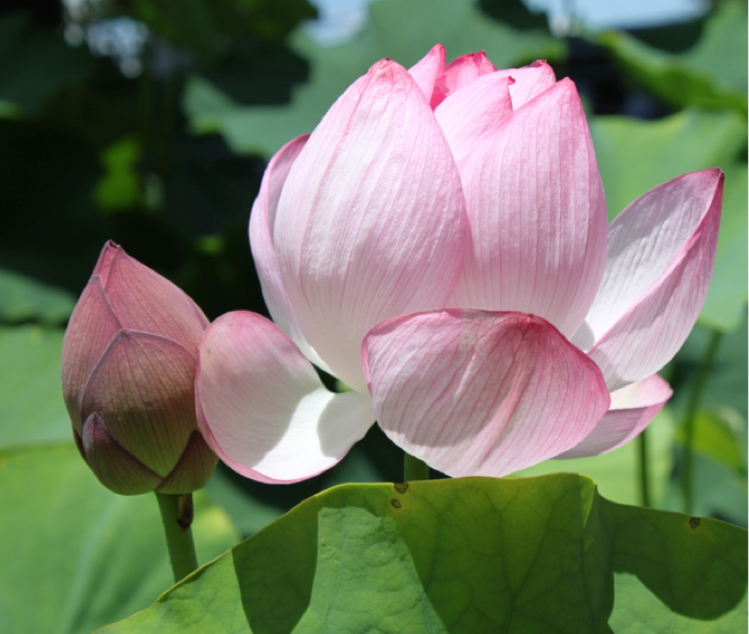
No mud, no lotus, Thich Nhat Hanh used to say. The mud at Nishiyama Betsuin was real — long days, aching feet, the challenges of being a beginner again. So was the lotus. They were, as it turned out, the same thing.
I am no longer just a person training to be a priest. I am now a priest who is also a son, a brother, a friend, a husband, a father, and a teacher. And when I think about how I show up in each of those relationships, I remember that everything is tokudo.
Namo Amida Butsu.