


The full, golden moon still hangs in the dark sky at 5:00AM as I proceed up the walkway with the steady flow of nuns — malas in hand — softly reciting the mantra of Avalokiteshvara: Om mani padme hum.
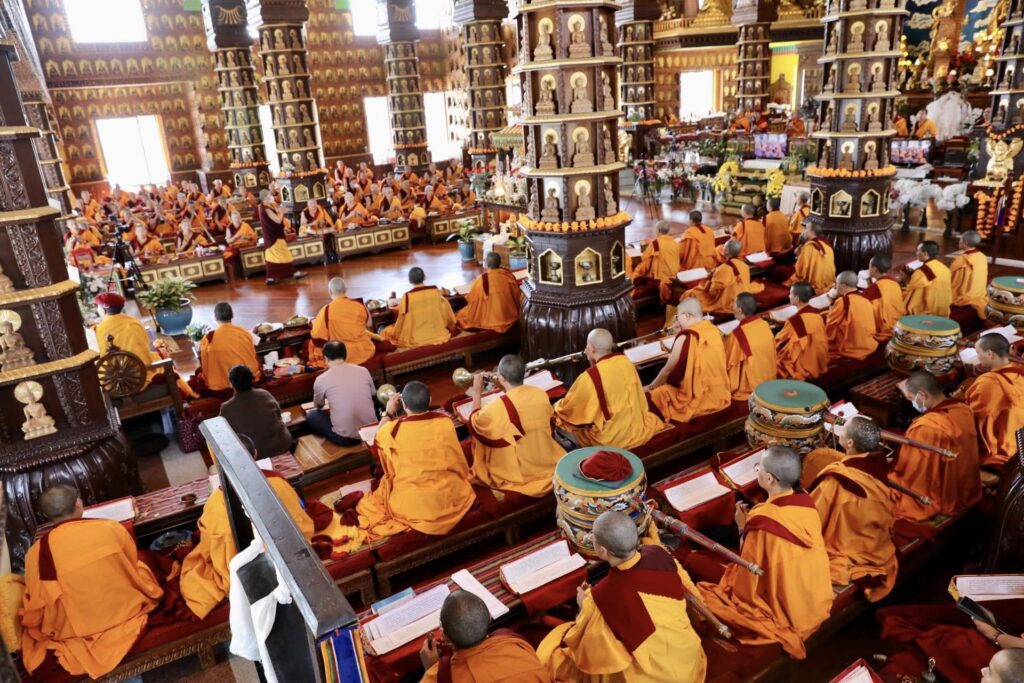
A rooster crows as the conches sound from the rooftop calling the community to gather. Arriving at the resplendent prayer hall atop Druk Amitabha Mountain in Kathmandu, the home of the Drukpa Kagyu (Dragon Lineage) nuns, we deposit our shoes and climb the stairs to enter. The hall gently awakens with smiles of greeting and quiet interchange as we wait for the umdzé (chant master) to take her place and make prostrations. Then everyone makes their own. Taking our seats, we commence a communal endeavor for nine days — performing the Avalokiteshvara Drupchen — to bring a mandala (sacred universe) brimming with compassion into being by every creative means possible.
Drupchen means “great accomplishment,” and it refers to an intensive group practice dedicated to transforming ourselves into the energy and quality of a Buddhist deity. But Drukpa nun and teacher of philosophy Lopön Jigme Tingdzin Zangmo gives a more nuanced explanation: “Many people think of Avalokiteshvara as a deity. What comes to mind is an image — with two arms, four arms, one thousand arms. But Avalokiteshvara is just pure compassion. And in this drupchen, compassion takes the form of Avalokiteshvara.”
During this nine-day immersive ceremony of 13- to 16-hour periods of practice, one is surrounded by every form and articulation of this encompassing energy and quality as a support to generate oneself as an expression of overwhelming compassion. The rituals integrate numerous elements: sacred instrumental music, sung liturgy, cham (sacred dance), hand gestures (mudras), sand mandala construction, mantra recitation, visualization, a fire offering, ritual exorcism, and more — all designed to stimulate the senses and coax our beings into realizing this aspirational project. It is literally a performance of “sacred realm” on a grand scale with the dramatic splendor and exquisite detail of the highest performing arts.
To give context to a secondary aspect of this “accomplishment,” in the Himalayan Buddhist monastic environment the performance of advanced rituals such as drupchen, cham dance, sand mandala construction, technical instrument playing, and leadership roles has traditionally been denied to female practitioners. But guided by the leadership and teachings of His Holiness the 12th Gyalwang Drukpa (Jigme Pema Wangchen) — the dynamic spiritual head of the more than 800-year-old Drukpa lineage of Himalayan Buddhism ─ the Drukpa nuns have broken free of such unfounded limitations. For over twenty years, they have engaged in highly advanced worship and ritual activities that are even now barely opening to women in other Himalayan monastic communities. The Drukpa nuns are frequently referred to as “the Kung Fu Nuns” because of their rigorous training in this martial art form. But regardless of their powerful kicks and swordplay, they are first and foremost highly competent and devoted Vajrayana practitioners.
The Tibetan title for this Avalokiteshvara Drupchen is Thugje Chenpo Drowa Kundrol, which means “The Great Compassion that Liberates All Beings.” Nun and teacher Lopön Tingzin emphasizes, “This is an extraordinary Buddhist practice because compassion is the very essence of Buddhism. By performing the Avalokiteshvara Drupchen, we work to generate great compassion with the aspiration of not just transforming ourselves, but of liberating all beings.”
The drupchen text is a terma — a revealed treasure teaching from the Nyingma School (the oldest school of Tibetan Buddhism) and therefore, traces its origins to Padmasambhava, the Tantric master credited with bringing Buddhism to Tibet in the mid-8th century. Terma are understood to be teachings of Padmasambhava hidden by himself or his foremost disciples throughout the Himalayan landscape or in select persons’ mindstreams to be rediscovered in the future ─ often to address moral decline during difficult periods in history. The text comes from the Jang Ter (Northern Treasures) branch and was revealed by the Treasure Revealer Rigdzin Gödem (1337–1409), also known as Rigdzin Gokyi Demtruchen. This Nyingmapa treasure was taught to His Holiness the 12th Gyalwang Drukpa by his father Zhichen Bairo Rinpoche (1933-2017), who was a great Nyingma master and holder of the Katok lineage in Tibet. This drupchen was one of his main practices and is performed at the Katok monasteries.
One of the Gyalwang Drukpa’s root gurus advised him to perform this drupchen and spread it to his followers. As a result, His Holiness and Zichen Bairo Rinpoche taught the practice to the nuns in 2003, who began performing it in 2004 in Nepal and Ladakh, and with that, shook up perceptions of what nuns could and should do. The Drukpa nuns now perform this drupchen annually just after Losar during the “miracle month” of Chöthrul Dawa — a month when all meritorious acts are believed to be multiplied one hundred-fold.
Like a beautiful sedimentary rock, this drupchen is a composite of many layers accumulated over time: the practices and teachings of Padmasambhava, the text revealed by Rigdzin Godem colored by his own extraordinary mindstream, the embellishments added by inspired masters who have upheld the practice, and the expressions of devotion infused by generations of ritual performers up to the present.
The Drupchen – Opening Rituals
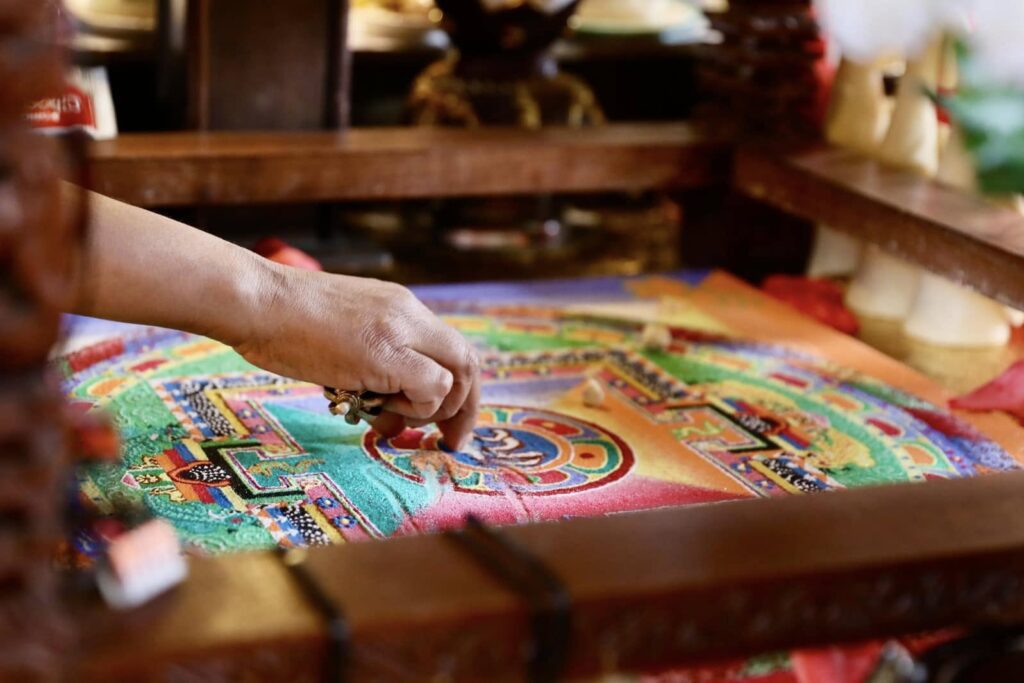
The Drupchen opens with sachok — the groundbreaking, or ground consecration. For this ceremony, everyone goes outside to request permission from the “invisible owners of the ground” (local deities and earth spirits) to use this place for the creation of the pure realm of Avalokiteshvara. The practitioners walk around the campus to the four directions (east, south, west, and north) and make ritual offerings of torma (ritual cakes) to the protectors asking that they eliminate any obstacles to the successful completion of the drupchen. The gates are symbolically locked to seal the boundary of the sacred space. Next, they dig a hole in the ground and bury a small effigy of an obstacle maker — an additional protective measure to safeguard against potential obstacles. Afterward, everyone returns inside the temple and commences the ritual to construct the sand mandala, which forms the foundation of the three-dimensional mandala palace that is assembled for the drupchen.
At this point, the nuns perform Ging Cham. Dressed in skeleton costumes with a tall flag extending up from the top of their masks, four ging (workers/messengers of Guru Padmasambhava) arrive with a ruckus. Beating their hand drums with a hooked drumstick, they drive away or pacify obstructive spirits with their dance. They eventually coordinate with the Dorje Lopön (Ritual Master), the Lekyi Lopön (Activity Master), and the Chopön (Shrine Master) in creating the mandala, or kyilkhor — a three-dimensional representation of a sacred universe. Relatively speaking, they are constructing the palace of Avalokiteshvara, which applies to the sand mandala as well. To initiate this, they perform a series of measuring rituals (with string) to establish reference points and a grid for the sand mandala image. Once the mandala is complete, the drupchen can begin.
The second day is called darzin (assignment). Here, the discipline master assigns the musical roles for the drupchen, handing over the individual instruments to each performer in a formalized procedure.
On day three, we get into the heart of the practice, starting with the preliminaries — refuge and generating bodhicitta (the heartfelt wish to alleviate suffering and benefit all beings). This flows into a stream of supplications to the lineage masters, on whose merit the blessings of this practice rest. “Ho hoy. Ho ho hoy. Ho ho ho hoy. Ho ho ho-ho-ho hoy,” the umdzé intones on a single note. This hallmark introductory phrase, unique to this liturgy, is repeated multiple times each day. The chanting style comes from the Katok lineage, following a musical tradition quite different from the nuns’ customary Drukpa Kagyu style. These melodies tend to be slow and often start with the repetition of the syllable “ho,” an invocatory exclamation — to summon the energy of Avalokiteshvara, the quality of compassion.
Invocation
After three chimes of a bell, we commence the lhargyal, an offering of beautiful sound — one of the eight sensory offerings traditionally presented to initiate a deity practice. It literally means “victory,” implying that we will be victorious in our accomplishment of Avalokiteshvara. The entire hall resounds for over five minutes with shimmering vibrations produced by conches, a variety of horns, bells, around 25 cymbals, and a similar number of drums. I follow the actions of Dorje Lopön, who presides over the ritual activity. Her entire being vibrates in offering as she energetically sounds the damaru (hand drum) in her right hand and rings the bell with her left. I add my bell to the symphonic outpouring. Every cell in my body feels awakened in this process. The sound dissolves and the clear unison of the umdzé and her assistant ascends with a reverential invocation.
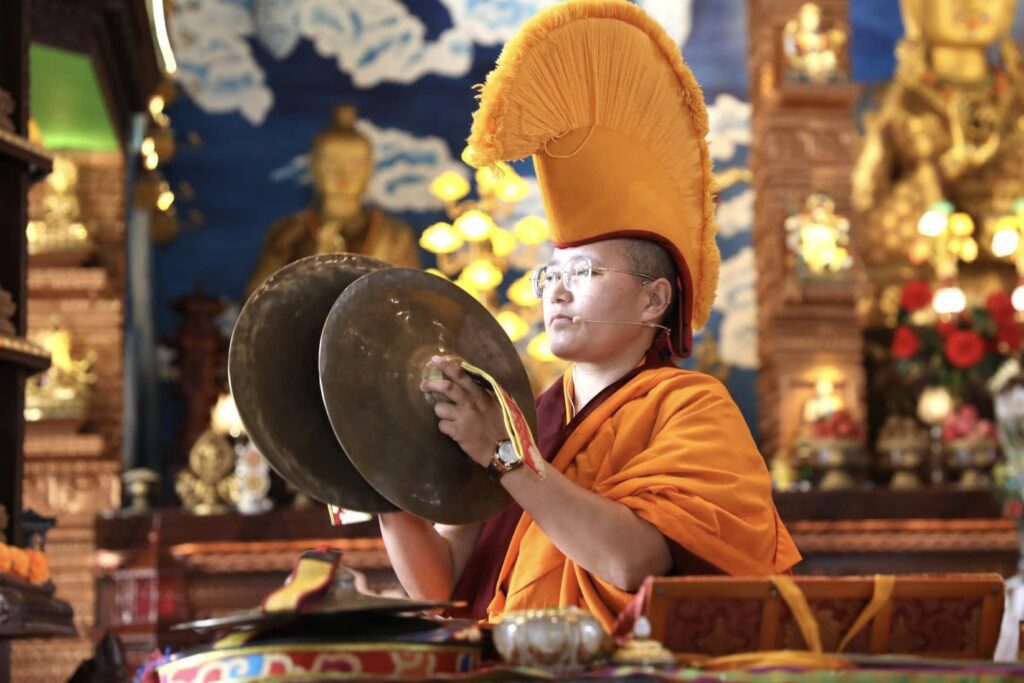
The 44-year-old umdzé, Jigme Sherab, not even five feet tall, is an energetic bundle of remarkable skill, command, and vocal control. Trained by His Holiness the 12th Gyalwang Drukpa and his father Zichen Bairo Rinpoche, she conducts us for 13-16 hours a day through the entire ritual. Throughout, she sings sublime solos, blended duets, and rousing ensemble prayers, and plays formidable cymbal solos. Afterward, she leads cham rehearsals into the night.
As the welling of sound from the lhargyal dissolves, Umdzé Sherab and Assistant Umdzé Konchok merge their voices chanting, “Ho ho ho hoy” to begin Jinbeb. During this ritual section, translated as “descent of blessings” or “blessing waves,” the chopön carries an incense bundle tied together with a white ceremonial scarf. With the long end of the scarf loosely draped over her left arm, she dances the alluring fragrance around the mandala pivoting in slow clockwise revolutions. She gracefully dips and raises the incense in spirals to permeate the space with scent─inviting the wisdom beings into the mandala. The mesmerizing chant moves in spirals as well. Lopön Tingdzin explains, “We are invoking Avalokiteshvara. We are saying, ‘Please come.’”
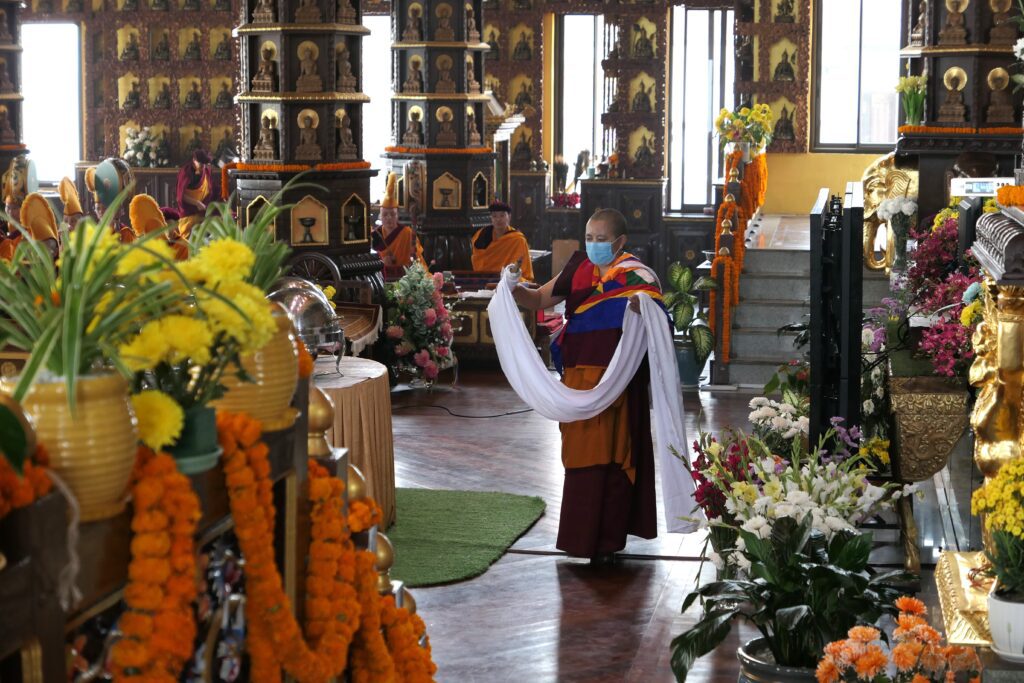
The third element woven into this exalted invocation is yabdar, or the summoning ritual. Here, Dorje Lopön and the chopön simultaneously toss five-colored streamers to invoke the five Wisdom Buddha energies.
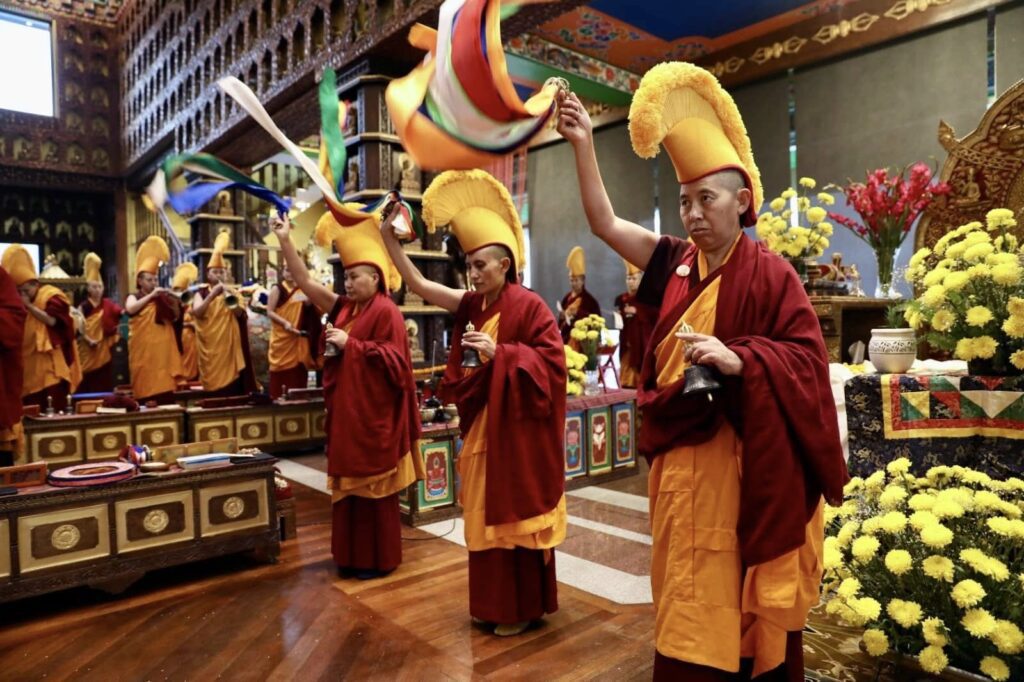
With the yabdar ritual, we summon all the buddhas, bodhisattvas, and wisdom holders and invite their blessings. During the ritual, the chopön pauses her incense dance. She stands facing the mandala as the umdzé leads the entire sangha (now wearing their tall, fringed, golden hats) in an anthem-like prayer to the commanding beat of the big drum. Each verse ends proclaiming, “Samaya Siddhi Hung,” a request to the wisdom beings to confirm our empowerment. As we sing these words, Dorje Lopön and the chopön simultaneously toss their five-colored streamers toward the mandala. At the same time, everyone gestures a mudra with their vajra and bell. Once we conclude the final verse of the hymn, another magnificent lhargyal ensues as the chopön completes her incense dance around the mandala. And with that, we beckon, invite, and implore the compassion of Avalokiteshvara into presence.
Kyerim – Generating the Deity
Without a pause, the umdzés commence a meditative duet. Accompanying their hour-long chant is a flow of complex mudra choreography integrating the vajra (ritual implement signifying compassion) and bell (symbolizing emptiness). Everyone performs this elaborate gesture dance that correlates with the chanted description of Avalokiteshvara. The liturgy and the narrative mudras support and reinforce the deity visualization (vase, front, and self) followed by offerings and praises. Every detail of the iconographic depiction of Avalokiteshvara and a multitude of offerings are described and gestured.
The visualization organically flows into a long period of mantra recitation, an integral part of Vajrayana deity practice. One intones the deity’s mantra while maintaining a specific visualization of the deity to transform one’s speech and mind and generate oneself as the deity. This process is conceived to transform ordinary perception into the pure view that this world is sacred realm.
Generation of the deity is repeated seven to eight times each day. But Lopön Tingdzin reminds me that during the drupchen, we are regenerating ourselves as Avalokiteshvara all the time. The energy builds as the week progresses with additional highlights. The sound offerings are more long-lasting and feature distinct instruments. For example, when the dungchen (long telescoping horn) players are directed to prolong their sound offering, their shoulders repeatedly heave up and down as they pump breath through the instruments. I marvel at this feat of endurance.
Cham and Ganachakra
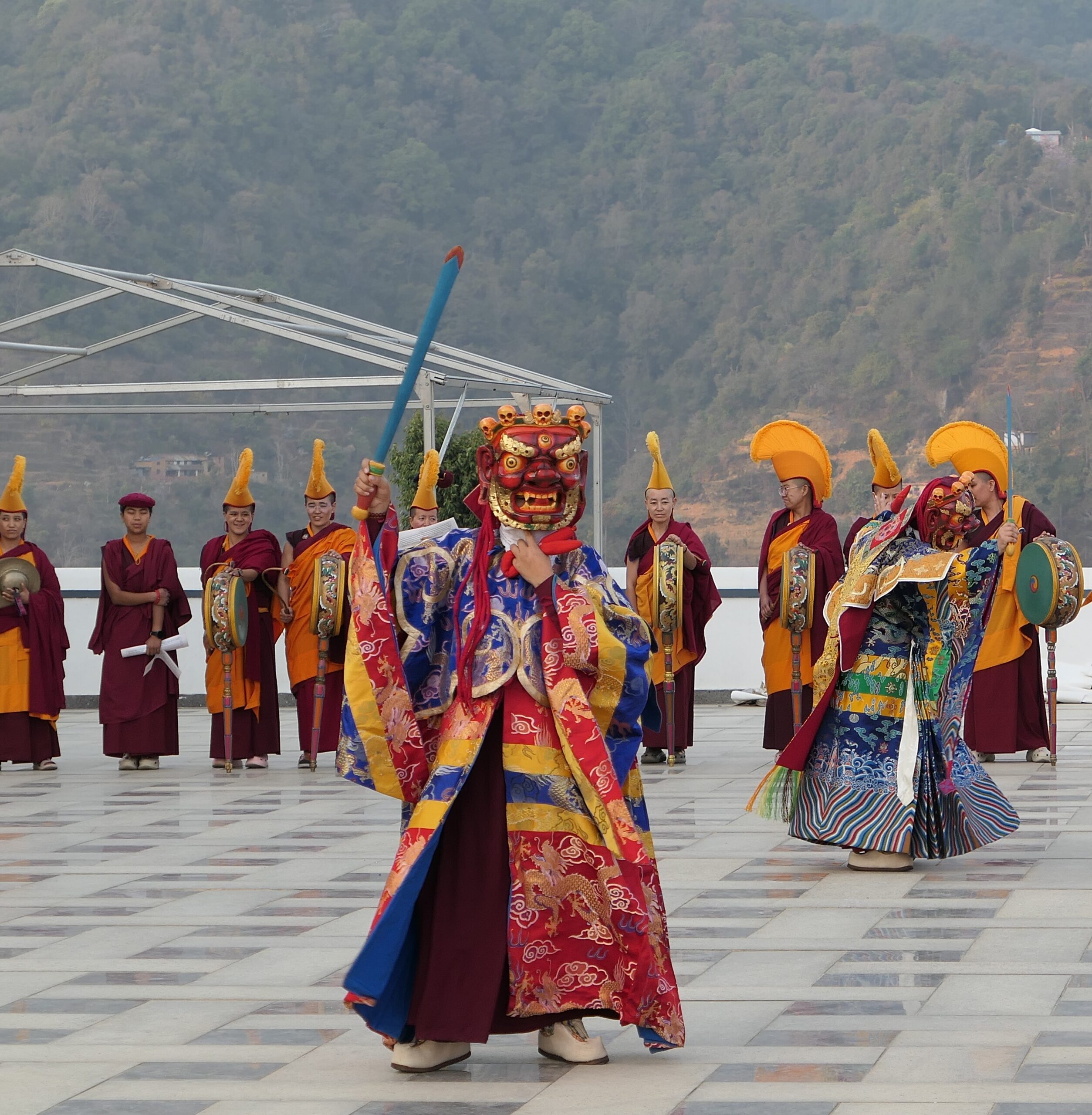
On days 6 through 8, Kunthub Cham is performed outside in the courtyard as evening descends. This is the dance of the deity Kunthub Gyalmo, whose name means “All-capable Queen.” She is the supremely wrathful protectress of drupchens; she dances with her retinue of three other fierce ones. In Kunthub Cham, the musicians precede the dancers out to the monastery courtyard playing the horns and cymbals. The dancers follow, wearing brocade silk robes and wrathful masks topped with a crown of five skulls. They move energetically — hopping and turning — wielding a sword to subdue and transform obstructors, enemies, and any hindrances to the dharma and the successful completion of the drupchen.
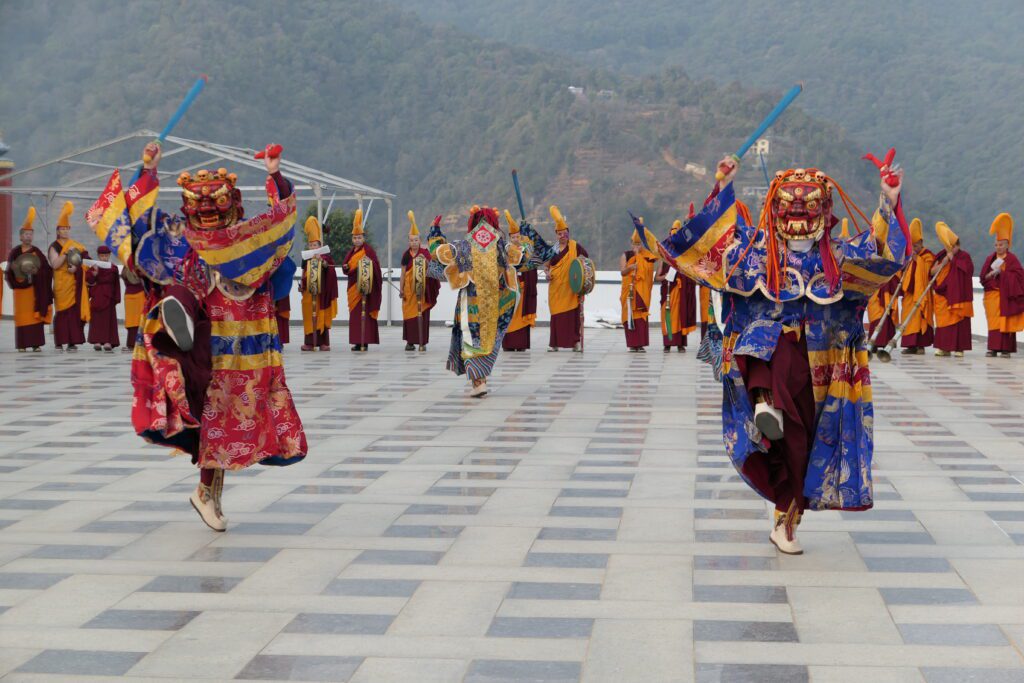
To the side of the dance, the lopöns sit and perform a parallel ritual of tossing black scarves at a linga (effigy). Lopön Tingdzin explains:
With this action, they invoke all the negative energy of Mara (obstacles hindering liberation) into the linga. After the cham, the Dorje Lopön ritually cuts, or liberates, the linga. We call this drolwa (liberation). But Mara not only refers to external harm doers; Mara also represents our own afflictive emotions of desire, anger, and ignorance.
In the drupchen, multiple ritual activities sometimes occur simultaneously. Here, the liberation ritual functions with Kunthub Cham to intensify the protective activity.
The seventh day includes a grand Ganachakra (Skt.) or Tsok (Tib.) — a great gathering, or feast offering. Today, the prayer hall is filled to capacity. Everyone is present, including the nuns on kitchen duty and the school-age novices. The morning yabdar ritual is amplified with more lopöns performing the action.
After morning tea break, the horns and cymbals escort sixteen dancers into the prayer hall encircling the mandala for Gar Cham. Costumed as celestial beings in pastel brocades and tantric bone ornaments (crown, earrings, necklace, chest plate, apron, armlets, bracelets) representing aspects of enlightened wisdom, they dance a flowing choreography that incorporates their bell and vajra. Based on a tantric teaching from Vajradhara (the primordial Buddha), this sacred expression of combined song and dance presents a plethora of bliss offerings, as described in the lyrics. In addition, the text expounds on wisdom, union, and emptiness. During a beautiful reprise, the dancers intone the syllable “Ah” three times as they stretch their arms and legs wide and make half turns while moving around the circle. The sound and movement perfectly embody easeful spaciousness. The performers chant the text from memory as they dance the hour-long cham.
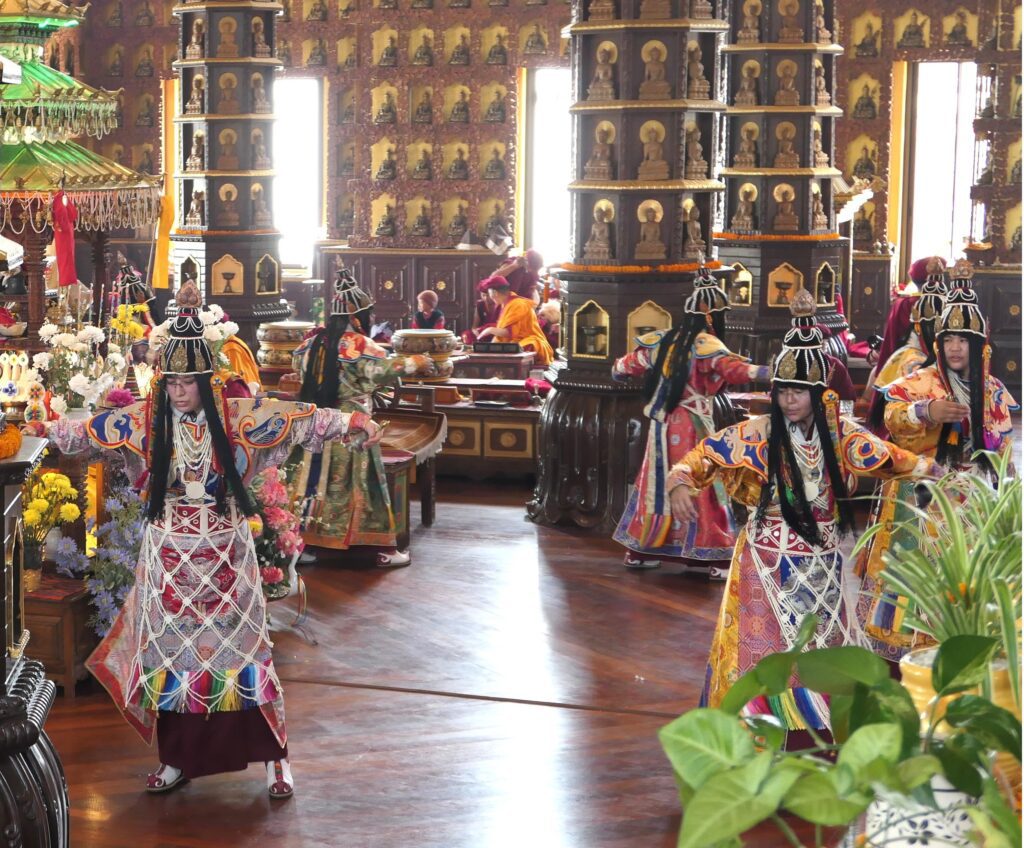
Lopön Tingdzin adds, “As a performer, one must be able to hold the energy of Avalokiteshvara while moving with the message of the text. The practice is so powerful that many performers in the past transformed into the rainbow body from having performed it.”
Ganachakra is a community offering and ritual feast, involving the practitioners and a host of visualized buddhas and bodhisattvas. The ritual is dedicated to accumulating merit, wisdom, and renewing commitment to spiritual harmony and devotion. With tables piled high with mountains of fruit, food, and flowers, this grand ganachakra is a vision of abundance. Lopön Tingdzin reframes it as not simply being about food, but as a practice of union. It is, in fact, a form of communion.
The offering of remainders, or leftovers, to less fortunate beings is accomplished with the ritual dance Lhak Cham. Lhakma refers to leftovers. We imagine less fortunate beings, sometimes called “guests of compassion,” as the meek and powerless, who arrive late without hope of receiving anything. Since every being deserves some part of the feast, Lhak Cham is danced while tossing five-colored streamers and holding plates of visualized leftovers that are then offered.
Fire Puja
On the eighth day of the drupchen, the jinsek (fire puja) takes place outdoors in the courtyard inside a temporary white tent. Jinsek is a practice of offering substances into a ritual fire, using the fire element to expedite a quick and powerful delivery of the offerings to the divine realm. For the Avalokiteshvara Drupchen, a small group of ritualists (the umdzé, assistant umdzé, Dorje Lopön, lekyi lopön, several assistants, and several instrument players) withdraw from the main hall to the outside tent and don white head bands. They perform a peaceful fire puja to burn away and purify all defilements and pacify negative conditions. The preparation requires gathering and offering twenty-one substances specified for the ritual such as kusha grass, grains, wood, oil, etc. For each substance, Dorje Lopön, who leads the ritual, recites a mantra purifying the substance before the assistants feed it into the fire.
Meanwhile, prayers continue in the main hall led by Jigme Choeky, one of several umdzés-in-training. (The nuns rotate the position of umdzé every three years.) After a designated period of mantra recitation, Jigme Choeky leads us in a half hour chant of “Om mani padme hum” using an exquisite, devotional melody. She tells me that the tune came from the Kathok masters who taught them this drupchen. Once the jinsek is completed, everyone receives a dot of the ash placed on the forehead and a white protection cord — both representing Avalokiteshvara’s blessings.
In the evening, after Queen Kunthub makes her cham appearance in the courtyard , we return to the prayer hall. Everyone stands on their seat cushions wearing their tall, fringed golden hats and offers a dazzling lhargyal. With the imminent conclusion of the drupchen, three lopöns then toss their multi-colored streamers.
Conclusion
On the ninth and final day, we proceed through a packed schedule that gathers speed like a dramatic drumroll.
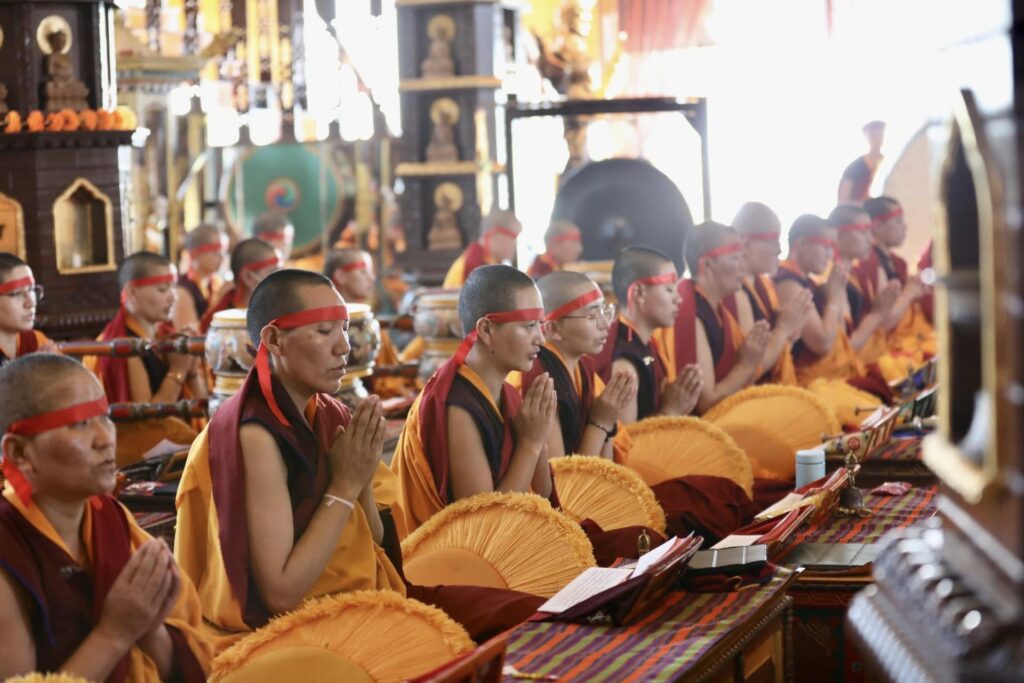
For the wang, or empowerment, the ritual leaders don dakini collars, wigs, and crowns as they and everyone else place a red ribbon around their forehead. The red bands represent blindfolds and symbolize the darkness of our ignorance and confusion. Through the initiation into this practice of Avalokiteshvara, we see into our true empty nature. After the wang, we remove the bands, symbolically removing the darkness of ignorance.
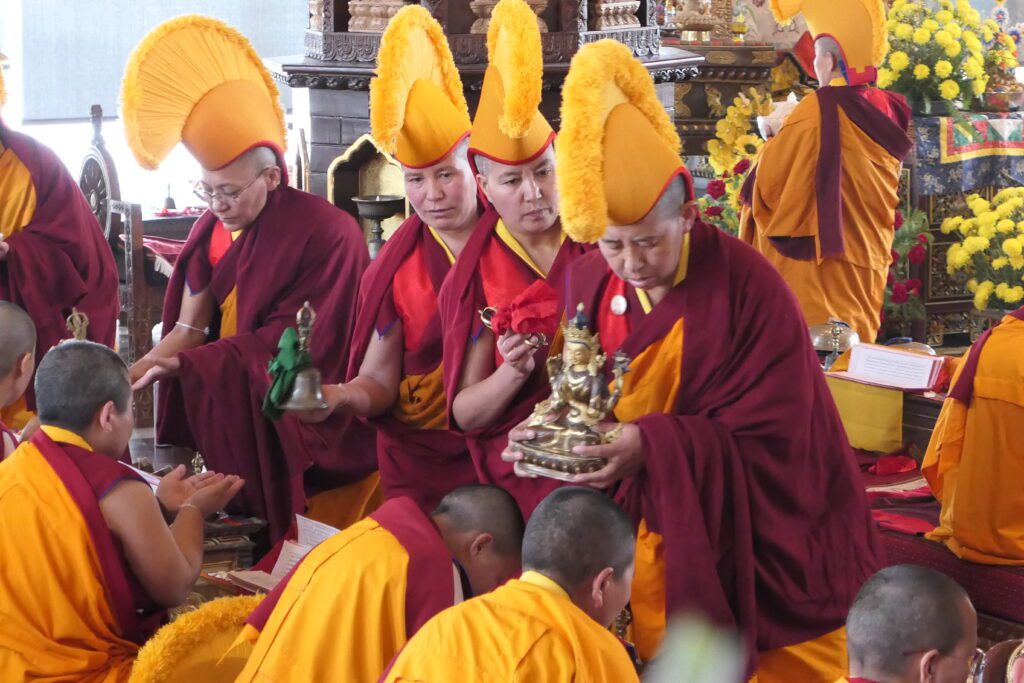
The nuns stand on their cushions wearing their formal golden hats for a final lhargyal. High-pitched whistles, wailing kangling (trumpets), and a giant gong initiate sounds of transformation. The conches, gyaling (clarinets), dungchen (long telescoping horns), cymbals, and bells join in the swell of vibrating splendor. The umdzé and assistant umdzé chant to the bass drum’s command, modulating their voices ever upward as the incense bundle is danced in spirals around the mandala. After Jinbeb, the shimmering ocean of sound again fills the hall as the yabdar streamers fly. The sound offering stretches on and on at Umdzé Sherab’s discretion. She massages the sound from her cymbals — opening the discs wide and then swaying them from side to side in a magnificent visual as well as acoustical display.
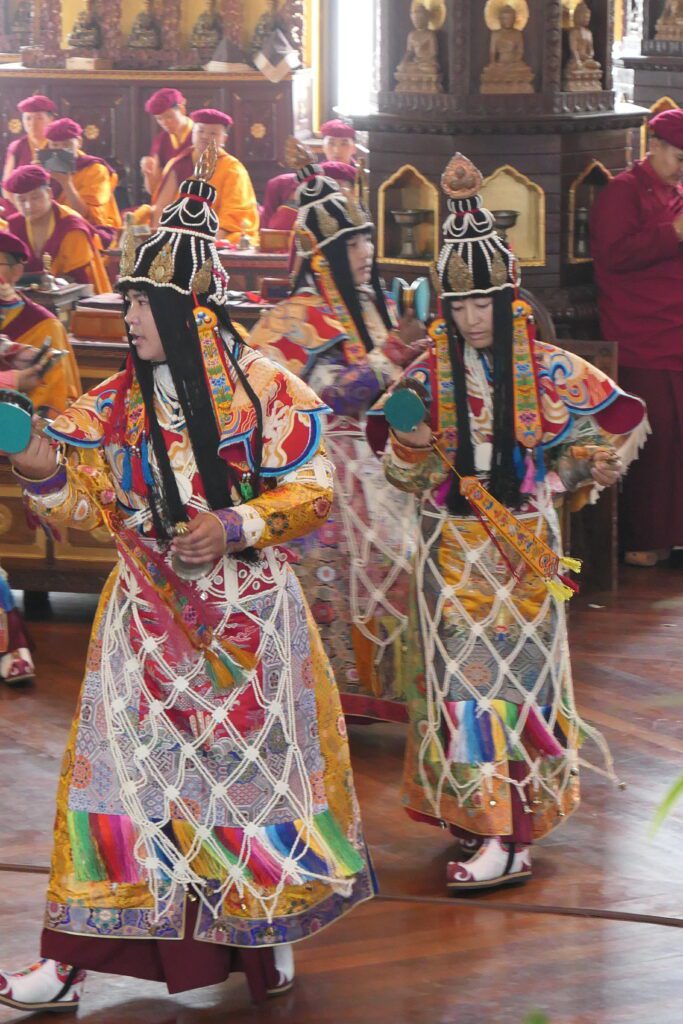
A new blast of horns ushers in sixteen dakinis. Their dynamic entrance — with a flourish of the leg every few steps — captures everyone’s attention. The room fills with lightness as they sing and dance “Kadrinchenma Cham,” a prayer of overwhelming gratitude. With open, flowing gestures, the dancers circle the mandala sounding their damarus and bells with precision. As soon as the dance is complete, the horns ring out a fanfare as a group of lopöns swoop in and collect the precious objects and substances adorning the mandala. With purposeful swiftness, they thread themselves through the prayer hall touching each object to every forehead and pouring sacred nectar into cupped palms to bestow their blessings and power upon all.
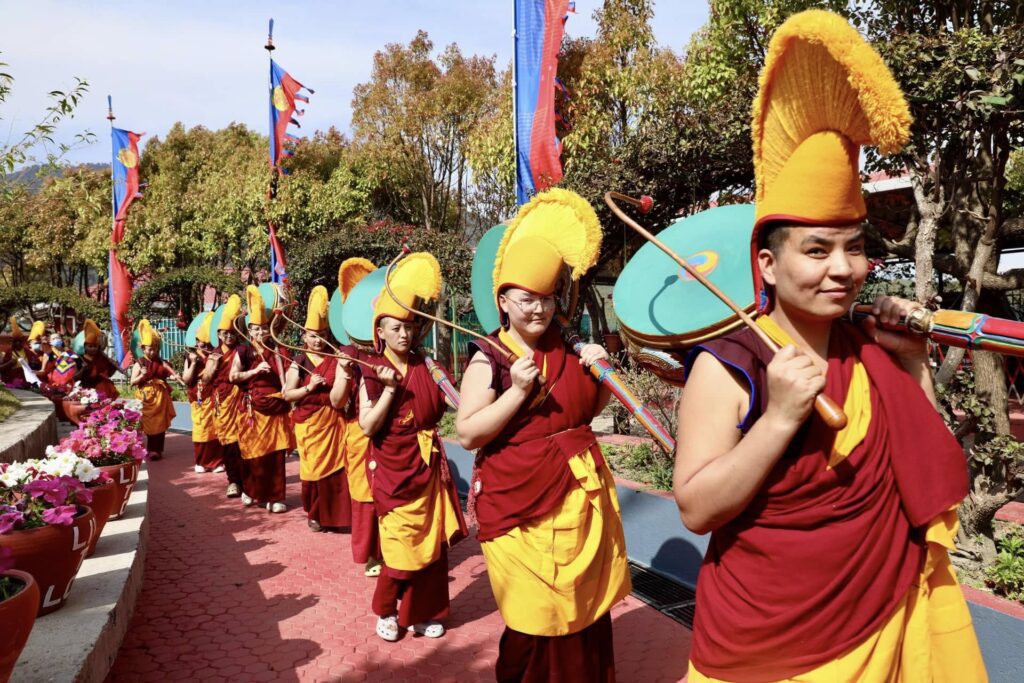
Another instrumental surge announces a sub-ritual — the procession to unlock the four gates, signifying the conclusion of the ritual retreat. One can hear the distant horns as we continue activities inside the temple. Then Dorje Lopön approaches the central shrine and dissolves the sand mandala with a quick cut through the design with her vajra. The grains of sand are promptly swept into a container and everyone gathers outdoors for a ceremonial procession. Led by the nuns playing their instruments, the entire community chants the six-syllable mantra as we file to the fountain, part of the crowning statuary on the upper expanse of the campus. We pour the sand into the flowing water, and with this action, the realm of Avalokiteshvara and its blessings merge with the rest of the world.
Upon returning to the courtyard, Umdzé Sherab leads us into the formation of a gakyil, meaning “Circle of Joy” or “Bliss Swirl.” Imagining that the deities are overjoyed with our accomplishment, we promenade into an endless spiral to generate and magnify auspicious wishes and blessings for all the practitioners involved in the drupchen. Somehow, the spiral unwinds itself and afterwards, we enter the temple and perform tashi, a final ritual to extend the auspicious wishes outward. Singing the stirring anthem, we toss handfuls of rice at the end of each verse — a symbol of offering the blessings of the drupchen to all beings.
We disperse from this communal endeavor of generating infinite compassion and re-enter the mundane world. Like a grain from the sand mandala circulating into the vast water system, I too can carry the realm of compassion to all I touch — remembering that we are all pure by nature: all forms are deity, all sounds are divine speech, and all thoughts are enlightened mind.
With sincere gratitude to Lopön Jigme Tingdzin Zangmo and the nuns of Druk Amitabha Mountain for generously opening the path into this mandala.