
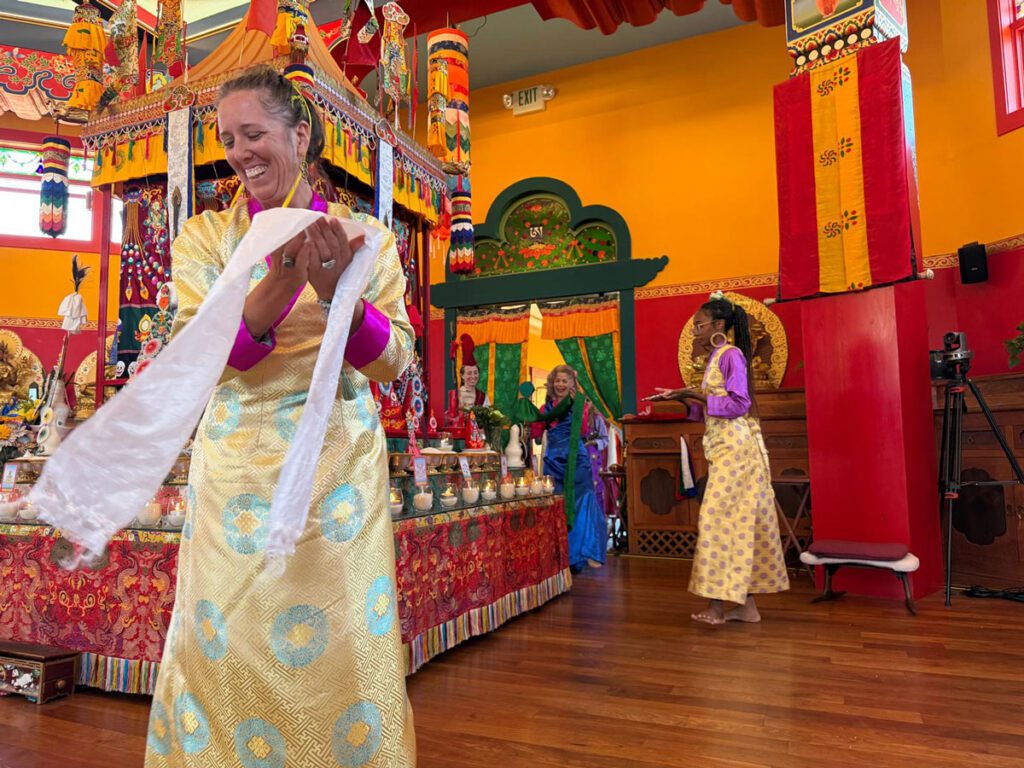
The dancers weave a graceful grapevine step, holding objects of enjoyment mounted on colorful ceremonial scarves — musical instruments, flowers, perfume. Wearing long, silk, Tibetan gowns in bright hues, we circle the ritual mandala in Tara Mandala’s prayer hall in a dance of offering. This sacred dance is part of an elaborate form of inner offering called “Chötreng,” or Garland of Offerings, performed during the “White Dakini Drupchen” a communal ritual of accomplishment. This evocation of generosity is sung by the chant master and congregation while everyone performs mudras (hand choreography) as they visualize offering and receiving sixteen splendid gifts. These are imagined to be multiplied and delivered by beautiful Wisdom Goddesses, and as such, we dance them.
“The offering of dance to enhance the energy around an occasion is a frequent part of Buddhist life in the Himalayas.”
“Everyone ─ gods and humans alike ─ love dance — just as they love flowers. No one can resist the beauty,” a Bhutanese cham master once told me as he explained why cham (sacred dance) is offered in so many rituals in Vajrayana Buddhism. He was describing the invocatory power of dance ─ the power to call divine qualities into presence. The offering of dance and offerings in general are made to cultivate generosity ─ one of six transcendent qualities, or paramitas. As the Nyingma master Thinley Norbu Rinpoche (1931 –2011) wrote in the liner notes to a cham instruction video he produced, “In the precious Vajrayana tradition, in which the offering of dance is practiced, everything is turned into virtue, including all movement.”
With the Vajrayana approach, we turn everything, including dance, into a magnificent offering and multiply it with the help of visualization. The offering of dance to enhance the energy around an occasion is a frequent part of Buddhist life in the Himalayas. It’s common to offer a ritual dance to welcome a lama, to invoke a deity’s presence during a ritual, or to boost the auspiciousness of an event. There are numerous examples of this all throughout the region.
Welcoming the Sacred
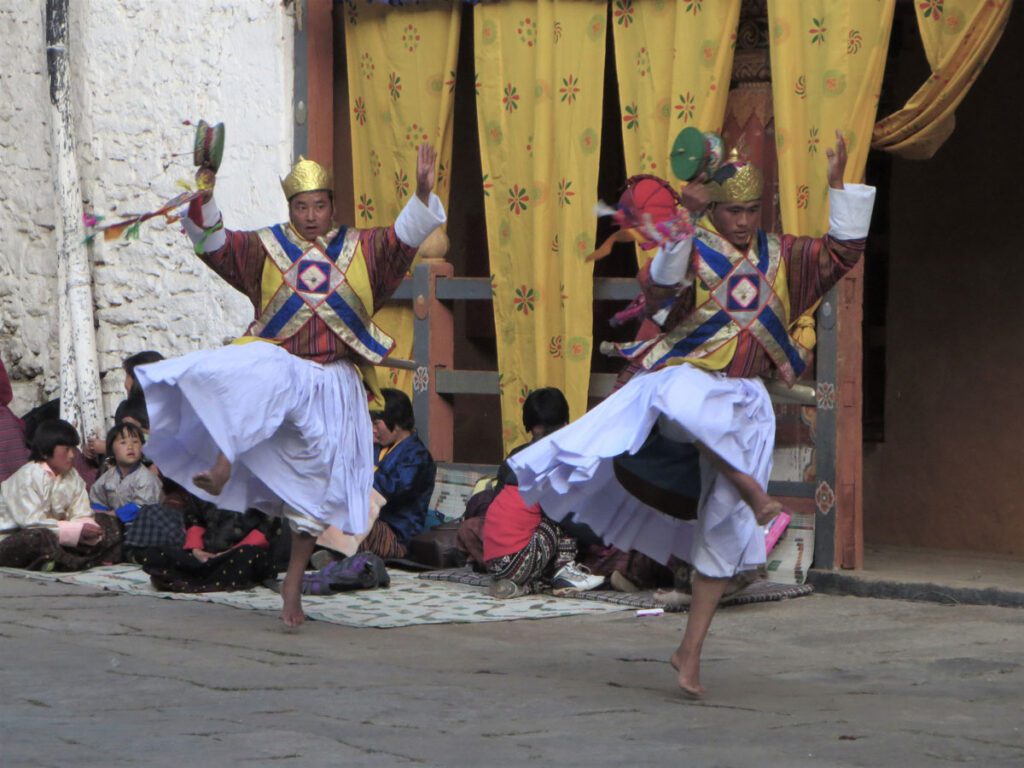
In Bhutan, lamas, kings, and VIPs are welcomed to celebrations, prayer events, and public teachings with an escort dance called “Jipai Pawo Cham” (Majestic Hero’s Dance). The dance is performed by two or four pawo (heroes) accompanying the honored guest in procession flanking him or her with joyful sound and movement ─ hopping and bounding with arms raised as they rattle their damaru drums. Upon arriving at the place of ceremonial reception, the dancers stand before the honored guest and perform the complete dance, including peaceful, semi-wrathful, and wrathful sections, as the serkyem, or ritual libation, is proffered.
Guru Padmasambhava, the Indian tantric master also known as Guru Rinpoche who brought Buddhism to Tibet and Bhutan in the mid-8th century, is invoked during many prayer gatherings and Tsechu (Guru Rinpoche Day) celebrations with a cham called “Zheng Zhik Pema.” The dancers are costumed as dakas and dakinis, beings who populate Guru Rinpoche’s Glorious Copper-Colored Mountain Paradise. In this dance-prayer, the dancers spin and jump, sounding their damarus to a declaimed liturgy that the Guru is said to have given to his foremost disciple, Yeshe Tsogyal, as a means of summoning him instantly.
During the daylong Tsechu Puja that honors Guru Padmasambhava with a full day’s program of sacred cham, the Guru is welcomed and then bid farewell with “Kadrinchenma Cham,” a dance expressing immense gratitude and the longing to see the Guru again and again. The dance-prayer, performed by dakinis, is part of the Tsechu Puja text, a treasure revealed by the great treasure revealer Chokyi Wangchuk (b.1212 – d.1270), and is performed at many Nyingma and Kagyu monasteries.
Dance to Increase Auspiciousness
Under the leadership of His Holiness the Twelfth Gyalwang Drukpa, the Drukpa Kagyu nuns and monks often pack their religious rituals with cham dances to augment the auspiciousness of the events. The Avalokiteshvara Drupchen, a nine-day ritual event dedicated to accomplishing the compassion of Avalokiteshvara, held at Druk Amitabha Mountain in Kathmandu, Nepal, is a case in point. The drupchen ritual, as performed by the Drukpa nuns, is suffused with highly dramatic and peaceful cham dances that were later added to the original ritual text by His Holiness and his father, the Nyingma master Zichen Bairo Rinpoche. This was done to enhance the auspiciousness of the ritual event. And the dances do exactly that. They raise energy by virtue of the preparation and anticipation around them, and afterwards, by the inclination to reflect upon them.
These same nuns and monks perform another genre of dance offering: gurma, or songs of realization. These verses celebrating spiritual life are sung while performing delightful, folksy choreographies. They are frequently presented during special occasions such as grand pujas, formal teachings, completion of long-term retreats, consecration of temples and stupas, and birth and death anniversaries of lineage masters. The Drukpa nuns include these as a regular offering during their feast day pujas twice a month.
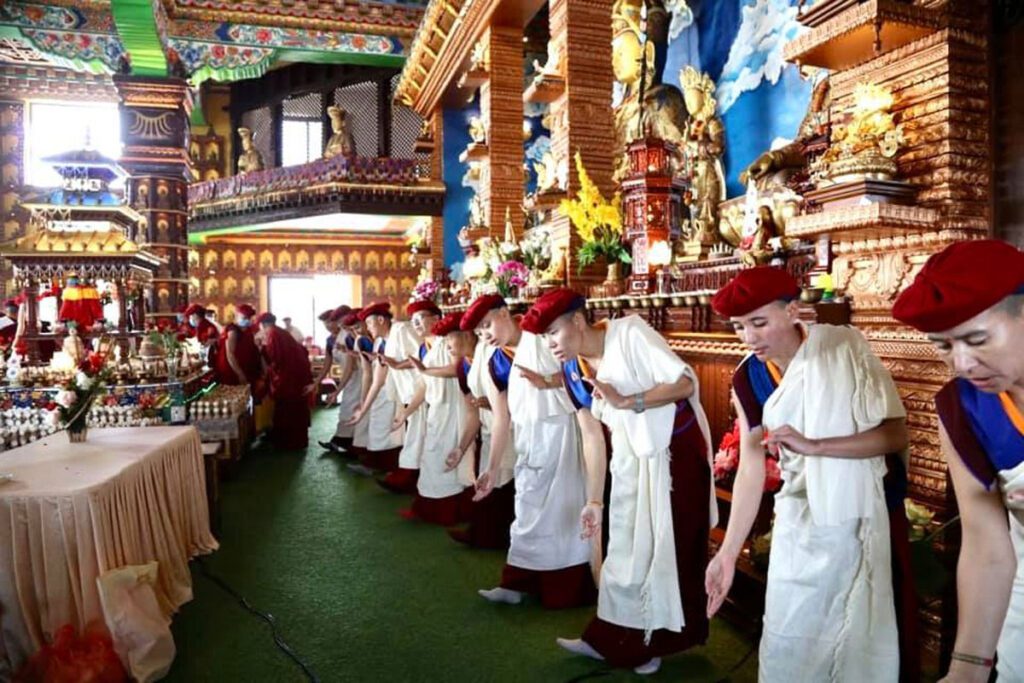
Sacred dance is also offered as an homage and welcome to monks and nuns when they come out of long-term retreat. The Drukpa Kagyu monks and nuns mentioned above perform a set of gurma dances to celebrate the return of retreatants. On this occasion, they dance wearing the repa sash — a white, cotton wrap — of accomplished tantric yoga practitioners draped over their monastic robes. In a similar gesture, the Karma Kagyu nuns of Karma Drubdey Nunnery in Trongsa, Bhutan, welcome their returning yoginis by performing “Khandro Denga Cham” (Cham of the Five Dakinis) as well as a gurma dance to a composition by the 11th century yogi and poet Milarepa.
In Himalayan Buddhism, prayers requesting that a spiritual teacher remain in this world are frequently composed and recited because the teacher’s longevity is considered the practitioners’ best opportunity for enlightenment. “Khandro Denga Cham,” also called “Khandro Tenzhug” (Long life Prayer to the Dakinis), is a component of longevity rituals meant to remove obstacles to the long life of great lamas, spiritual teachers, and all beings. The tradition holds that the dakinis and other celestial beings, meanwhile, desire these great teachers to move on to other buddha realms and summon them to leave this life. “Khandro Tenzhug” is performed as an offering to the dakinis to allay their call and prolong the life of the lama.
The Vedic Roots of Ritual Dance
Vedic wisdom and practice provided the foundations for many of the ritual conventions that were absorbed into early Buddhism and are still practiced today. The Vedas, a body of early sacred and philosophical Hindu texts composed during the period of about 1500–1200 BCE, attest to a pre-Buddhist cultural context in which music and dance were woven into the fabric of ritual practice, spiritual contemplation, and cosmic understanding. The Yajur Veda, a compilation of rituals, offering formulas, and mantras, contains references to the rhythmic recitation of mantras during rituals. Fast forward to Vajrayana deity yoga, systematized by Indian commentators circa 700 CE, where one still chants a recitation in Sanskrit (even in Tibetan texts) of making offerings while performing representative mudras, or hand gestures. This embodied activity is part of the visualization technique used to invite the deity into presence. Frequently the texts elaborate the visualization with celestial offering goddesses, who multiply and enhance the offering activity.
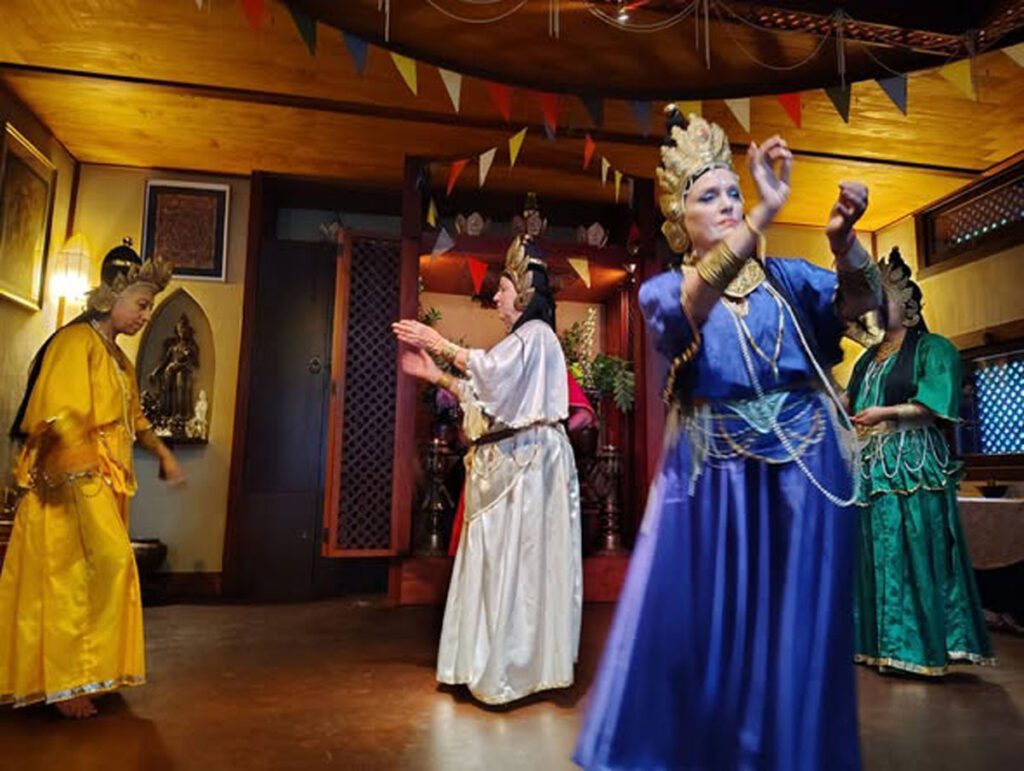
In the Kathmandu Valley of Nepal, where the Vajrayana Buddhism of the Newar (indigenous inhabitants of the valley) people has a distinctive South Asian flavor, these offering goddesses bestow their bliss offerings through a dance. The Newar Buddhist priestly caste of vajracharyas (non-monastic priests) have, for at least a thousand years, practiced a yogic dance tradition and ritual art called charya nritya, or “dance as a spiritual discipline.” Within this tradition, one performs “Sodasha Lasya” (sixteen expressions of grace) dancing as sixteen offering goddesses. The performer dance/mimes offering each item: strumming a lute, playing the flute, beating a drum, placing a mala garland around the deity’s neck, singing a song that vibrates outward from one’s lips, sending plumes of scent from an incense bundle wafting through the air, and more.
These same offering goddesses make a danced appearance in the Tibetan and Bhutanese traditions in a variety of dances called “Rigma Chudruk Cham” (Dance of the Sixteen Wisdom Goddesses). And the cham I performed called “Chötreng” falls into this category. Each lineage or locale has its own iteration of the cham, performed in beautiful dakini attire ─ a silk brocade robe with a set of bone ornaments, including an apron, armlets, wristlets, necklaces, a chest emblem, and crown. For centuries, the dance was performed by monks dressed as these female wisdom beings because monks populated the religious institutions where these dances were performed. It is only over the last twenty years that female practitioners have been invited to perform this and other dakini cham ─ both within nunneries in the Himalayas and at a handful of dharma centers in the East and West.
Dancing to Bestow Good Wishes
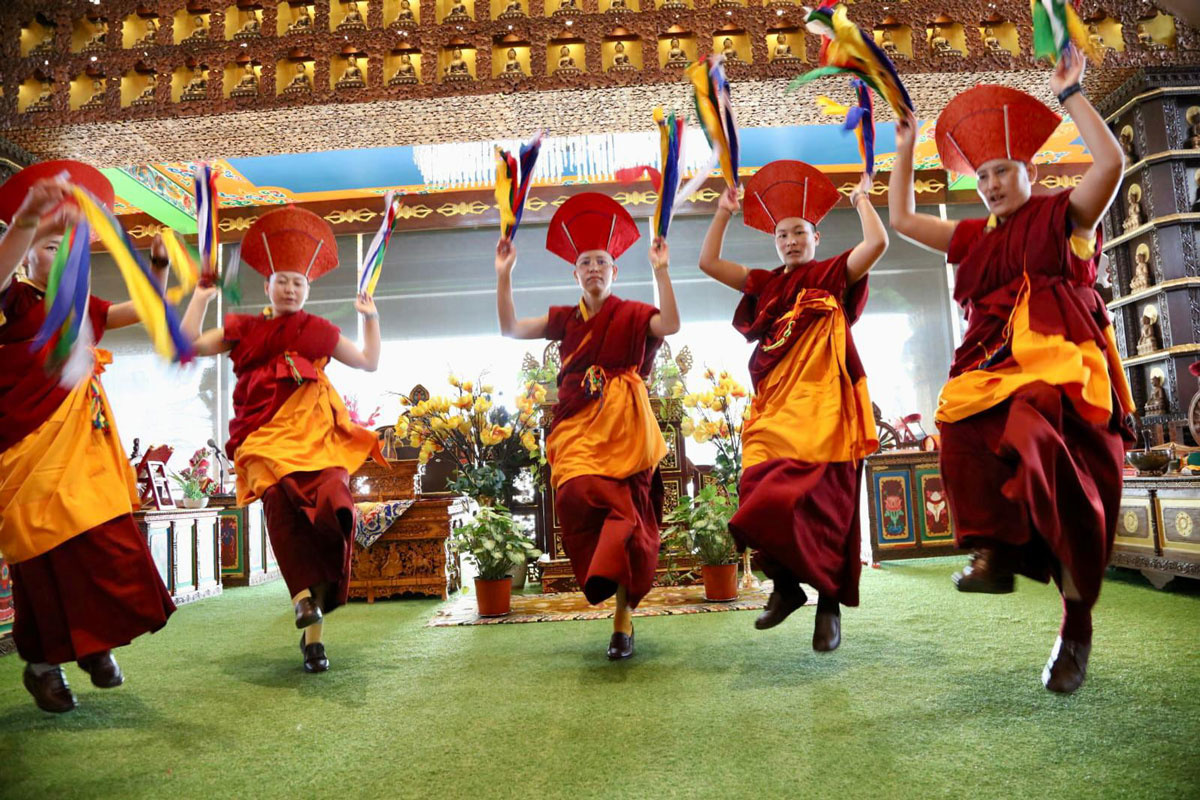
Finally, I return to the Drukpa Kagyu nuns and monks, who frequently conclude large ceremonial events with a gurma called “Tashi Cham” to dispense wishes of auspiciousness. Whereas it is customary for prayer services to conclude with a prayer extending tashi (auspiciousness) to all beings, the Drukpa monastics dance it with gusto. Holding in each hand a set of streamers in the five colors representing the five natural elements and five wisdoms, they move in a circle tossing their arms and streamers in spirals like giant paint brushes. With their stomping feet, they crush negativity and with their arms, they stir up joy while singing lyrics that describe the Five Wisdom Buddhas arriving from their five directions bringing good fortune to all sentient beings. Each verse resounds with the refrain, “How delightful and joyful!” This heartfelt tashi is delivered with body, speech, and mind ─ the three doors that all sacred dance integrates. Just as generosity is a transcendent virtue, so too are the dances that deliver its boundless goodness.