

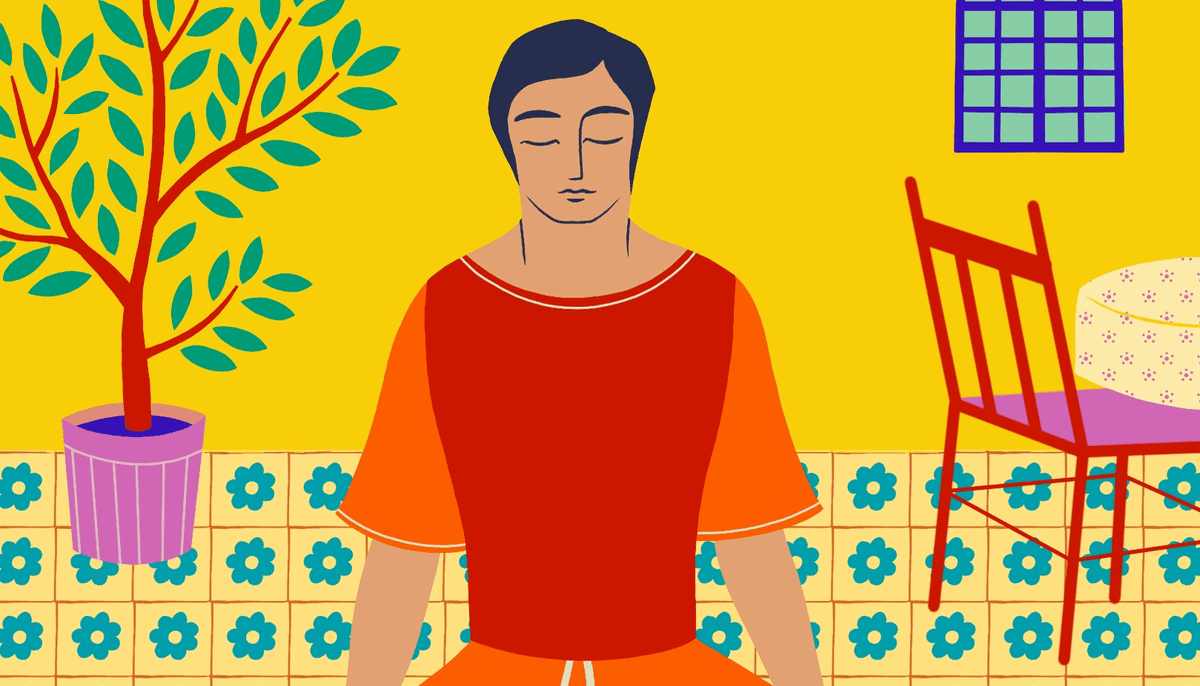
What is Shamatha?
Shamatha means “peaceful abiding” or “tranquility.” Also called mindfulness or concentration meditation, shamatha is an important introductory practice that leads to the practice of vipassana, or insight meditation.
The purpose of shamatha meditation is to stabilize the mind by cultivating a steady awareness of the object of meditation. The traditional practice of shamatha uses different kinds of supports or anchors for our practice. Eventually, this leads to practicing without supports and meditating on emptiness itself in an open awareness. For this particular practice, the instructions will be for shamatha meditation using the breath as the focus of our practice.
Shamatha meditation allows us to experience our mind as it is. When we practice shamatha, we are able to see that our mind is full of thoughts, some conducive to our happiness and further realization, and others not. It is not extraordinary that our minds are full of thoughts, and it is important to understand that it is natural to have so much happening in the mind.
Over time, practicing shamatha meditation calms our thoughts and emotions. We experience tranquility of mind and calmly abide with our thoughts as they are. Eventually, this leads to a decrease in unhelpful thoughts.
When we experience stable awareness, we are then ready to practice vipassana, in which we develop insight into what “mind” is by investigating the nature of thoughts themselves. In the Vajrayana tradition of Buddhism, the ultimate goal is to practice calm abiding and insight in union, which opens the door to realizing the true nature of mind.
Traditionally, shamatha practice is taught through instructions on the physical body and then looking at the meditation instructions themselves.
The Seven-Point Posture
The seven-point posture of Vairochana is an ancient set of posture points that are said to align the physical body with our energetic body. The posture has been practiced for thousands of years by Hindu and Buddhist yogis. The seven points are:

- Sit cross-legged.
- Hands in lap or on knees.
- Have a straight back.
- Widen the shoulders to open the heart center.
- Lower the chin.
- Open mouth slightly with the tongue resting on the roof of the mouth.
- Eyes open, gazing about four finger widths past the tip of nose.
A Body-Sensitive Posture
We all have different bodies and capabilities. It is important to adjust this demanding traditional posture to meet the needs of our own bodies, and not struggle to adapt our bodies to the posture. What is most important in terms of body posture is keeping the back and spine as straight as possible and remaining comfortable. So the seven points of a more body-sensitive posture could be:

- Sit on a cushion or a chair, stand, or lie down.
- Arrange your hands in any way that is comfortable.
- Hold your back as straight as possible.
- Keep your shoulders relaxed and chest open.
- Hold your head at whatever level is comfortable.
- Keep your lower jaw slightly open.
- Keep the eyes closed or open.
Instructions for Basic Breathing Meditation
There are many kinds of breathing meditations. Some have been written down, while others have only been transmitted orally from teacher to student. The following is a basic breathing meditation from the Vajrayana tradition:

- Adjust the body into a comfortable position, and start the practice by becoming aware of your breath. Notice the inhalation and exhalation.
- As you notice the breath, continue to let go of thoughts as they arise. Each time you are distracted by clinging to a thought, return to the breath. Keep doing this over and over again.
- Eventually, as you exhale, become aware of your breath escaping and dissolving into space. Experience the same thing with the inhalation.
- Slowing down, begin to allow your awareness to mix into open space with the breath on both the inhale and exhale.
- To deepen the practice, begin to hold the breath after the inhalation for a few seconds before exhaling. By doing this, you are splitting the breath into three parts: inhalation, holding, and exhalation. Keep doing this.
- As you inhale, begin to chant om to yourself. As you hold, chant ah. As you exhale, chant hung. Chanting these sacred syllables helps to further support awareness and is believed to purify our minds.
- As you continue with exhalation, relax more. Continue awareness practice, letting go of thoughts and returning to the breath. Do this for as long as you can.