

Right effort is the most underappreciated factor on the Buddha’s path to enlightenment. I’ve heard countless Buddhist teachers mention it and then hurry on to the more familiar and photogenic practices—mindfulness, concentration, maybe a few reverent mentions of wisdom. Right effort doesn’t have the glamor.
The Buddha taught an eightfold path that leads to enlightenment: right view, right intent, right speech, right action, right livelihood, right effort, right mindfulness, and right concentration.
Generally, these are grouped into three themes—wisdom (right view and intent), ethics (right speech, action, and livelihood), and meditation (right effort, mindfulness, and concentration). These days, within the meditation cluster, all the cultural prestige flows to mindfulness and concentration—the practices we associate with sitting on a cushion at particular, designated times, trying to achieve profound tranquility.
“The good news is that habits can change — not overnight, and not by force, but gradually.”
Right effort, by contrast, is a practice we try to sustain continuously, in the background, throughout the course of the day. It doesn’t clock out after twenty minutes. It doesn’t get a cushion. It’s just there, every waking hour, ensuring that we’re not lost in the kind of stressful, repetitive thoughts that make life’s challenges even harder to navigate.
The uncomfortable truth is that without right effort, the other two meditation practices don’t do what we hope. Mindfulness notices what’s happening—in our body, our feelings, our moods. Concentration stabilizes our attention while we’re actively doing a meditation practice. But right effort is the payoff. It’s what we carry with us off the cushion into the rest of our busy, information-saturated lives.
Right effort is how we maintain a kind of inner vigilance, watching as our minds wander into familiar anxieties, rehearsed arguments, the mildly disappointing text messages we’ve ruminated on several hundred times. Right effort is the way we escape those mental habits that lead nowhere, keeping us stuck and frustrated. It’s the moment I ask myself, “Is this line of thinking actually useful, or am I spending the next ten minutes relitigating something that ended three days ago?”
To find a road map for how to practice right effort, there’s no better place to turn for guidance than the Sabbasava Sutta, one of the most profound teachings in the Pali canon.
The sutta opens with a simple observation: Suffering proliferates when attention is applied in the wrong places. The Buddha offers examples of questions not to obsess about, such as “What was I in the past?” “What will I be in the future?” These translate, in our terms, into lying awake at midnight suddenly needing to evaluate every significant life decision since adolescence. I know this particular spiral well. It doesn’t tend to resolve anything. It does tend to last until 2 a.m.
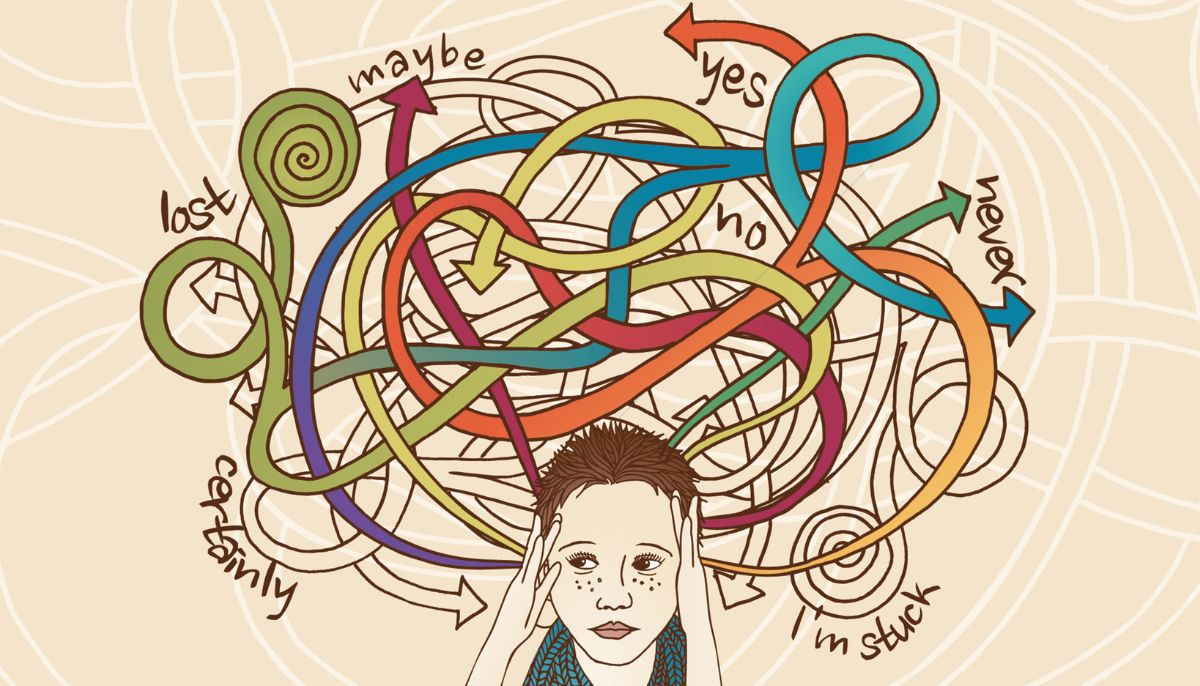
The problem isn’t reflection itself. It’s the way certain lines of thinking become self-reinforcing loops. The Buddha calls these “a thicket of views,” which I find to be a useful metaphor. A thicket is something you enter easily but exit with difficulty; each step forward makes turning back more complicated. Mentally, it begins innocuously enough. You might think, “That meeting felt off.” Then within a few minutes, you conclude that “Something is wrong” and that “This always happens.” While each new thought feels like progress, it usually leads to deeper entanglement.
The Sabbasava Sutta doesn’t just describe the problem of how the mind gets caught in unhelpful, proliferating thoughts; it also offers a practical tool kit that translates to daily life with surprising fidelity. This tool kit is composed of wise attention, restraint, avoiding, using the requisites, enduring, and removing and developing.
Wise attention focuses our mind on manageable, immediate concerns, for example, “What am I doing that’s making my life more stressful?” rather than “What does this mean about who I am as a person?” So, instead of pondering how I compare with others, I focus on the tightness in my chest, the restlessness in my body, the elevated quality of the breath. This practice alone often reduces stress, as it interrupts the layering of narrative on top of sensation.
Restraint means I stop feeding a series of thoughts and fixations once they’ve grabbed hold of my attention. Maybe you’re wondering what people thought of you during a recent Zoom meeting. There’s a real difference between acknowledging that uncertainty and constructing a multi-act drama around it. Likewise, when a message arrives saying only, “Can we talk?,” restraint is noticing how the mind begins its threat preparations and choosing not to fund the production.
Avoiding gets an unfair reputation, as though it were somehow cowardly when actually it can just be the wise thing to do. The Buddha’s original examples of things to avoid—dangerous animals, hazardous terrain—have their modern equivalents, such as certain social media posts or social dynamics that result in predictable agitation.
Using the requisites may be the most radical teaching in the sutta. The Buddha includes food, sleep, shelter, and health care as legitimate supports for the path, not distractions from it. I’ve noticed, with disappointing regularity, that my capacity for wise mental effort collapses when I’ve slept too little or spent too much time with a screen. A tired, under-resourced system interprets life’s neutral experiences as threatening. Right effort includes taking care of our bodies, so our minds aren’t being asked to perform sophisticated emotional regulation under difficult conditions.
Enduring is where things get genuinely transformative. Life delivers a steady stream of irritations: disappointing news, delayed meetings, uncomfortable interactions with loved ones, awkward exchanges with strangers. Without right effort, my mind can treat each of these as a problem requiring immediate self-protection, plus ongoing internal commentary.
Enduring means allowing discomfort to arise while refraining from the habitual response that would normally follow it. Contemporary psychology calls this Exposure and Response Prevention. Over time, discomfort can be experienced without catastrophe, and the intensity of reaction decreases. This is learning at the level of lived experience, not abstract understanding.
Removing and developing—interrupting patterns that have already taken hold and actively cultivating states that support clarity and stability—complete the picture. Generosity, kindness, appreciation: These aren’t abstract ethical ideals. They’re measurable shifts in emotional tone and physiological state. The mind is shaped by what it repeatedly attends to in much the same way the body is shaped by what it regularly consumes. Right effort is, among other things, the ongoing practice of choosing what the mind gets fed each day.
Right effort is not about wrestling the mind into submission. I’ve tried that over the years. It goes about as well as arguing with an Uber driver who’s taken a bizarre route; we arrive later, harried, and nothing is actually resolved.
Too much forcing creates its own tension. But too little and the same old mental loops just run the show indefinitely. The practice is calibration: Sometimes I redirect, sometimes I just let something pass, sometimes I simply refuse to keep engaging with a thought that’s been circling since Tuesday. It’s about skillful adjustment, not white-knuckling.
I always have to remember that my body doesn’t know the difference between what’s actually happening and what I’m imagining. I can be sitting completely still, not a thing wrong in the observable world, and spend twenty minutes catastrophizing about a work email. My nervous system will respond as though the catastrophe is real: cortisol, tension, shallow breathing, the works. What we dwell on has genuine physiological consequences.
So, the practice isn’t about what happens on the meditation cushion or during a retreat. It’s how we occupy our attention while waiting for a table at a crowded restaurant. Right effort either shows up, or it doesn’t.
In its simplest form, right effort is just an ongoing commitment not to make things worse than they already are. A lot of my suffering—and I’d wager a lot of yours too—isn’t built into the situation itself. It’s constructed, thought by thought, through habits I’ve been rehearsing for years.
The good news is that habits can change—not overnight, and not by force, but gradually. Through practice, the mind becomes less likely to head straight for the thicket every time something doesn’t go the way I wanted. That’s not nothing. It might, actually, be most of it.