
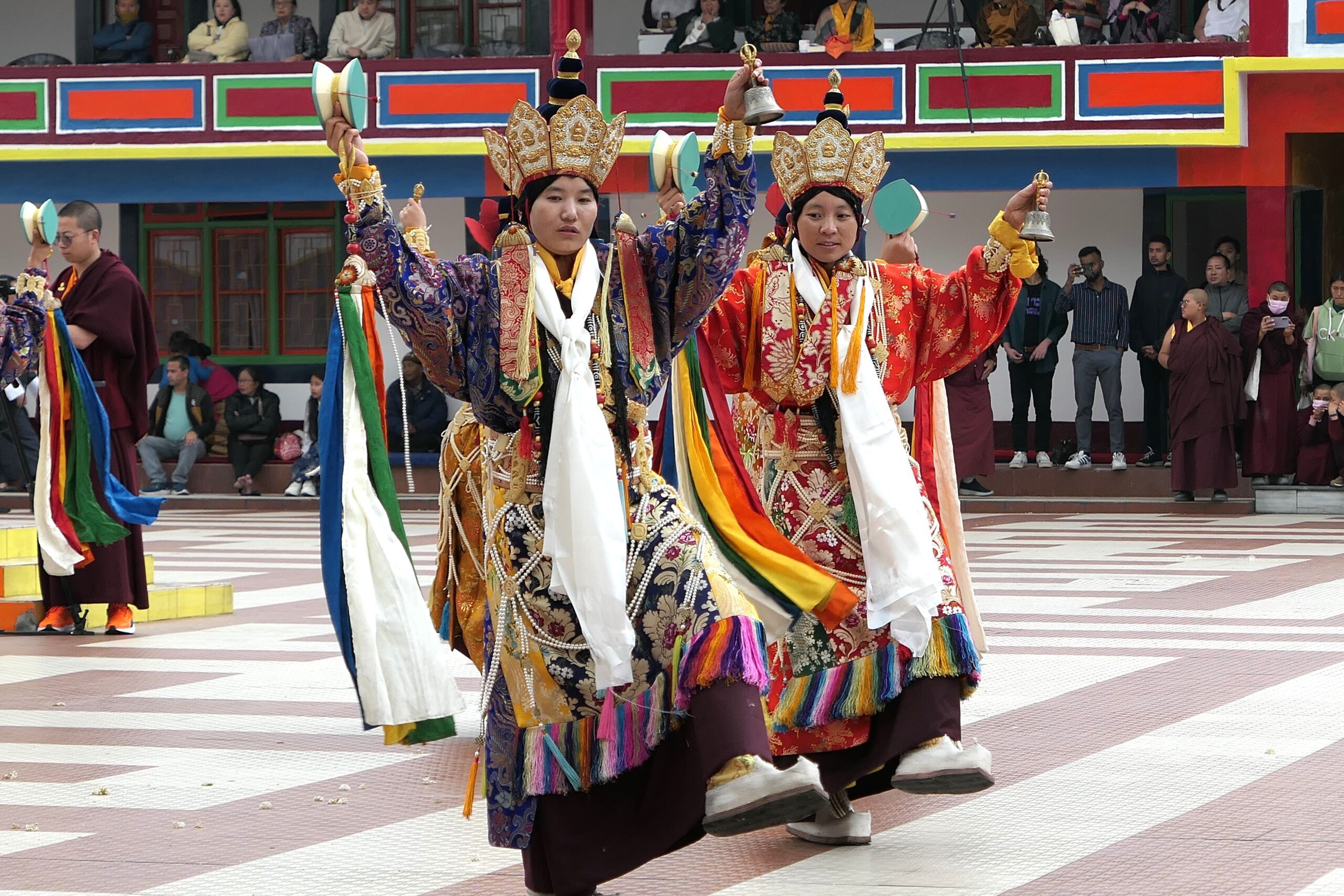

Early in my ongoing search for female practitioners of cham (Vajrayana Buddhist ritual dances), I was scrolling through a YouTube feed of cham videos. I clicked on some from the 2014 Kagyu Monlam in Bodh Gaya, India. Amid scenes from this grand Buddhist prayer festival, I homed in on a particular clip of a dakini cham. Dakini is translated as khandroma in Tibetan, meaning “sky-goer” or “she who dances through space,” and refers to wisdom beings who embody shunyata, or emptiness/spaciousness ─ an aspect of enlightenment characterized as feminine.
Performing cham and other high level ritual activities have customarily been off-limits to female practitioners; the performers could be monks or lay practitioners, but always men. I was used to seeing these dances performed by male monastics dressed as dakinis ─ in silk robes, bone aprons, and crowns ─ dancing the role of these female wisdom beings.
As the video continued, I heard distinctly female voices singing the accompanying liturgy to the dance. I wondered if this was the groundbreaking moment that I thought it might be. As I scrolled down the page, I noticed the caption below: An Historical First: Nuns Perform in Tsechu Lama dance. The description identified two nunneries involved, so I set to work arranging to visit them.
Thrangu Tara Abbey
My first outreach was in 2022 to the Thrangu Tara Abbey in Nepal. Four nuns from the nunnery were part of a select group assigned to perform a sacred cham dance for the 2014 Kagyu Monlam. This was a breakthrough moment for the nuns of this lineage, who had never before performed these sacred Vajrayana dances. The Kagyu Monlam is a major international prayer festival held annually in Bodh Gaya, India ─ at that time, presided over by His Holiness the 17th Karmapa, Ogyen Trinley Dorje, head of the Karma Kagyu school of Tibetan Buddhism. With roots dating back to 15th-century Tibet, it often attracts over 10,000 to attend Buddhist teachings and pray for peace, harmony, well-being, and happiness for the world. The selected nuns were turning a page in the history books in a very public way.
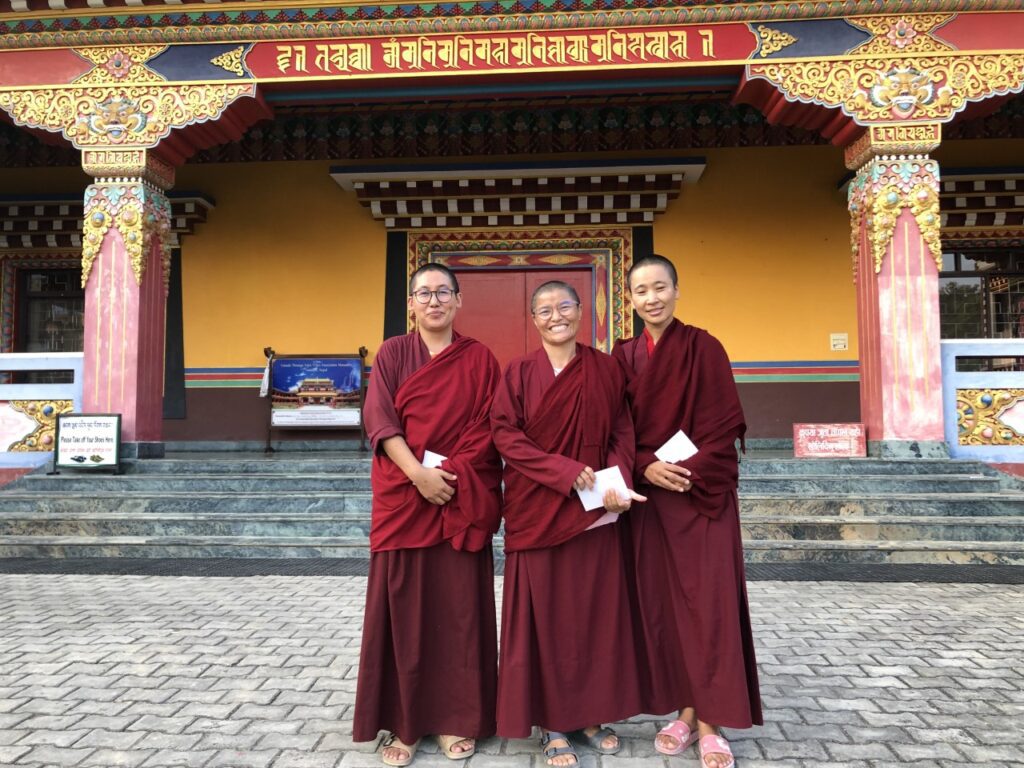
I learned that the Thrangu cohort of four dancers was currently split between two locations. Three nuns were at Lumbini Buddhist University (located in Lumbini, Nepal, the birthplace of Siddhartha Gautama Buddha) pursuing higher studies, and one nun was at the main abbey in Kathmandu. I decided to visit both sites.
The nuns all contributed energetically to recounting the details of their story.
The congenial and confident university students ─ Pasang Drolma Lama, Karma Drolma Gurung, and Jamyang Lhamo ─ were originally from Nubri and Manang in the high Himalayan region of Nepal, having joined Thrangu Abbey at ages thirteen, fourteen, and fifteen, respectively. Now in their mid-thirties, they are boundary-breakers in more ways than one: no one in their home villages had a university degree when they were growing up.
A week later in Kathmandu, I met the fourth dancer, Sherab Sangmo, along with Chokyi Lamo, a nun who did not dance at the Kagyu Monlam, but had participated in other Thrangu dance activities and was a very capable spokesperson. She recalled how Thrangu Nunnery had received a letter from the Karmapa’s office requesting that four nuns perform a cham for the Monlam. Eight more nuns from Kyegue Dhagmo Chosling Nunnery in Sikkim would perform together with them. Because Kagyu nuns had never performed the cham dances prior to this occasion, the Thrangu nuns understood the Karmapa’s request to be part of his efforts to promote gender equality and train nuns in ritual practices that had formerly been off limits to female practitioners.
His Holiness had previously opened the position of umzey (chant master) and the activity of debate to female practitioners; this seemed to follow the pattern. In fact, when I checked with Khenpo Karma Tenkyong, a spokesperson from the Karmapa’s office, he confirmed that indeed, this was His Holiness’ motivation and added that the aspiration was that cham performance would be an ongoing practice for female practitioners.
The nuns were asked to perform “Kadrinchenma Cham” and sing the accompanying liturgy. Because the dance had always been performed by monks, the nuns would have to learn it from monk cham masters (champon). The four nuns from Thrangu and eight nuns from Kyegue Dhagmo Chosling traveled to Palchen Choling Monastery in Sikkim to train with the monks for 20 days, learning the cham and the chanted prayer. After this initial period of training, the nuns were assigned their specific roles ─ four would sing and eight would dance.
I asked the Thrangu group why they were chosen from all the nuns at the abbey for this exceptional opportunity. They responded that, at their abbey and abroad, they had been long performing a dharma dance of the Mandala Dance of the 21 Taras, created by Buddhist teacher and dancer Prema Dasara. They were known to be at ease with performing in public.
Pasang Drolma admitted to feeling nervous at the immensity of performing at the Monlam. But the nuns’ confidence was bolstered in advance of the event by performing for Thrangu Rinpoche, and also for the Karmapa and all the monk performers during the chamjug (formal dance rehearsal). After the chamjug, the Karmapa gave the nuns his blessing and the empowerment to practice the cham. Pasang Drolma recalled that His Holiness did not just give them the usual blessing by bestowing a khata (white ceremonial scarf) but instead gave them a “hand blessing” by placing his hands directly on their heads ─ a particularly meaningful gesture.
“Kadrinchenma Cham” is performed by eight offering goddesses in two separate episodes during the larger “Tsechu Cham.” This day-long composition of sacred cham dances is held in Vajrayana communities across the Himalayas to honor Padmasambhava (Guru Rinpoche), the tantric master who brought Buddhism from India to the Himalayan region in the mid-eighth century. Tsechu means “tenth day” and refers to Padmasambhava’s departing promise to his followers. As Guru Rinpoche was leaving Tibet to bring the Buddhist teachings to the land of the untamed rakshasas (thought to be Sri Lanka), he vowed to return on the 10th day of each lunar calendar month to dispel the suffering of the people. Hence, tsechu is celebrated throughout the Himalayan region, drawing huge public attendance to view the sacred cham and receive the blessings they convey.
The event includes a grand procession in which usually a senior lama takes the role of Guru Padmasambhava. For this Monlam, His Holiness the Karmapa fulfilled this role. The Guru (Padmasambhava) is paraded under a billowing golden parasol in the company of his eight manifestations and an extensive entourage (including the dakini dancers) to a central throne. From there, he views and receives a series of dance and musical offerings from various celestial beings.
Kadrinchenma can be translated as “great, or boundless, kindness.” In this context, the prayer expresses immense gratitude to Guru Padmasambhava, one’s root lama, Yeshe Tsogyal, and a whole list of honored wisdom beings for their great kindness. The cham is both an offering of gratitude and a supplication for blessings. The dance is first performed just after this opening procession. Once the Guru and party have completed their circumambulation of the courtyard and are seated, eight dancers dressed as dakinis/goddesses form a semicircle facing the great Guru. Over their silk brocade robes, they wear elaborate bone ornaments ─ belt, apron, necklaces, bracelets, earrings ─ and a five-lobed crown. These accessories signify their embodiment of the six paramitas, or transcendent perfections: the necklace represents generosity; armlets and bracelets are morality; earrings indicate patience; head ornaments signify joyful effort; belt and apron illustrate concentration; and the female practitioner’s body represents wisdom. They dance with a damaru (small drum representing compassion) in their right hand. The drum is decorated with a tail of silk streamers in the five elemental colors ─ blue, gold, red, green, and white. In their left hand, they hold a drilbu (bell, signifying emptiness). Throughout the choreography, they sound the two instruments to animate these two qualities that give rise to enlightened awareness.
The second performance of the cham takes place at the end of the “Tsechu Cham,” following the exit procession. Once everyone has departed (into the temple), the goddesses face the temple and dance a final entreaty for lasting blessings praying to “see the Guru’s face again and again” before their own exit.
The “Tsechu Cham” is a terma or “treasure” revealed by the great 13th-century tertön (treasure revealer) Guru Chokyi Wangchuk, popularly known as Guru Chowang (1212–70). Terma are understood to be teachings of Padmasambhava hidden either by himself or his foremost disciple Yeshe Tsogyal throughout the Himalayan landscape. They may take the form of scriptures, artifacts, relics, or may appear as visions or dreams directly in the mind-stream of chosen treasure revealers to be rediscovered in the future ─ when the people and the times would be receptive to spiritual renewal.
The extensive “Tsechu Cham” is a central feature of the “Lama Sangdu” terma ─ a worship and practice of Padmasambhava performed during Tsechu time. An oral tradition tells of Guru Chowang’s visionary visit to Padmasambhava’s Copper-Colored Mountain Paradise (Zangdok Palri), where he saw pawo (heroes) and pamo (heroines, dakinis) performing a dance. When he awoke, he recollected the dance movements from his vision and arranged the choreography and liturgy for the “Tsechu Cham.” Many treasure dances (tercham) have been revealed in this manner.
The observance of Tsechu and the associated cham dances were originally a Nyingma tradition (the oldest of the four main schools of Tibetan Buddhism). According to the Karmapa’s sources, this current practice came to the Karma Kagyu lineage through the Eighth Tai Situpa, Chokyi Jungne (1700–74), who learned the dance through his close ties with the Nyingma monastery of Bentsang in Netong. He then instituted the dance at his own seat at Palpung Monastery in eastern Tibet. Later, because of the close relationship between the Karmapa and Tai Situ incarnations, the 14th Karmapa Tekchok Dorje (1798–1868) established this cham at his monastic seat at Tsurphu Monastery. The ritual dance practice was maintained as part of Tsurphu’s tradition until 1959, when the 16th Karmapa Rangjung Rigpe Dorje (1924–81) escaped to India and brought the dance with him. He instituted the “Tsechu Cham” at his seat-in-exile Rumtek Monastery in Sikkim. Today the practice is thriving at Rumtek and Tsurphu as well as other Nyingma and Kagyu monasteries.
Pasang Drolma reported that the Karmapa was very happy with the nuns’ performance. As he helped to remove their dakini crowns afterward, he asked if they felt tired and handed them tissues to wipe the sweat from their faces. His Holiness understood the energy involved as he was performing three major cham for the event as well.
As His Holiness and the nuns made history and reinforced the “Tsechu Cham” tradition with the introduction of female performers, the Karmapa underscored the importance of the cham’s origins and meaning with an earnest teaching to the attendees. Thrangu nun Sherab Sangmo shared her takeaways from the Karmapa’s teaching: “The cham dancer empties herself of ordinary identity and transforms her body, speech, and mind into an expression of the deity’s divine activities. Through her cham performance, she conveys that experience to the viewers thereby purifying and liberating them through seeing the dance.” In this way, the cham dances are a display of “emptiness” — the infinite potential for becoming. Sherab Sangmo summed up the experience concluding, “Cham is a key to understanding emptiness.”
The Thrangu nuns have not had the occasion to perform the cham again as the Tsechu Puja is neither performed at their nunnery nor at any nearby monastery associated with them. But they assured me that the nuns of Kyegue Dhagmo Chosling Nunnery in Sikkim continue to perform “Kadrinchenma Cham” at Palchen Choling Monastery for Tsechu Puja and gave me a contact to seek out there.
Karma Drubdey Nunnery
Through a chance conversation, I learned that the nuns of Karma Drubdey Nunnery in central Bhutan had also performed at the 2014 Kagyu Monlam. I was aware that the Karma Drubdey nuns were known for their dance practices, but I had not guessed how extensive they were. At the historic Monlam, two distinct dakini cham were performed by the Karma Kagyu nuns: “Kadrinchenma Cham” and “Pamo Cham” (Dance of the Heroines). The Karma Drubdey nuns from Bhutan danced “Pamo Cham”. In 2023, I arranged to visit the nunnery and learn about that experience and the other dances these capable nuns weave into their tapestry of practices.
Karma Drubdey Nunnery, established in 1968 by the great scholar, teacher, and yogi Khenpo Tsultrim Gyamtsho Rinpoche, sits on a steep hillside above the village of Kuenga Rabten in the Trongsa District of Bhutan. After the Communist Chinese takeover of Tibet, Khenpo Rinpoche together with thirteen nuns escaped and stayed at the Kuenga Rabten winter palace at the invitation of Her Majesty Queen Ashi Phuntsho Choden Wangchuck (wife of the second King of Bhutan). One day, Khenpo Rinpoche was found meditating in a small cave above Kuenga Rabten Palace. This became his special meditation spot and, later, the site of the nunnery’s main temple.
Today, with a total of about 180 nuns ranging in age from six to eighty years old, Karma Drubdey is the only Karma Kagyu nunnery in Bhutan. The nuns regularly attend teachings with other monastics of the lineage and have occasional interchange with their sister nunnery Tek Chok Ling in Kathmandu, also founded by Khenpo Tsultrim Gyamtsho Rinpoche. In the main temple, a notable (and unusual for Bhutan) wall mural depicts the Kagyu lineage masters: the 16th Karmapa in the center, the mahasiddha (great yogi) founders above, and the Karmapa incarnations below.
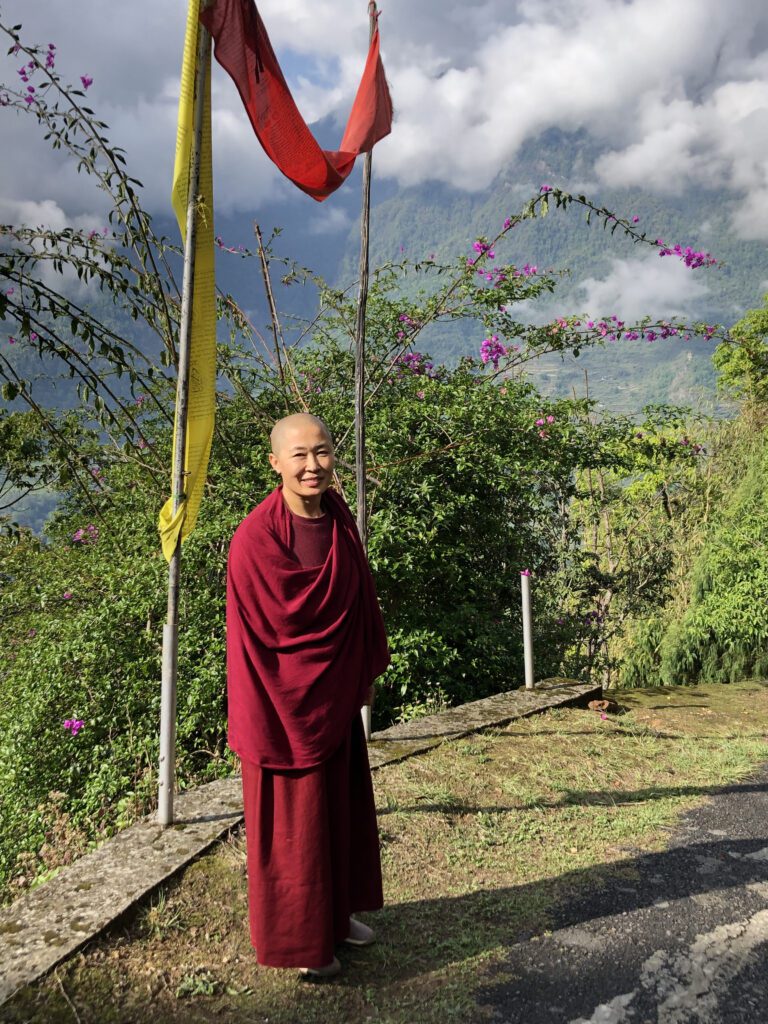
I was introduced to Lopön Chophal Palmo, who grew up in a nearby community and has been a Karma Drubdey nun since the age of eighteen. Having studied for thirteen years at Dolma Ling Institute, a center of higher learning for Tibetan Buddhist nuns in Dharamsala, she is a lopön (teacher) for the nunnery’s shedra (monastic secondary school). Lopön Chophal Palmo gathered the nun dancers and facilitated my visit and discussion with them.
Back in 2013, the nunnery was informed that His Holiness the Karmapa wanted five nuns to learn and perform “Pamo Cham” for the 2014 Kagyu Monlam. “Pamo Cham” requires five dancers as it is a dance of the dakinis of the Five Wisdom or Buddha Families. These are five aspects of enlightened mind identified by color, characteristics, and activities ─ also associated with the five natural elements. The dancers reported that they were chosen according to their height and for their melodious voices as “Pamo Cham” alternates between dancing and singing sections. It is possible that Karma Drubdey was singled out to perform this cham because singing is so integral to its performance and to this nunnery’s practices. The nuns of Karma Drubdey are very accomplished, strong singers. This is likely because of Khenpo Tsultrim Gyamtso Rinpoche’s renowned teaching methods, emphasizing the composing and singing of spontaneous songs of realization.
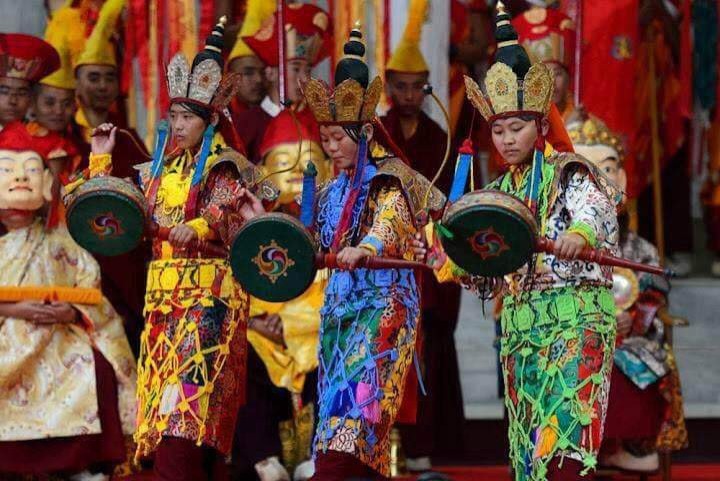
Like the Thrangu nuns, the Karma Drubdey nun dancers needed to learn the cham from Kagyu monks. Thus, six months prior to the Monlam, the nuns traveled to Rumtek Monastery in Sikkim. The journey took three days traveling by bus and taxi. Once there, the nuns stayed for ten days learning the dance from four of the senior monk dancers and the liturgy from two umzeys. Afterwards, one of the umzeys came to the nunnery to help them review the cham. They continued to practice every evening until the Monlam. Upon arriving in Bodh Gaya, the nuns participated in the formal rehearsal, and the Karmapa gave his approval.
The nuns shared that the Karmapa and the Discipline Master had helped dress them in their costumes. (With many delicate adornments that need to be securely tied into place, these costumes always require assistance to put on.) His Holiness then gave all the performers a protection string just before the performance. At first, the nuns felt nervous about performing in the overwhelming venue for the vast audience. But soon, they gained a new sense of confidence and realized their good fortune to participate in this very special moment.
As part of the larger “Tsechu Cham,” “Pamo Cham” is one of the offerings presented to the Guru. The cham is derived from descriptions in the Tsechu liturgy depicting the pamo, or spiritual heroines, as singing and dancing on gossamer rays of rainbow light surrounding the celestial palace of Guru Rinpoche. The five pamo enter the dance ground carrying a large hand-drum in their left hand and a hooked drumstick in their right. The drum represents wisdom and the drumstick signifies compassion. Each beat symbolically unites wisdom with compassion, in a liberative offering of sound.
Again, these nuns have not had the opportunity to continue performing “Pamo Cham” as they do not hold a Tsechu Puja at the nunnery, but I was reassured that the nuns of Kyegue Dhagmo Chosling now perform this cham for the Tsechu Puja at Palchen Choling Monastery.
The pamo dancers also shared some of their other singing and dance practices with me. Because of Khenpo Rinpoche’s profound dedication to, and love of, gurma (spiritual songs of realization), he requested, back in 1998, that the nuns create a dance to one of Milarepa’s gurma and another to the sutra of “Arya Tara Who Protects from the Sixteen Fears.” During a year-long retreat, Karma Drubdey nun Ani Kheychok composed the melody for Milarepa’s “A Song of Meaningful Connection” while seven other nuns choreographed several dharma dances. They went on to arrange many more of Milarepa’s and Rinpoche’s verses to music. Rinpoche was delighted with the results and encouraged their efforts. So they established this as a nunnery practice.
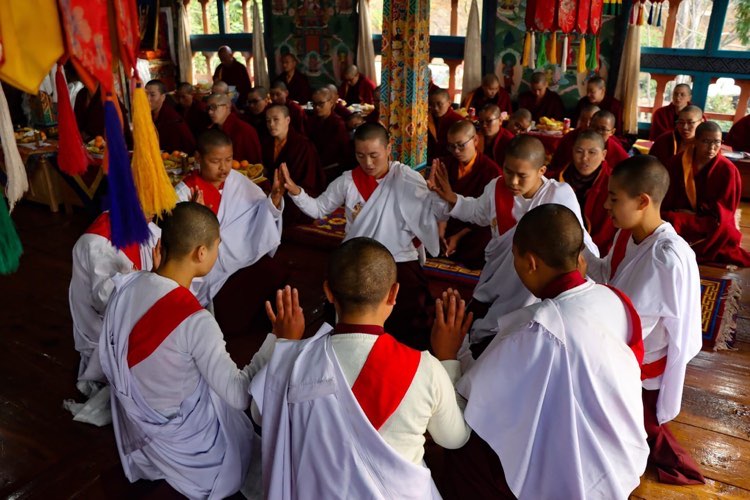
Milarepa composed “A Song of Meaningful Connection” for his sister Peta and his former betrothed Zessay in appreciation of the nourishment they provided him during life-threatening retreat conditions. He sang this song of interdependence as he redoubled his efforts at meditation. The nuns sing the song while performing a circle dance, which consists of gestures and postures describing the narrative. They wear their maroon monastic robes, over which a white shawl is draped ─ suggestive of the “repa” in Milarepa’s name, meaning “cotton-clad” in Tibetan. This refers to the thin, cotton cloth Milarepa and other yogis wore (and still do) as they pursued their yogic practices. In fact, all the nuns perform this dance as a sadhana once a week on Friday evenings. And they sing selections from Milarepa’s gurma every day after completing their daily Tara Puja in the temple. Then, without announcement, the pamo dancers burst into singing “A Song of Meaningful Connection.” I was awestruck by the power and beauty of their resonant voices.
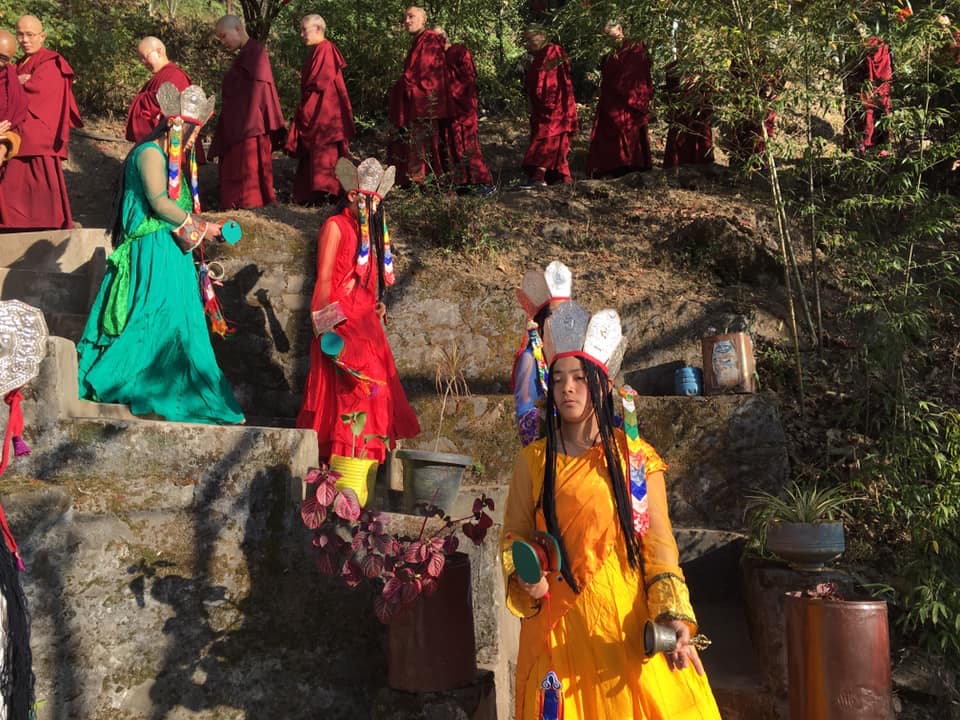
Chophal Palmo went on to tell me that in 2018, while the nuns were in the capital city of Thimphu attending a three-month transmission of the Kangyur (Tibetan Buddhist canonical collection of the Buddha’s teachings), five Karma Drubdey nuns were asked to perform the “Khandro Denga Cham” (Cham of the Five Dakinis) for a longevity prayer for the Je Khenpo (title for the senior-most religious hierarch of Bhutan). Monks from the state-affiliated Central Monastic Body of Bhutan taught the dance to the nuns for the occasion. This was another ground shifting moment, given that religious events in Bhutan have traditionally exhibited a distinctly masculine presentation. Who knows what other shifts in practice and thinking will follow? Back at their nunnery, the nuns now perform this cham along with the Milarepa Dance as a welcome offering when nuns come out of retreat.
Kyegue Dhagmo Chosling Nunnery
In April of 2024, I arrived in Sikkim at Palchen Choling Monastery (also known as Ralang Monastery) for their seven-and-a half day Tsechu Puja. I came early. In fact, the only other arrivals at that point were thirteen nuns from the nearby, sibling institution Kyegue Dhagmo Chosling Nunnery. They were there to rehearse the two cham they would be performing for the puja finale ─ the day-long “Tsechu Cham.” Palchen Choling Monastery, belonging to the Karma Kagyu order of Himalayan Buddhism, is home to some 200 monks. The beautiful structure, completed in 1995, was undertaken by the 12th Gyaltsab Rinpoche (b. 1954), an incarnate lama and regent of the Karmapas. The monastery holds a Tsechu Puja with its grand display of cham every other year, alternating with Rumtek Monastery.
I found the thirteen nuns in a small entrance hall rehearsing. The scene was abuzz with wall-to-wall activity as they reviewed the cham movements with senior monk dancer Karma Tshering. There were smiles and occasional outbursts of laughter as the nuns, in successive groups of three, demonstrated a section of the dance for their teacher and worked to integrate his corrections and clarifications.
Kyegue Dhagmo Chosling Nunnery, located just sixteen kilometers from the monastery, is also under the supervision of H.E. Gyaltsab Rinpoche and home to some eighty nuns from age five to eighty. The nunnery (a very modest facility) offers instruction in philosophy as well as ritual performance. My contact at the nunnery, Jamyang (Jambey) Tsomo Dagmo, had become a nun at age fifteen at her own request. She had been one of the original Kadrinchenma dancers at the 2014 Monlam but had since transitioned to the role of umzey, both for the cham and for the nunnery. At age 29, she functioned in a leadership role within the nunnery, also serving as the nunnery driver. During the period prior to the official start of the Tsechu Puja, Umzey Jambey was responsible for shuttling all eighty nuns to the monastery, where they stayed for the duration.
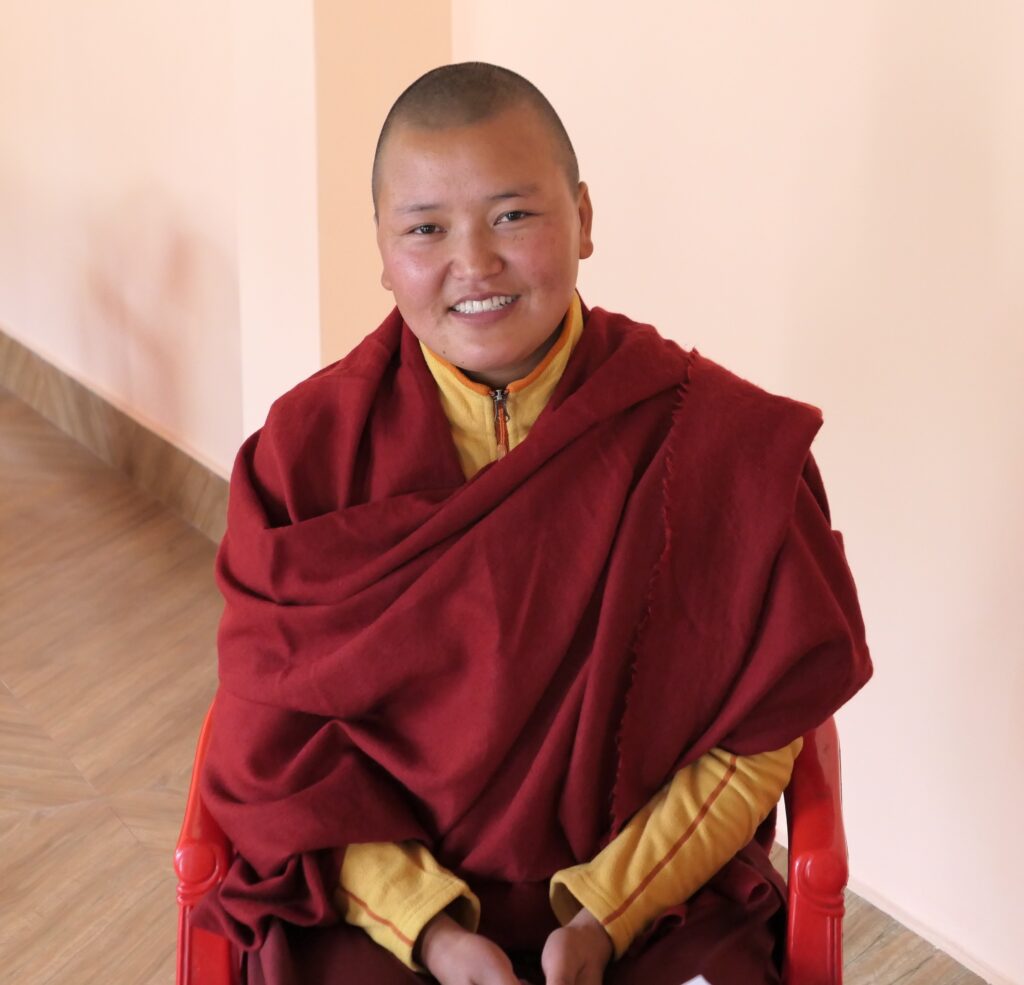
After a week of puja and a palpable build-up of excitement, the final Tsechu day started at 6:00AM with a day-long schedule of sacred dances performed in full costume with masks. The anticipated main event, “Guru Tshengye Cham” (Dance of the Eight Manifestations of the Guru), unfolded throughout the afternoon. Horn players heralded the magnificent procession, replete with an entourage of parasol and standard bearers, followed by monks and nuns costumed as celestial beings, including the Guru’s eight manifestations. They circled the courtyard in a vision of royal splendor ─ Guru Padmasambhava represented by a large, dramatic float on wheels. Once the procession was completed, the heavenly guests took their seats around the perimeter and a series of offering dances to the Guru proceeded.
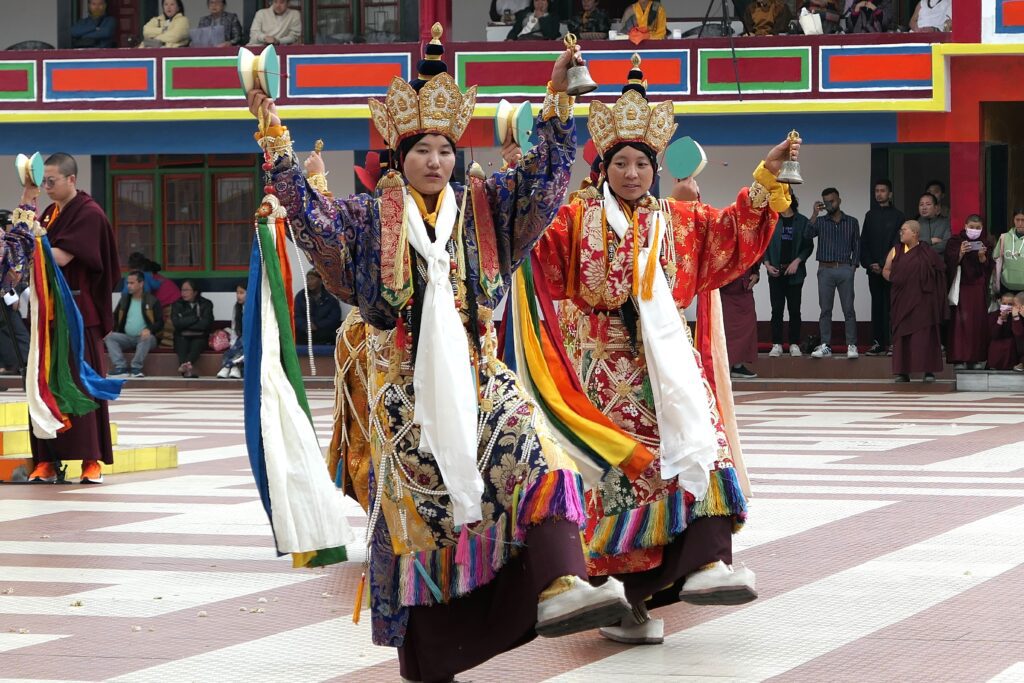
Then, I finally saw what I had been seeking: nuns empowered to perform the cham they were meant to dance. With grace and confidence, the eight Kyegue Dhagmo Chosling nuns that I had seen in rehearsal were now transformed into exquisite offering goddesses. Wearing crowns and silk brocade costumes covered in delicate bone ornaments, they gathered to face Guru Rinpoche and perform “Kadrinchenma Cham.” The danced movements of serene control merged with the pure strains sung by Umzey Jambey, forming a sublime and unified expression.
Moving with spacious awareness, the dancers slowly pivoted on one leg while lifting the other. Then they stepped into another balance lifting the other leg ─ all while sounding their hand implements. Each verse ended as they inclined their torsos forward, draping the colored streamers of the damaru across their uplifted arms while taking three steps backward in a reverent gesture of offering.
Following another cham, a separate group of five nuns, dressed in silk robes in saturated hues of the five dakini colors (white, yellow, red, green, and blue), formed a tight circle opposite Guru Rinpoche to perform “Pamo Cham.” They huddled together singing in clear tones, “I bow down to the body, speech, and mind of the Supreme Lama.” The pamo then spread out into a semicircular formation facing Guru Padmasambhava. Bearing large hand-drums and hooked drumsticks, they performed a sequence of slow stepping, side-bending, and turning movements while beating the drum on each move. With every drumbeat, they flipped the drum toward a different angle ─ making a sound offering to all directions.
Returning to huddle and chant the next verse, the pamo placed the rim of their drums on the tops of their boots and rapped the wooden rim with their sticks. After chanting the verse, they fanned out to repeat the dance. The liturgy gives a description of the iconography of Guru Padmasambhava: “Your right hand holds a five-pronged vajra. This signifies the spontaneously present five kayas [aspects or states of buddhahood] within you. Your left hand holds a kapala [skull cup] filled with amrita. This signifies the great bliss that is present unceasingly within you. Your leg holds a vajra position. This signifies that you are beyond birth and death.”
Once the final verse was sung, the pamo uncoiled their circle and formed a line to exit. Pivoting toward each direction, they continued to drum with each departing step. Upon her exit, each pamo turned back to bow to the Guru, still beating out her full-hearted offering of body, speech, and mind.
The pamos’ offering was followed by solos performed by each of the Guru’s eight manifestations. At the conclusion, all but the Kadrinchenma goddesses made another grand procession before exiting into the temple.
The eight Kadrinchenma dancers remained standing in place, showering splendorous sound on the scene with their damarus and bells until everyone had exited. Recalling the tearful scene at the Guru’s final departure from Tibet, they ceremonially followed behind and assumed a semi-circular formation facing the Guru float as it disappeared inside the temple. Their poignant reprise of “Kadrinchenma Cham,” was accompanied by a new set of lyrics, supplicating Padmasambhava to grace everyone with his reassuring presence again and again. Moving their formation toward the temple, they continued the dance as one-by-one or two-by-two, they gradually disappeared.
And with that, the dance and the grand spectacle dissolved into emptiness.
Promoting Nuns as Empowered Leaders
Although only one nunnery from the original group of three continues to perform these cham, their public display ushered in many new “firsts” for these and other female monastics.
The Thrangu dancers are at the vanguard of nuns making inroads into higher education with Sherab Sangmo teaching philosophy in the shedra and Karma Dolma Gurung and Jamyang Lhamo now completing their master’s degrees. The university students, already teaching undergraduate courses, are setting an inspirational precedent for others and will assume roles of leadership because of their achievements.
The Karma Drubdey nuns received another cham performance invitation from the highest echelon of religious authority in Bhutan and have integrated the experience into a regular practice to celebrate the nuns’ accomplishments.
The Kyegue Dhagmo Chosling nuns continue to perform the two dakini cham at Palchen Choling’s Tsechu Puja reminding all that female practitioners are essential to the pure vision of an integrated community with shared responsibilities and visibility. They have taught the cham to more nuns to fulfill this ongoing responsibility.
Meanwhile, Umzey Jambey has received opportunities to develop her skills as a fully recognized chant master within the greater Karma Kagyu community ─ recently leading an entire monlam for the Germany sangha on her own.
It appears that liberating female practitioners to perform cham has set more than a dance into motion. It has opened minds to promoting nuns as empowered leaders so they can fulfill their potential and benefit many beings in the process.